
Multi-threading a deal on LinkedIn means being known to several people in the buying group before you pitch. A Factors.ai report published on 23 September 2026 found that accounts with six or more contacts engaged before a deal was created had a 17.1 percentage-point higher win rate than accounts where only one contact was engaged.
For most sellers, the fastest place to find those extra contacts is the network they already have. Reach is a LinkedIn outreach tool that works through your own browser session. It imports your connections from LinkedIn's data export and scores each person against a target audience you write down, giving a fit score, a reason and a suggested angle. This post covers what the new data says, why so many sellers end up with one contact per account, and how to find the others without spamming anyone.
What did the Factors.ai LinkedIn report find about buying groups?
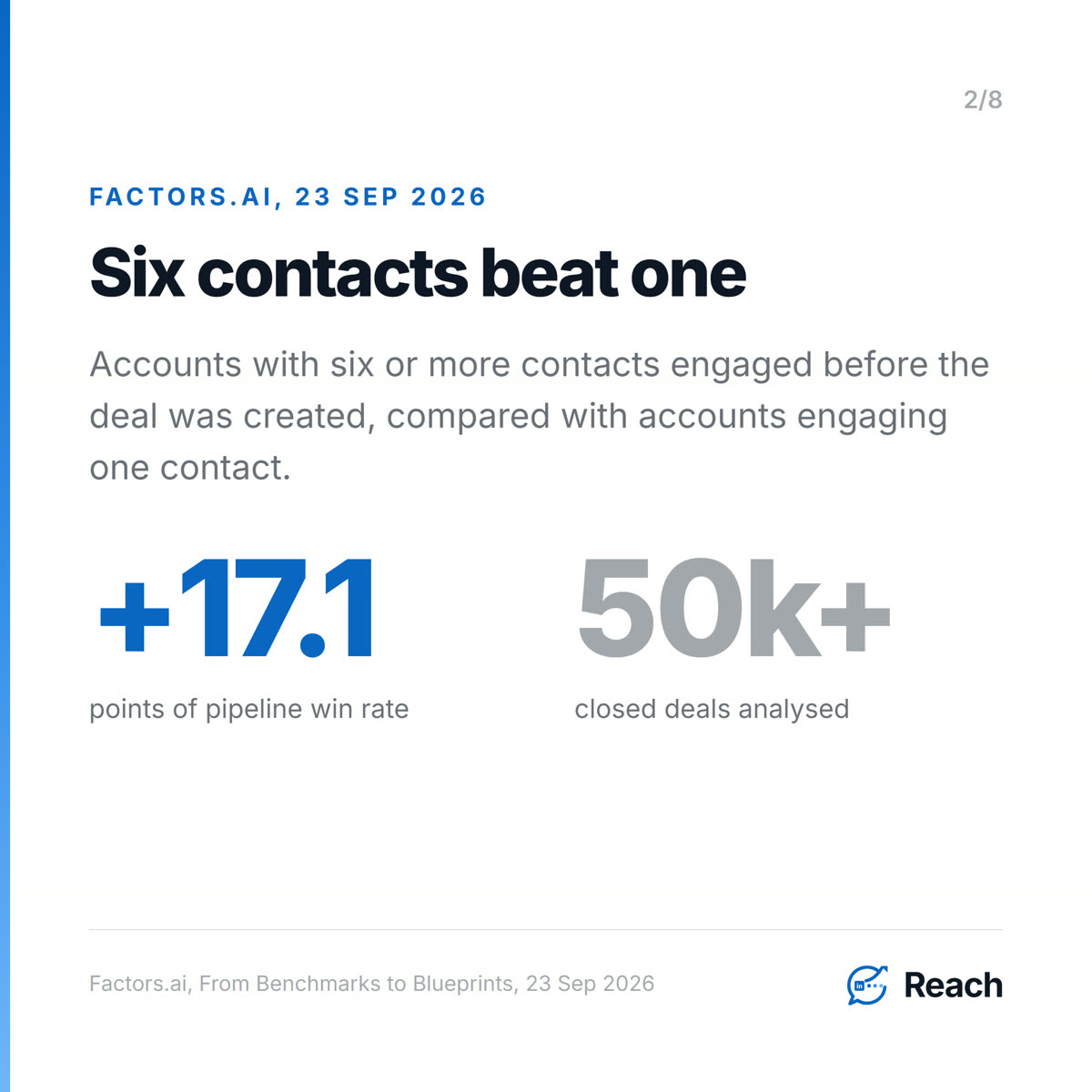
The report says deals are more likely to close when more of the buying group is engaged, and when that starts early. Factors.ai published From Benchmarks to Blueprints: The LinkedIn Revenue Engine for B2B on 23 September 2026. It covers more than 50,000 closed deals and over $150 million in LinkedIn ad spend. The figures below come from its press release:
- Accounts with six or more contacts engaged before the deal was created had a 17.1 percentage-point higher pipeline win rate than accounts engaging one contact.
- Deals involving an end user, an influencer and a technical evaluator showed a 22-point lift, the strongest role-based result in the analysis.
- Accounts going dark, buying groups failing to decide, and teams losing access to the right decision-maker made up 27.1% of documented lost deal value.
- Sustained engagement on LinkedIn began 124 days before a deal was created.
LinkedIn shared the findings to marketers the next day. In its words, engaging "another 3 or more contacts during the active cycle lifts win rates by 16 points". It also noted that 76% of LinkedIn ad spend targets director-level roles.
Two caveats. The report measures correlation ("associated with higher win rates"), so it doesn't show that adding contacts causes the lift. And it is built on ad-driven accounts. The pattern is still useful for anyone selling on LinkedIn without an ad budget, because the buying group is the same.
Why do most LinkedIn sellers end up single-threaded?
Most sellers are single-threaded because they find people one at a time, and the one they find is usually the most senior person they know. The 76% figure shows the same habit in ad spend. Everyone aims at the director.
We checked our own account before writing this. Reach had judged 1,094 people in our network as qualified. We took the 200 best fits. 190 of them list a company, and those 190 work at 188 different companies. So in our best list, nearly every account had exactly one person on it. Nothing was broken, and each of those people was a reasonable fit. We had simply never asked who else we knew at the same companies.
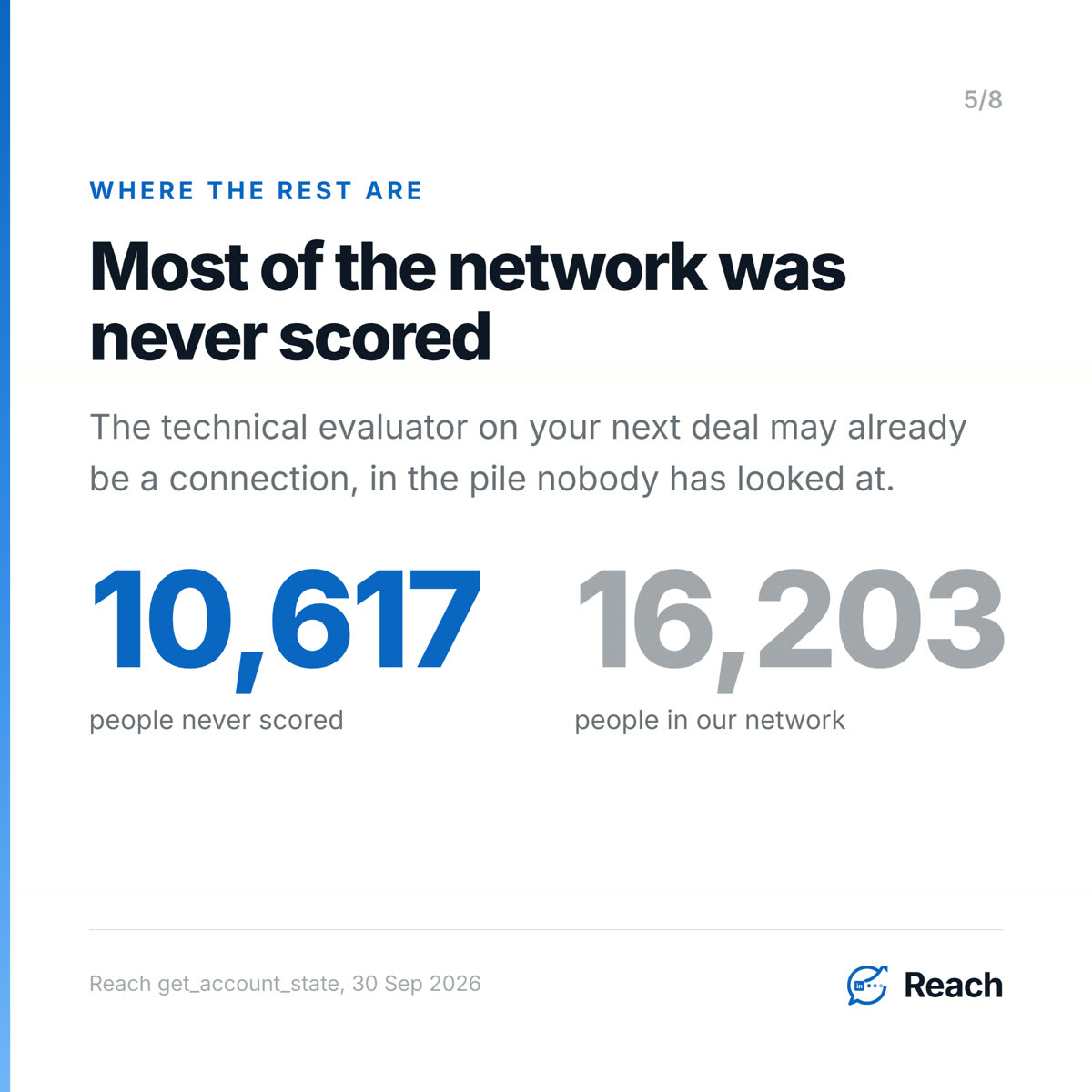
The data also shows where the gap is. Our network holds 16,203 people and 10,617 of them have never been scored at all. The colleague who would be the technical evaluator on a deal may already be a connection, sitting in the unscored pile.
How do you multi-thread a deal on LinkedIn without spamming the account?
You multi-thread by being known to more people at the account, and that does not mean pitching all of them. Six people at one company receiving the same connection note in the same week reads as a campaign, and they will compare notes. A workable sequence:
- Start with people you already know there. A past conversation, a shared project, an old reply. These are the cheapest threads to open again.
- Map the roles the deal needs. The report's strongest result came from covering the end user, the influencer and the technical evaluator. Titles like "Head of Production" or "Senior Engineer" can matter as much as "CEO".
- Engage before you ask. Comment on their posts, send one useful thing, answer a question they asked. That is the early engagement the 124-day figure is pointing at.
- Keep one sales conversation per account. Everyone else hears from you as a person, not a sequence. When the deal moves, you are already known to the people who get pulled in.
- Stop when someone answers. A reply from anyone at the account is the signal to talk, not to send the next scheduled touch.
For finding the people in the first place, we wrote a longer guide on finding leads in your existing LinkedIn network. For the ask itself, see how to get a warm introduction on LinkedIn.
How does Reach help you find the rest of the buying group?
Reach scores your whole imported network against a written target audience, so the second and third people at an account show up next to the first. Here is how that works in practice.
Import the network you already have. Download your LinkedIn data export and bring it into Reach. Connections and message history come in together, so you can see who you have actually spoken to.
Write the target audience around the buying group, not one title. Target audiences in Reach are versioned and written in plain language. Instead of "CEOs at 20 to 200 person manufacturers", describe the roles a deal needs: the owner who signs, the operations lead who lives with the problem, the engineer who will evaluate it. You can keep a separate audience per product.
Let qualification judge everyone, not just the obvious names. Each person gets a fit score, a reason and a pitch angle. The reason matters here. A reason like "Head of production at a 40-person machine shop, owns the scheduling problem" (an example, not a real person) tells you which role this person plays in the buying group.
Look at the scored list company by company. Search the qualified people by company name and you see who else you know there, with their scores and fit reasons next to each other. That is the multi-threading map, built from your existing connections.
Qualification narrows the list, and you still decide who to talk to. Nothing sends without an approval step you control. You can see how it works at reach.linkenite.com. For why the judging step matters more than the sending step, read why AI sales tools don't work.
Common questions
What is multi-threading in B2B sales?
Multi-threading means building relationships with several people in a customer's buying group instead of depending on one contact. If your one contact leaves, goes quiet or loses the internal argument, a single-threaded deal stalls. Factors.ai found that going dark, stalled buying groups and lost access to the decision-maker made up 27.1% of documented lost deal value.
How many contacts should you engage per account?
The Factors.ai data points to six or more before a deal is created, and three or more further contacts during the active cycle. Treat those as benchmarks from ad-driven accounts, not rules. Covering the right roles, especially the end user and the technical evaluator, showed a bigger lift (22 points) than the six-contact count (17.1 points).
Is it spam to message several people at the same company on LinkedIn?
It is spam when they all get the same pitch in the same week. It is normal selling when each person hears from you for a reason that is about them, and only one of them is in an active sales conversation. Engagement like a comment or a useful link counts as a thread.
Can I find the buying group without Sales Navigator?
Yes, if the people are already in your network. Export your LinkedIn data, import it into a tool that can score it against the roles you need, and look at the results by company. Your first-degree connections at an account are often more than you remember.
Does Reach contact the other people at the account automatically?
No. Reach finds and scores them. What gets sent, and to whom, goes through an approval step you control, and the LinkedIn work happens in your own browser session.
Sources
Trend (opened and read, 2026-09-30)
- Factors.ai press release, "B2B Buying Starts 124 Days Before the CRM Sees a Deal, New Factors.ai Report Finds" - Business Wire, WILMINGTON, Del., 23 Sep 2026. Business Wire itself returned 403 to the fetcher, so the full text was read on the Yahoo Finance Canada mirror (marked "This is a paid press release"): https://ca.finance.yahoo.com/news/b2b-buying-starts-124-days-174800037.html Original: https://www.businesswire.com/news/home/20260923140061/en/B2B-Buying-Starts-124-Days-Before-the-CRM-Sees-a-Deal-New-Factors.ai-Report-Finds Opened in the in-app browser, page text searched. Quoted verbatim:
- "Accounts with six or more contacts engaged before deal creation recorded a 17.1 percentage-point lift in pipeline win rate compared with accounts engaging one contact."
- "Deals involving an end user, influencer and technical evaluator recorded a 22-point lift, the strongest role-based result in the analysis."
- "Accounts going dark, buying groups failing to reach a decision and teams losing access to the right decision-maker represented 27.1% of documented lost deal value."
- "sustained engagement on LinkedIn begins 124 days before a deal is created."
- "Engaging more of the buying group was associated with higher win rates." (correlation, stated as such in the blog)
- "Based on the analysis of over $150 million in ad spend"
- Report landing page (opened): https://www.factors.ai/lp/benchmarks-to-blueprints-linkedin-report - "50,000 closed deals", "100+ B2B companies", "Reaching 6+ contacts before a deal opens lifts win rates by 17 points."
- Social Media Today, "LinkedIn shares insights into key B2B buying behaviors", Andrew Hutchinson, 24 Sep 2026 (opened in-browser, full article text read): https://www.socialmediatoday.com/news/linkedin-shares-insights-into-key-b2b-buying-behaviors/831324/
- Quoting LinkedIn: "Engaging another 3 or more contacts during the active cycle lifts win rates by 16 points."
- "76% of LinkedIn ad spend targets director-level roles"
- NOT used: SMT's "2.4x higher win rates" for paid + organic, because the Factors.ai release states the same comparison as "10.8 percentage points above the baseline". The two disagree, so neither went in.
First-party (Reach MCP, run 2026-09-30)
search_peoplequalified=true, limit 200: totalMatching 1,094. Of the 200 best-fitting, 190 list a company, across 188 distinct companies (2 companies had two people each). No company named anywhere in the output.get_account_state: pipeline total 16,203, unjudged 10,617, qualified 1,093 (the one-person difference from search_people is timing between calls - the blog uses 1,094 from the search that the 200/188 figure comes from).list_accounts: empty, so the account/site feature was NOT featured.
Feature (shipped)
- Lead qualification against a written, versioned target audience: fit score, reason, pitch angle. Reach repo
docs/STATE-OF-THE-SYSTEM.mdon master (df2bbf0), section "Lead qualification". Network import from the LinkedIn data export (connections and messages) is the existing shipped import path.


.png)
.png)
.png)
.png)
.png)
.png)
.png)
.png)
.png)
.png)
.png)
.png)

.png)
.png)
.png)
.png)


.png)
.png)

.png)


.jpg)

.jpg)
.jpg)


.png)


.png)

.png)
.png)
.png)


.png)
%20(2).png)
.png)
.png)




.png)

.png)


.png)


.png)


.png)


%20BLOG%20BANNER.png)


.png)