
AI sales tools don't work for most teams because the model has no context about your business, your customers or the conversations you have already had, so it writes outreach that any competitor could have produced from the same three prompts. The fix is not a better model. It is pointing the AI at data you already own - your existing network, your message history, and a written definition of who you actually sell to.
Reach is a LinkedIn tool that runs in your own browser, on your own LinkedIn session, and reads your existing connections and message history so an AI can work from your relationships instead of a bought list.
Why don't AI sales tools work?
Because the most popular thing to point AI at in sales is also the lowest-impact thing you can point it at.
On 16 September 2026, at HubSpot's UNBOUND conference, CEO Yamini Rangan put a number on the gap. Of the companies HubSpot surveyed, 90% are using AI and only 6% are seeing transformational results. Forbes reported the keynote the same day.
The interesting part was not the size of the gap. It was the shape of it. HubSpot tracked around fifty AI use cases across marketing, sales and service, then plotted each one by how popular it is against how much impact it drives. Rangan's summary of that chart: "We get this beautiful slope moving in the exact wrong direction, away from impact." The popular uses - producing content, sending emails, prepping for meetings - scored low on impact. The high-impact ones all depended on data specific to one company.
Then the line that should worry anyone running an AI SDR. "AI with bad context is worse than no AI," Rangan said. Not slower. Worse. A human quietly corrects for stale data without noticing. An AI writes confidently from it and sends.
What does "context" actually mean in sales?
Context is the part a model cannot infer from your website: who you actually sell to, who you already know, and what was said last time. Rangan's own definition covers brand and positioning, customer conversations and ideal customer profiles, and team roles and approvals.
For LinkedIn outreach it collapses into three questions a tool should be able to answer before it writes a single word.
- Have we spoken before, and about what?
- Does this person match the audience we decided to sell to, or do they just look plausible?
- Is there a reason for them to hear from me today that isn't "we have a quota"?
Most AI sales tools answer none of the three. They take a list, take a persona paragraph, and write. That is the low-impact end of the slope, and it is where almost everybody starts.
Where is the sales context you already own?
It is in your LinkedIn account, and you have probably never read it.
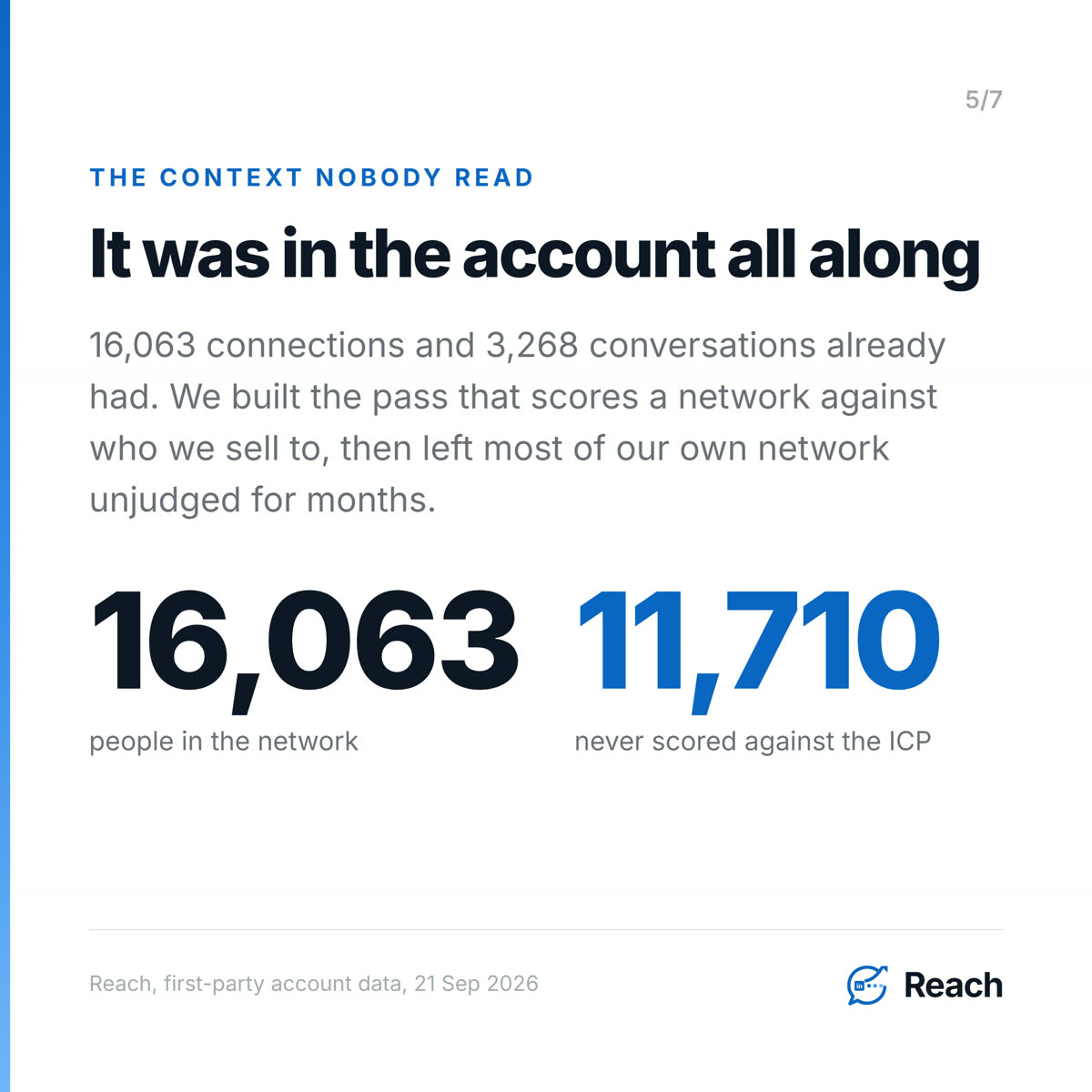
Here is what this account looked like on 21 September 2026. 16,063 connections. 3,268 conversation threads in the message history, and 1,979 of those are still waiting on a reply from us. And 11,710 people in that network have never once been scored against the target audience, because nobody asked the question.
That last number is the honest one. We built the qualification pass and then left most of our own network unjudged for months. The context was sitting there the whole time and we were not using it either.
One more number belongs next to those. Across the full history on this account, Reach sent 180 of 18,772 outbound messages. The rest were written by hand, by people. So the rates below describe what the account has done, not what the software achieved. Worth copying, not worth attributing.
- A small warm campaign to people already connected, researched one at a time: 28 replies from 37 contacted.
- The big templated corporate opener, the one starting "I hope you are doing well. We at Linkenite specialize in...": 137 replies from 839 contacted.
- A manufactured opener built to sound like curiosity, "here is a quick question, how many separate SaaS tools is your company paying for": 0 replies from 17 contacted.
Same sender, same product, same year. What changed is whether the message was aimed at someone with a reason to answer. The 37-person cohort is too small to prove a rate. The 0 from 17 is not ambiguous.
What does AI lead qualification against your ICP look like?
This is the part of Reach that runs before any writing happens.
You write down what you sell and who you sell it to. Reach stores that as a versioned target audience and product, so when you change your mind the change is dated and the old judgements stay attributable to the old definition. Then it reads the people already in your network - name, headline, company, and what the message history says about them - and scores each one against that definition, with the reason written out in plain language.
The output is not a list of everybody. It is a shorter list with an argument attached: this person fits because of X, and here is the angle. You can disagree with it, and disagreeing is the useful part, because that is how the definition gets sharper.
Nothing is sent at this stage. Qualification produces an opinion, not an action. Outreach still sits behind a human approval step, which is the other half of what the 6% do. Rangan's third point was that the companies getting value combine human judgement with AI rather than choosing between them.
What should AI do first in a sales process?
Read, not write.
The first job is to go through the people you already know and say which ones are worth a message this month. That is a high-impact use by HubSpot's own chart, because it cannot be done without your data. Writing the message is the last job, and it is the one everyone starts with.
For the practical version, we wrote up how to find leads in your existing LinkedIn network, and separately where LinkedIn lead data can legitimately come from now that buying it has become a legal problem.
Rangan's line was "It is your data. It is your context and, therefore, it is your advantage." On LinkedIn that is unusually literal. Nobody can buy your fifteen years of connections.
Common questions
Why do AI-written LinkedIn messages get ignored?
Usually because they are aimed at someone with no reason to answer, not because the writing is bad. A generic model writes a competent message to a stranger. A model with your message history writes to someone who already knows your name, about something that actually happened.
Is an AI SDR worth it?
It depends on what you feed it. HubSpot's 2026 research found 90% of surveyed companies using AI and 6% getting transformational results, and Rangan said outright that AI running on bad context performs worse than no AI. If your AI SDR works from a bought list and a persona paragraph, that is the 94%.
What data does AI need to qualify a lead properly?
A written definition of who you sell to, the person's role and company, and whatever history you have with them. The history is the piece most tools skip, and it is the piece that decides whether a message reads as outreach or as a continuation.
Can AI qualify leads from my existing LinkedIn connections?
Yes, and it is the cheapest context available to you. Reach scores your existing connections against your stated target audience and gives a reason for each one. It runs on your own browser session, so no password is shared and no list is bought.
Does lead qualification replace a CRM?
No. Qualification decides who is worth a conversation. A pipeline built from observed engagement tracks what happens after, and that is a different job.
Sources
Every URL below was opened this run. Figures that could not be traced to an opened document are not in the story.
Trend (opened in-browser, verbatim-verified 2026-09-21)
Forbes, John Koetsier, "Only 6% Of Companies Get Value From AI. Here's What They Do Differently" https://www.forbes.com/sites/johnkoetsier/2026/09/16/only-6-of-companies-get-value-from-ai-heres-what-they-do-differently/ Published Sep 16, 2026, 12:44pm EDT. Updated Sep 16, 2026, 02:20pm EDT. Reporting HubSpot CEO Yamini Rangan's keynote at HubSpot UNBOUND, Boston, the same morning (16 September 2026). WebFetch returned HTTP 403, so the page was opened in the browser pane and the text read directly, same workaround as the 2026-09-16, 2026-09-17 and 2026-09-18 stories.
Verbatim, load-bearing:
- "In her keynote this morning at UNBOUND,, CEO Yamini Rangan said 90% of the companies Hubspot surveyed are using AI. But only 6% are seeing transformational results."
- Rangan: "That's such a huge gap."
- "HubSpot tracked 50-some AI use cases across marketing, sales and customer service. The best performers run only four or five on average."
- "The things most people do with AI - producing content, sending emails, prepping for meetings - scored low on impact."
- Rangan: "We get this beautiful slope moving in the exact wrong direction, away from impact."
- "AI with poor data and minimal context does more harm than no AI at all, resulting in poorer business performance."
- Rangan: "AI with bad context is worse than no AI." / "Bad context is actually worse than having no AI at all."
- Rangan: "It is your data. It is your context and, therefore, it is your advantage."
- Rangan: "The magic is not within the models. It is actually within the context of your business."
- Rangan, on the third habit of the 6%: "They're actually combining the strengths of both."
- Rangan's definition of context: "dynamic knowledge about your company, your customers and your team" - brand, voice, products and positioning; customer conversations, ideal customer profiles and buying signals; team roles, goals, processes and approvals.
Not used: HubSpot's own product launches at the same event (Growth Context, the Breeze Assistant, the ChatGPT Ads integration), and the HubSpot uplift figures quoted in the piece ("nearly 2x more deals", "win 3x more deals", MQLs "more than 200%"). Those are a vendor's claims about its own customers, and the story does not need them.
First-party (Reach MCP against production, run 2026-09-21)
get_onboarding_status: workspace Linkenite,networkSize16,063,peopleToJudge11,710, 38 pieces of prepared work waiting on the owner (20 messages, 17 posts, 1 removal). Owner-decision text verbatim: "Nothing reaches anyone on LinkedIn until you decide on it."get_inbox:totalThreads3,268,totalNeedingReply1,979. Inbox sync 0.1h old and trustworthy. Connection graph last synced 239h ago and flagged not trustworthy, so 16,063 is a lower bound.get_resultscaveat verbatim: "Reach sent 180 of 18772 outbound messages in this history - the rest were sent by hand on LinkedIn. These results describe the ACCOUNT's outreach, not Reach's campaigns".get_resultsbyCampaign: "Reach - browser-first sellers (v2, sendable rows)", contacted 37, replied 28.get_resultsbyOpeningLine: "I hope you are doing well. We at Linkenite specialize in " contacted 839, replied 137. "Here is a quick question, how many separate SaaS tools is your company paying fo" contacted 17, replied 0.
Feature shown (shipped)
docs/STATE-OF-THE-SYSTEM.md, "Working product", line 13: "lead qualification against versioned target audiences and products". Human approval before sending is the same file's stated default. Nothing is claimed beyond those two things.
Internal links, all verified HTTP 200 this run
- https://reach.linkenite.com
- https://linkenite.com/blogs/2026-09-10-find-leads-in-your-existing-linkedin-network
- https://linkenite.com/blogs/2026-09-15-ai-sales-agent-human-in-the-loop
- https://linkenite.com/blogs/2026-09-16-how-to-track-linkedin-leads
- https://linkenite.com/blogs/2026-09-18-linkedin-lead-data-without-scraping
Team meeting, 2026-09-21 (Drive 1iWffht-92Ddh-hX1TtwlBSN1-E_zY_tG7C5wvXVUfXk)
Read for which feature the team is pushing, not quoted. The C-level campaign is in its nurturing stage with low response rates and two hot leads, and a 20-person influencer push returned one acceptance. Nothing from the meeting appears in the story, and no person or prospect named in it is identifiable in any published artifact.


.png)
.png)
.png)
.png)
.png)
.png)
.png)
.png)
.png)
.png)
.png)
.png)

.png)
.png)
.png)
.png)


.png)
.png)

.png)


.jpg)

.jpg)
.jpg)


.png)


.png)

.png)
.png)
.png)


.png)
%20(2).png)
.png)
.png)




.png)

.png)


.png)


.png)


.png)


%20BLOG%20BANNER.png)


.png)