
The LinkedIn algorithm works in two steps: a retrieval system reads the language in your profile and posts to decide whether your content is considered at all, then a ranking system uses engagement, yours and other people's, to decide where and to whom it is shown. To be seen you need clear words on your profile and in your posts, you need to be active on other people's posts, and you need to measure both.
That summary comes from a podcast episode published on 30 September 2026, and the rest of this guide explains each step, shows our own numbers, and covers how to check whether the algorithm is actually showing your work.
Reach is a LinkedIn tool from Linkenite that runs in your own browser, drafts posts for a person to approve, and reads your page analytics back from LinkedIn so you can see what was really shown.
What changed in the LinkedIn algorithm this autumn?
The most recent plain-language explanation is Trust Insights' unofficial LinkedIn algorithm guide, whose October version Katie Robbert and Christopher Penn discussed on their In-Ear Insights podcast on 30 September 2026. They update the guide about once a quarter.
Two caveats before using it. It is unofficial, so it is their reading of how LinkedIn behaves and not documentation from LinkedIn. And the episode gives no numbers for reach or posting frequency, so anyone quoting a precise "post at 9am for 3x reach" figure from it is inventing one.
What the episode does give is a clean model. LinkedIn runs two systems in sequence, and you have to get through the first before the second matters.
How does LinkedIn's retrieval system decide what gets considered?
The retrieval system decides whether your post is even a candidate, and it does that mostly from language. In the episode's words, "The retrieval system looks at language, particularly in your profile and some of the content that you post."
So the words on your profile do real work. If your headline says "Helping companies grow" and your posts are about LinkedIn outreach for small B2B teams, the system has very little to connect them. The practical advice from the episode is short. "Write a concise, keyword-rich headline." And, "Write your entire profile with human readers and both AI systems in mind."
For a seller that means the profile should name what you sell and who it is for, in the words a buyer would use. The posts should use the same words. A post that drifts into general motivation every other week is harder to place.
How does the LinkedIn ranking system decide who sees your post?
Once a post is a candidate, the ranking system decides where it appears and for whom, based on engagement. The hosts put it this way: "The ranking system decides based on your engagement, yours and others, where to show you."
Note the "yours" in that sentence. Your own activity counts, which matches their second piece of advice: "You need to be active with your content and engaging with others to be in the ranking system." Posting and leaving is half the job. Commenting on other people's posts, and replying to the comments on yours, is the other half.
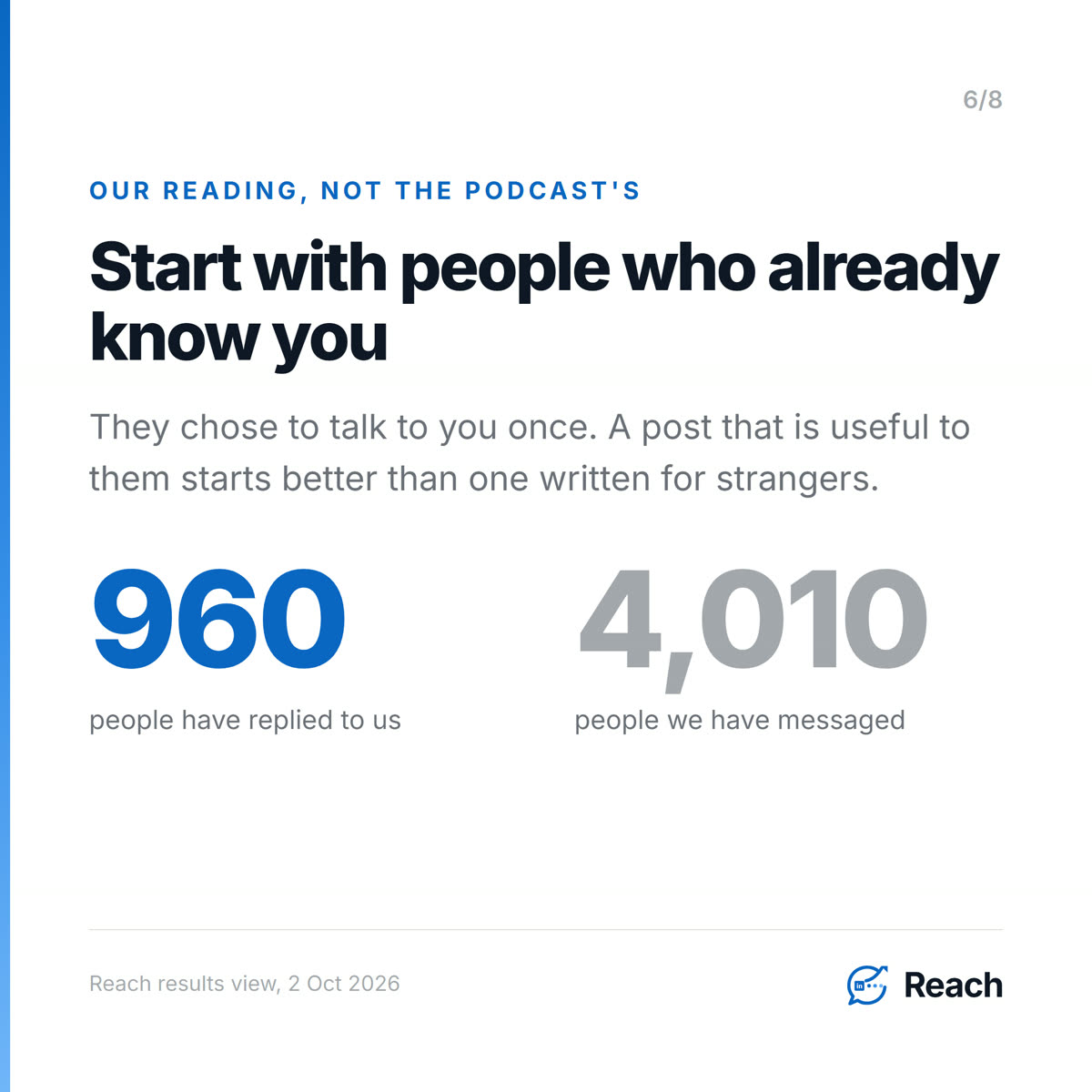
This is where the network you already have comes in. Our reading, not the podcast's: the people most likely to engage early are the people who already know you. On our own account, 960 of the 4,010 people we have messaged have replied at some point, according to Reach's results view on 2 October 2026. Those are people who already chose to talk to us once. A post that is useful to them has a better start than one written for strangers.
Does having more followers mean more reach on LinkedIn?
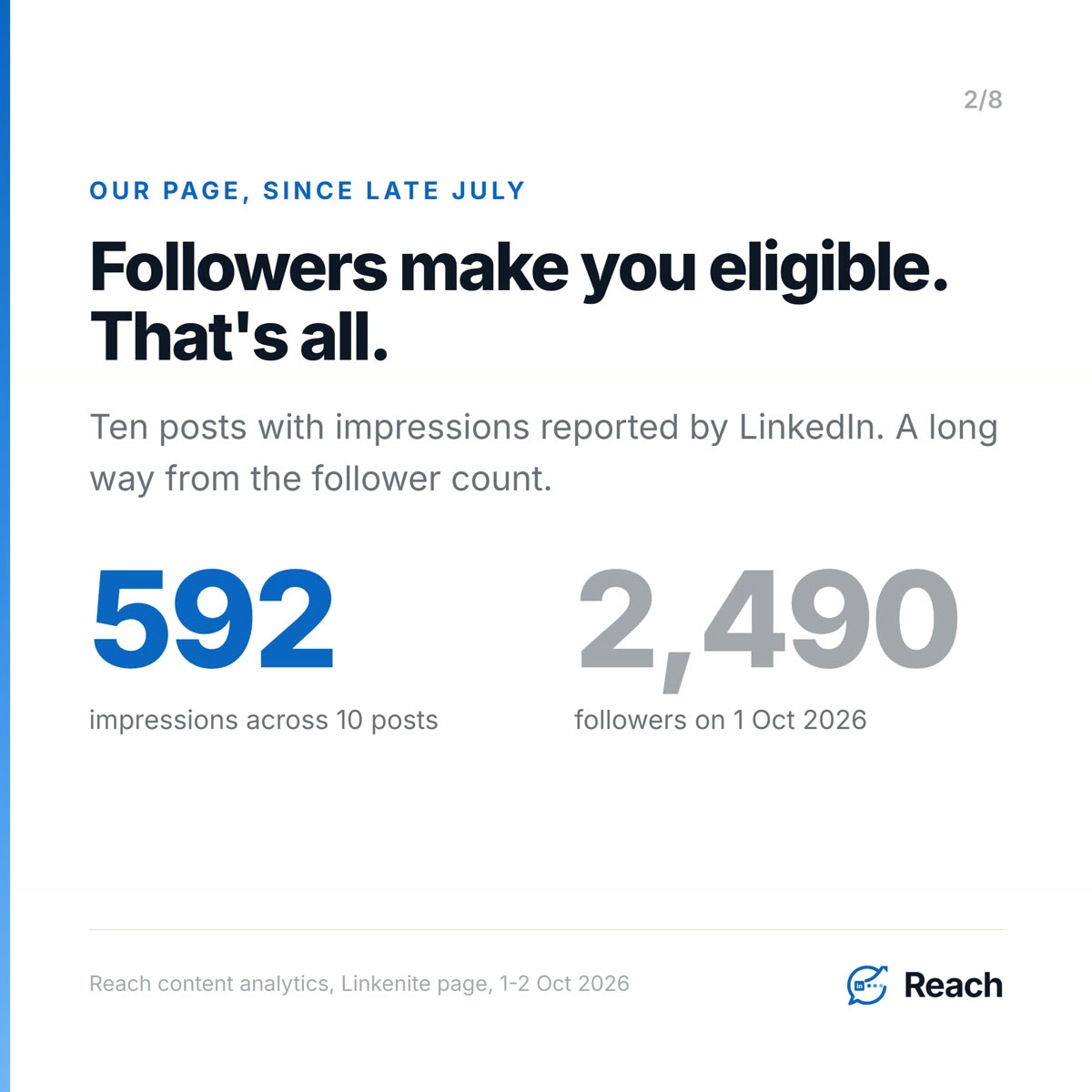
No. Followers make you eligible to be shown, and ranking still decides whether you are. Our own company page is a fair example, and it is a bit humbling.
The Linkenite page had 2,490 followers on 1 October 2026. Reach has 20 of its posts on record since late July, and LinkedIn reported impressions for 10 of them. Those 10 posts got between 21 and 105 impressions each, 592 in total. That is a long way from 2,490.
Being honest with ourselves, most of those were product videos with a slogan on top. They were relevant to us, and the numbers say they were not relevant enough to the people following us to earn more than a few dozen views. So we are working on posts the existing followers actually react to, which brings back the two systems: clear language to get considered, real engagement to get ranked.
How do you measure whether the algorithm is showing your posts?
You measure it with the two kinds of analytics LinkedIn already gives you. The episode names them: "your audience analytics and your content analytics." Audience analytics tell you whether your profile language is pulling in the right people. Content analytics tell you whether the ranking system is showing your posts, and to how many.
The trouble is that most people never look, or look at one post and guess. That is the part Reach handles in our own workflow.
- Drafting with sources. The agent drafts a post and has to point at what each claim comes from, so a post is grounded before anyone reads it.
- A person approves the exact words. The approval is tied to that exact text. If the words change after approval, it needs approving again. 24 post drafts are waiting for a human on our account right now, so this is not the fast way, and that is on purpose.
- A person presses Publish, in their own browser, on their own LinkedIn session. Reach never posts on its own.
- The numbers come back. Reach's browser-local sync reads impressions, clicks, reactions, comments and reposts for the pages you manage, which is where the 592 above came from. One limit we will state plainly: on our account it has reconciled 82 posts from the personal profile but has metrics for none of them yet, so for personal posts we still read the numbers on LinkedIn itself.
You can see how it works at reach.linkenite.com. If you write your drafts with AI, we covered what LinkedIn has said about that in does LinkedIn penalize AI-generated posts. And if you are deciding who to write for, warm outreach vs cold outreach has the numbers on why the people who already know you answer more.
A simple routine that fits both systems
The model turns into a short weekly routine. None of it needs a tool, and the tool only helps with the measuring.
- Rewrite your headline so it names what you sell and who buys it, in their words.
- Post on the same topic in the same words, about something your existing network would want to read.
- Spend time in other people's comments before and after you post, and reply to every comment on your own.
- Once a week, look at impressions per post, not followers. Keep the topics that got shown and drop the ones that did not.
Common questions
Is the Trust Insights LinkedIn algorithm guide official?
No. It is an unofficial guide that Trust Insights updates about once a quarter, and the October 2026 version was discussed on their podcast on 30 September 2026. Treat it as a well-informed model and check it against your own analytics.
Does posting more often beat the LinkedIn algorithm?
The episode does not give a posting frequency or any number for it. What it says is that you need to be active with your own content and engaging with others to be in the ranking system, so regular posting plus real engagement matters more than volume alone.
What should I put in my LinkedIn profile for the algorithm?
A clean professional photo and "a concise, keyword-rich headline", in the episode's words, plus a profile written for human readers and AI systems at the same time. For a seller, that means naming the product, the buyer and the problem in plain words.
Why do my LinkedIn posts get so few impressions when I have thousands of followers?
Followers make you eligible to be shown, and the ranking system still decides by engagement. Our own page has 2,490 followers and its 10 measured posts got 21 to 105 impressions each, so this is common.
How do I know if the LinkedIn algorithm is showing my posts?
Check impressions in your content analytics, post by post, and compare topics over a few weeks. Reach reads those numbers back for pages you manage, and LinkedIn shows them to you directly for personal posts.
Sources
Trend (opened and read, 2 October 2026)
- Trust Insights, "In-Ear Insights: LinkedIn Algorithm Updates October 2026", podcast episode with Katie Robbert and Christopher S. Penn, published 30 September 2026. https://www.trustinsights.ai/blog/2026/09/in-ear-insights-linkedin-algorithm-updates-october-2026/ Quoted verbatim from the episode page:
- "The retrieval system looks at language, particularly in your profile and some of the content that you post."
- "The ranking system decides based on your engagement, yours and others, where to show you."
- "You need to be active with your content and engaging with others to be in the ranking system."
- "Write a concise, keyword-rich headline."
- "Write your entire profile with human readers and both AI systems in mind."
- "your audience analytics and your content analytics."
- The guide is unofficial and updated about once a quarter. The episode gives no figures for reach or posting frequency, so none are quoted.
First-party (Reach account data for Linkenite, read 2 October 2026)
- Linkenite company page: 2,490 followers (snapshot of 1 October 2026). 20 posts on record since 28 July 2026, LinkedIn reported impressions for 10 of them, 592 impressions in total, 21 to 105 per post (average 59).
- Personal profile: 82 posts reconciled from LinkedIn history, metrics present for none of them yet.
- Results view: 4,010 people messaged from this account, 960 of them have replied. Most of those messages were sent by hand on LinkedIn, so this describes the account and not a Reach campaign.
- Approval queue: 24 post drafts waiting for a human decision.
Feature shown (shipped)
- Content drafting with sources, approval bound to the exact approved text, a person presses Publish in their own browser, and browser-local analytics sync for managed pages. Described at https://reach.linkenite.com/


.png)
.png)
.png)
.png)
.png)
.png)
.png)
.png)
.png)
.png)
.png)
.png)

.png)
.png)
.png)
.png)


.png)
.png)

.png)


.jpg)

.jpg)
.jpg)


.png)


.png)

.png)
.png)
.png)


.png)
%20(2).png)
.png)
.png)




.png)

.png)


.png)


.png)


.png)


%20BLOG%20BANNER.png)


.png)