
LinkedIn does not penalize a post just because AI helped write it, but it does cut the reach of content it classes as AI slop, and it says that content is now seeing 40% fewer views. What decides whether an AI-generated post gets penalized is whether it has substance behind it and a human who stands behind it.
That answer comes from LinkedIn itself, and it got sharper this week. On 23 September 2026 LinkedIn announced new tools against fake profiles and invented work histories. In the TechCrunch interview about the launch, LinkedIn VP of Product Oscar Rodriguez put the whole direction in one line: "faking credibility has never been cheaper or easier than it is today; and conversely, showcasing credibility has never mattered more." A post written by a model and published unread is one of the cheapest ways there is to fake credibility.
Reach is a LinkedIn tool that runs in your own browser on your own logged-in session. It drafts posts from sources you can point to, holds every draft until a human approves the exact text, and reads the real impressions and reactions back from LinkedIn after the post goes out. The agent never presses Publish. A person does.
Does LinkedIn penalize AI-generated posts?
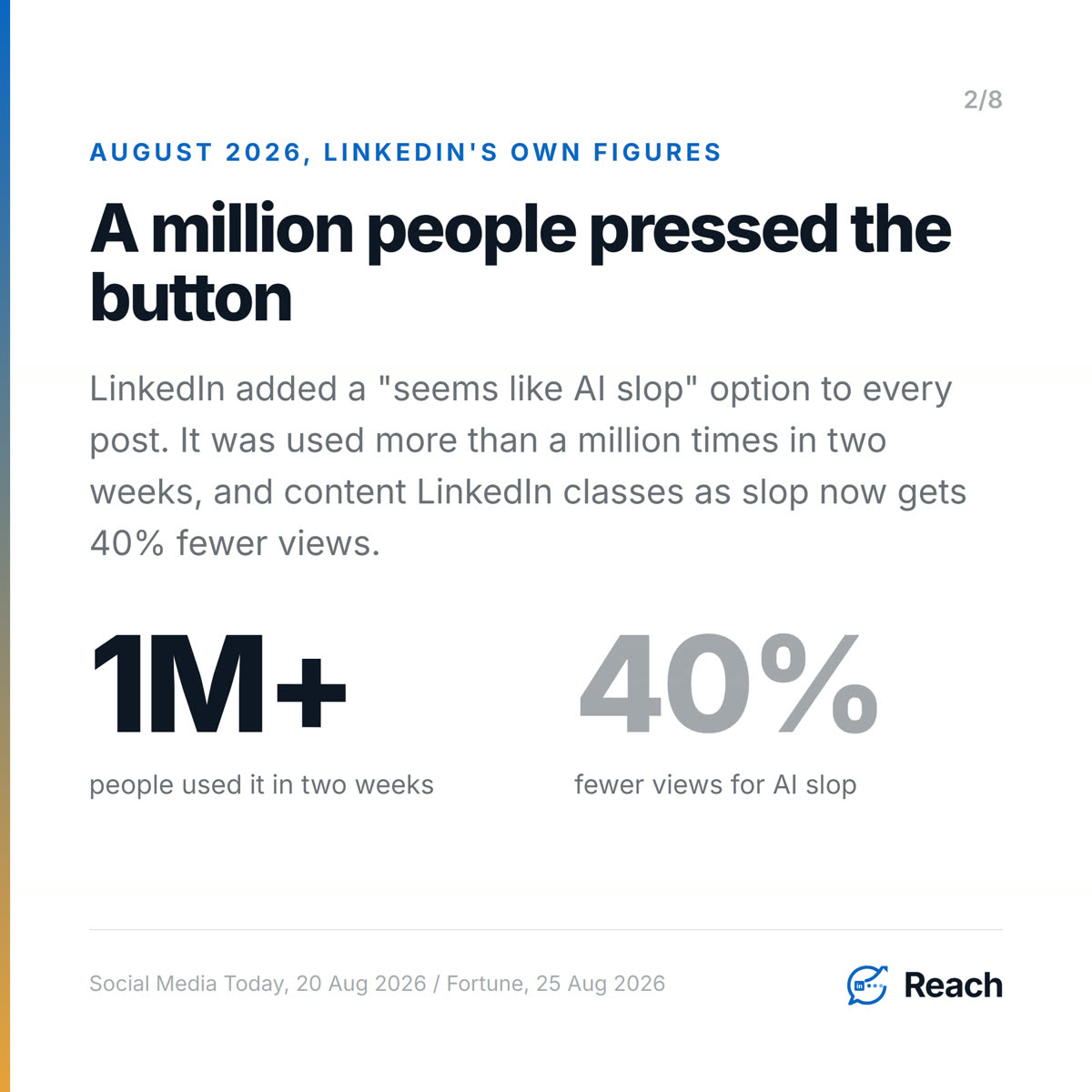
LinkedIn goes after AI slop. AI assistance on its own is allowed. When LinkedIn reported the first results of its "seems like AI slop" button in August, it said the option is not designed to target all use of AI in post creation, and that using AI to refine your language is fine, according to Social Media Today's report on 20 August 2026.
What it does target is described in the same report as content that is polished in its presentation but lacks substance. LinkedIn's Chief Product Officer Hari Srinivasan said more than a million people used the button in its first two weeks. Social Media Today reported that content LinkedIn defines as AI slop is now seeing 40% fewer views.
Two details matter if you post. First, one report does not bury a post. LinkedIn said a single report only changes what that member sees, and that "no single piece of feedback determines how content is distributed on the platform." Second, the judge is meant to be people rather than a detector. Srinivasan said LinkedIn wants "feedback from real humans on what sounds authentic, not just have an AI detector review it and get it wrong."
So the practical test is simple. Would a person who knows you read the post and think you wrote it and meant it?
Why does credibility matter more on LinkedIn now?
Because LinkedIn is now paying for it in distribution. In the same 23 September interview, Rodriguez said verified members "receive, on average, 50% more post views than non-verified profiles, and they get 90% more impressions as well." He also said LinkedIn's verification tools have now been used to verify 115 million users and over 700,000 companies.
Put the two announcements next to each other and the signal is consistent. Proof that you are a real person with a real history goes up. Polished text with nothing behind it goes down. LinkedIn is measuring the same thing both ways.
The scale of the problem explains why. The AI detection company Pangram found, as reported by Fortune on 25 August 2026, that more than 40% of LinkedIn's long-form posts were flagged as completely AI-generated. When close to half the feed reads the same, the posts that carry a real name, a real number and a real source are the ones that stand out.
Can you use AI to write LinkedIn posts without it reading as slop?
Yes, if the AI drafts and you decide. The failure is almost never that a model touched the text. It happens when nobody checks what the post claims, where the claim came from, or whether it sounds like the person whose name is on it.
In practice that means four checks before anything is published, and none of them can be done by the model on its own:
- Every specific claim traces to something you can open, a report, your own numbers, a conversation you actually had.
- The post says one thing you would defend if someone replied and disagreed.
- It sounds like you. Read it aloud. If it is smoother than the way you talk, it is not your voice yet.
- A human reads the final text, the exact text, and presses Publish.
The last check is the one most tools skip, because it is the one that slows things down. It is also the one LinkedIn is now rewarding.
How does Reach handle AI-drafted LinkedIn posts?
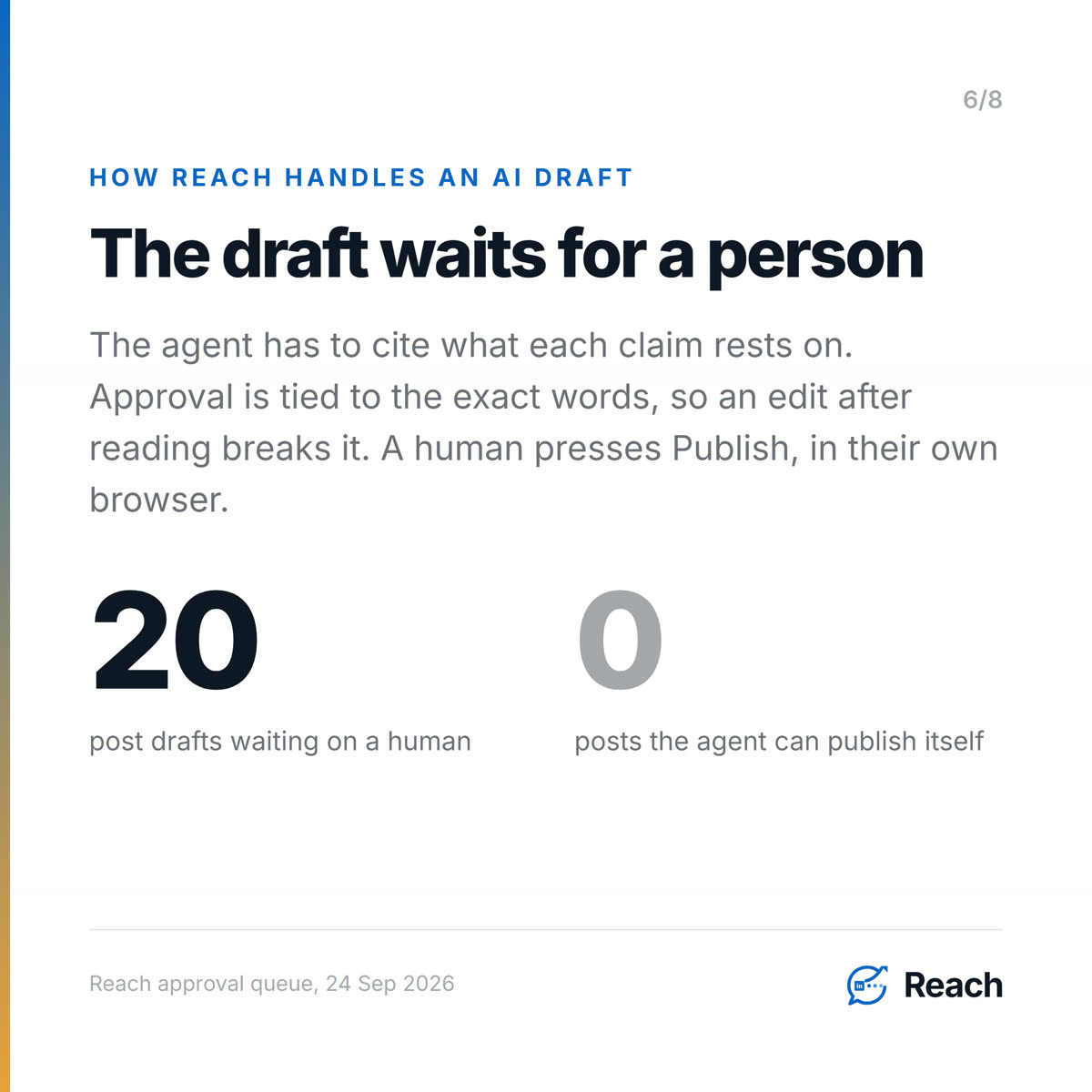
Reach treats a post draft as a proposal, and a proposal cannot publish itself. The agent writes the draft and has to cite what each specific claim rests on. The draft then waits in an approval queue. In this account there are 20 post drafts waiting on a human right now.
Approval is bound to the words. When a person opens a draft, Reach issues an approval receipt tied to that exact body of text. If anything edits the text after the human read it, the receipt no longer matches and the approval fails. An agent that never showed a human anything has no receipt to send. At publish time the browser extension fills LinkedIn's own composer on your own session, and a person presses Publish.
After it goes out, Reach reads the post's real numbers back from LinkedIn through the same browser session: impressions, clicks, reactions, comments and reposts. That closes the loop that most AI writing tools leave open. You find out whether the post landed, instead of assuming it did because it was produced.
This ties back to the network you already have. A post with substance is also something you can send to one specific person. In this account, messages that shared a useful asset got replies from 31 of 84 people contacted, 36.9%, against 24.4% across all 3,899 people contacted. Eighty-four is a small sample and most of those messages went out by hand, so read it as a direction rather than a rate. The direction is that content with something in it works twice, once in the feed and once in the inbox.
If you want the wider argument for keeping a human on the final action, we covered it in AI sales agent, human in the loop. How an AI agent can operate LinkedIn without ever holding your session is in AI agent for LinkedIn. Reach itself is at reach.linkenite.com.
Common questions
Will LinkedIn tell me if my post was reported as AI slop?
LinkedIn has been testing private notices in creators' analytics that show when members flagged a post as inauthentic, according to Social Day's report of 28 August 2026. They are feedback only and visible only to the creator. Treat one as a signal about how the post read, not as a penalty on its own.
Does one "AI slop" report reduce a post's reach?
Not by itself. LinkedIn said a single report changes what the reporting member sees, and that it looks at many signals together with safeguards against feedback being used to target people. The 40% drop applies to content LinkedIn itself classes as slop.
Is it against LinkedIn's rules to use ChatGPT or Claude to write posts?
LinkedIn said using AI to refine your language is fine. What it is acting against is content that looks polished but lacks substance. The rule of thumb is to use AI for the draft and keep the claims, the sourcing and the final decision with a person.
Does getting verified on LinkedIn help post reach?
LinkedIn's VP of Product said on 23 September 2026 that verified members get on average 50% more post views and 90% more impressions than non-verified profiles. That is LinkedIn's own figure, stated in an interview, and it links credibility to distribution in a single public number.
How do I know if an AI-drafted post actually worked?
Measure it on LinkedIn's own numbers after it publishes: impressions, reactions, comments, reposts and clicks. Reach reads those back through your browser session, so the draft and its result sit side by side.
Sources
Trending anchor (opened and read, 2026-09-24)
TechCrunch, Sarah Perez, "LinkedIn adds new tools to fight fake profiles and bogus work histories", published 23 September 2026. https://techcrunch.com/2026/09/23/linkedin-adds-new-tools-to-fight-fake-profiles-and-bogus-work-histories/ (opened twice this run, sentences quoted verbatim)
| Used in blog | Verbatim in article | Attributed to | |---|---|---| | Credibility quote | "The backdrop for all this is that faking credibility has never been cheaper or easier than it is today; and conversely, showcasing credibility has never mattered more," | LinkedIn VP of Product Oscar Rodriguez, TechCrunch interview | | +50% post views, +90% impressions | "They receive, on average, 50% more post views than non-verified profiles, and they get 90% more impressions as well," he noted. | Rodriguez | | 115M users, 700k+ companies | "LinkedIn's existing verification tools have been used to verify 115 million users and over 700,000 companies on the platform, he noted." | Rodriguez |
The article does not link a separate LinkedIn press release, so the figures are cited as LinkedIn's own, stated in an interview. The semicolon in the blog lives inside Rodriguez's verbatim quote and is left as he said it.
Background (older than 7 days, opened, used as context only)
- Social Media Today, "LinkedIn says 1M people have reported AI slop", 20 August 2026. https://www.socialmediatoday.com/news/linkedin-says-1m-people-have-reported-ai-slop/828465/ - more than a million people used the option in its first two weeks. Content LinkedIn defines as AI slop is now seeing 40% fewer views. Slop described as polished in presentation but lacking substance. Using AI to refine your language is fine. A single report only affects the reporter's own feed. "no single piece of feedback determines how content is distributed on the platform."
- Fortune, 25 August 2026. https://fortune.com/2026/08/25/1-million-people-clicked-linkedin-ai-slop/ - confirms the 1M and 40% figures, attributed to CPO Hari Srinivasan. Relays Pangram's finding that more than 40% of LinkedIn's long-form posts were flagged as completely AI-generated. The blog cites Pangram "as reported by Fortune", not directly.
- Social Day (socialday.live), 28 August 2026. https://socialday.live/features/linkedins-ai-slop-button-was-used-over-1-million-times-in-two-weeks-now-its-show - LinkedIn testing private, creator-only notices in analytics when members flag posts as inauthentic. Srinivasan quote: "We want members to get feedback from real humans on what sounds authentic, not just have an AI detector review it and get it wrong."
First-party (Reach MCP, run 2026-09-24, pravin@linkenite.com)
get_onboarding_status: owner decision pending on "26 messages, 20 posts, 1 person to remove" → "20 post drafts waiting on a human".get_results: byApproachshared_assetcontacted 84, replied 31, replyRate 0.369. Overall contacted 3,899, replyRate 0.244. Caveat carried into the blog: "Reach sent 180 of 18835 outbound messages in this history — the rest were sent by hand."get_content_capabilities: "Browser-local Voyager sync exposes managed pages, actual LinkedIn post history, impressions, clicks, reactions, comments, reposts, engagement, and publication reconciliation."browserLocal: LinkedIn session, final LinkedIn composer execution.- Code:
server/services/post-approval.ts- approval receipt bound to proposal id + exact body, recomputed from the current body on approve.
Considered and not used
- Account-level content analytics (
get_content_analytics, 376 rows 2026-08-01 to 09-24). Mixed across company pages, including competitor-watch pages, and only 29 rows carried impressions. Not a clean number for Pravin's own posts, so no analytics figure was published. - Several 2026 "LinkedIn algorithm" explainer pages surfaced in search (360Brew, external-link penalty, 5-10x video reach). Not opened, not cited.


.png)
.png)
.png)
.png)
.png)
.png)
.png)
.png)
.png)
.png)
.png)
.png)

.png)
.png)
.png)
.png)


.png)
.png)

.png)


.jpg)

.jpg)
.jpg)


.png)


.png)

.png)
.png)
.png)


.png)
%20(2).png)
.png)
.png)




.png)

.png)


.png)


.png)


.png)


%20BLOG%20BANNER.png)


.png)