
Most outbound teams believe the starting point of outreach is the first email.
It isn’t.
The real starting point is a decision that happens much earlier and almost never gets questioned: who you decide is worth contacting in the first place.
When that decision is wrong, everything that follows looks broken, even when it isn’t. This blog exists to unpack that blind spot and explain why many outreach failures are not messaging failures, follow-up failures, or automation failures. They are selection failures.
The mistake most teams don’t realise they’re making
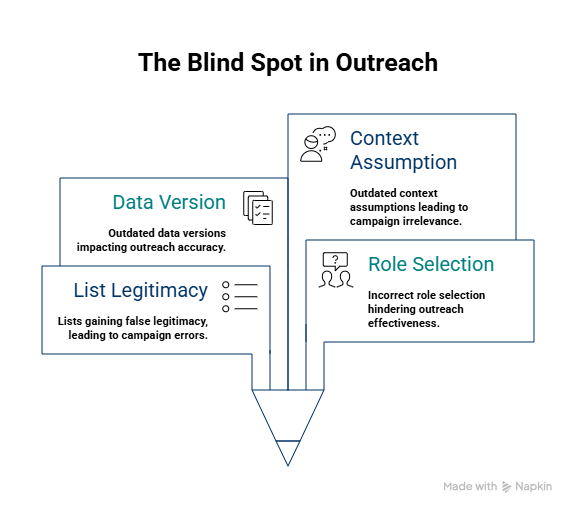
Outreach is usually evaluated downstream.
Low replies lead to copy changes.
Poor engagement leads to cadence tweaks.
Silence leads to more follow-ups.
What rarely gets audited is the input itself.
Most teams never stop to ask:
- Why these people?
- Why these roles?
- Why this version of their data?
- Why assume this context is still true?
Once a list exists, it gains false legitimacy. Campaigns are built on it. Metrics are judged against it. And when things underperform, everything except the list gets blamed.
Data doesn’t fail loudly. It fails quietly.
Bad data doesn’t crash systems. It erodes outcomes.
Outreach still runs. Emails still send. Dashboards still update. The failure shows up in subtler ways:
- Prospects who technically match filters but feel irrelevant
- Replies that say “not my area” or never arrive at all
- Conversations that stall because authority is missing
- Teams optimising endlessly without lift
None of this screams “data problem.” It feels like a content or execution issue. That’s why it persists.
Why targeting is not the same as understanding
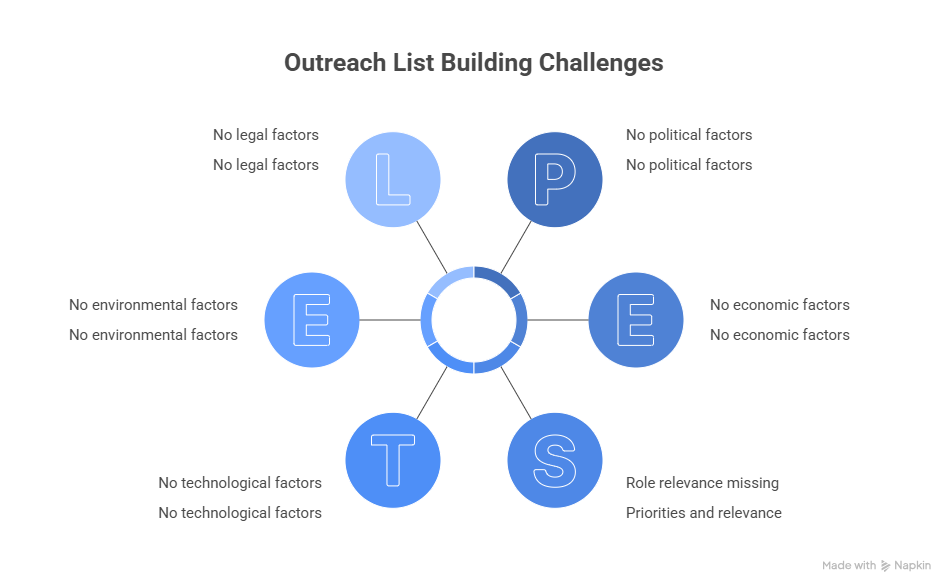
Most lists are built on surface-level correctness:
- Job titles that look right
- Companies that fit ICP definitions
- Industries that match filters
What’s missing is role reality.
Titles don’t tell you:
- What decisions someone actually owns
- How recently their role changed
- Whether they are upstream, downstream, or adjacent
- If this topic is even relevant to their current priorities
Outreach fails early when teams confuse contactability with relevance.
The unfair burden placed on copy
When results are weak, copy becomes the scapegoat because it’s visible and editable.
But copy is not meant to fix misalignment. It’s meant to express alignment.
If outreach reaches the wrong person, at the wrong level, with the wrong context, no subject line can rescue it. The email may be well-written, polite, even thoughtful, but it’s still misplaced.
Words can amplify relevance. They cannot create it.
What actually changes when data is fixed first
When enrichment is done properly, teams don’t suddenly become better writers. Something more interesting happens.
They stop fighting friction.
You start to see:
- Fewer emails feeling “forced”
- Personalisation becoming natural instead of decorative
- Replies improving in quality, not just quantity
- Follow-ups feeling conversational instead of obligatory
This is not because teams changed strategy. It’s because alignment removed resistance.
Why enrichment is a judgment layer, not a dataset
High-quality enrichment is not about adding more columns to a spreadsheet. It’s about improving the decision surface before outreach begins.
Good enrichment helps answer:
- Should this person be contacted at all?
- Is this the right level of seniority?
- Is the timing even reasonable?
- What context actually matters here?
When enrichment does its job, outreach becomes quieter, sharper, and more intentional.
Where SalesEnrich fits into this shift
SalesEnrich exists to address this exact failure point, not downstream symptoms.
Instead of treating enrichment as a one-time list cleanup, SalesEnrich focuses on keeping lead data decision-ready. That means role-aware, context-sensitive, and current enough to support judgment, not just automation.
At Linkenite, we’ve seen teams unlock better outbound performance simply by changing who they contact before worrying about what they say.
Once that upstream decision improves, everything downstream feels lighter.
The real takeaway
Outreach doesn’t fail because teams lack tools, templates, or effort.
It fails because the first decision is often made on incomplete or outdated assumptions.
Before rewriting emails, re-evaluate selection.
Before adjusting cadence, question relevance.
Before blaming copy, inspect context.
Because the most effective outreach doesn’t start with better words.
It starts with better judgment about who deserves them.


.png)
.png)
.png)
.png)
.png)
.png)
.png)
.png)
.png)
.png)
.png)
.png)

.png)
.png)
.png)
.png)


.png)
.png)

.png)


.jpg)

.jpg)
.jpg)


.png)


.png)

.png)
.png)
.png)


.png)
%20(2).png)
.png)
.png)




.png)

.png)


.png)


.png)


.png)


%20BLOG%20BANNER.png)


.png)