.png)
Here’s a fact
The second follow-up is rarely judged on its own.
It is judged as proof that a third one is coming.
Modern inbox behavior is not linear. People don’t read emails one by one and consciously decide each time. They recognise patterns. The moment a follow-up arrives on a predictable schedule, the brain classifies the sender as a sequence, not a person.
Once that classification happens, something subtle but critical changes. Replying no longer feels like a decision. It feels like an interruption to a process that will continue regardless.
This is why adding more follow-ups often reduces replies instead of increasing them. Not because persistence is wrong, but because predictability removes urgency.
That is the shift this blog exists to unpack.
When follow-ups used to work (and why they don’t anymore)
There was a time when follow-ups were interpreted generously. In quieter inboxes, silence usually meant the email was missed or deprioritised. A reminder felt helpful. Persistence felt professional.
That mental model no longer holds.
Today, inboxes are crowded and automated patterns are familiar. People have learned to anticipate what comes next. When a follow-up arrives exactly when expected, it doesn’t add value. It confirms a sequence.
And sequences don’t invite replies. They invite avoidance.
Why persistence stopped being impressive
Most outbound playbooks still treat follow-ups as a numbers game:
- More touches increase surface area
- More surface area increases reply probability
- Silence means “send again”
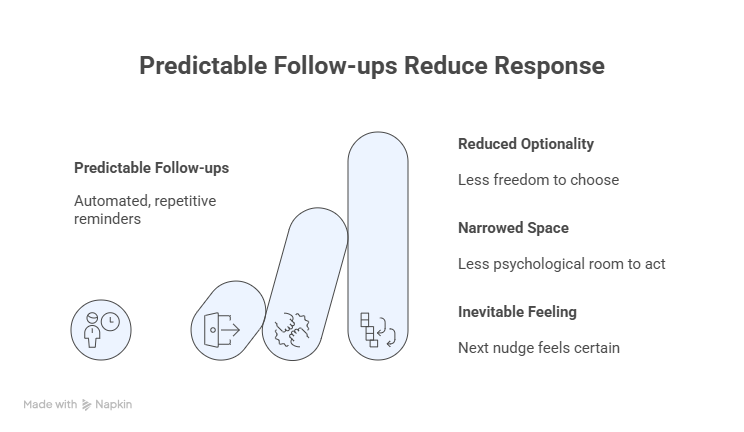
But modern recipients don’t experience follow-ups as isolated touches. They experience them as pressure curves.
Each predictable follow-up reduces optionality.
Each reminder narrows the psychological space to respond.
Each nudge makes the next one feel inevitable.
What used to signal commitment now signals automation.
Context beats reminders every time
A reminder references the past.
Context explains the present.
Most follow-ups fail because they don’t answer the unspoken question in the reader’s mind: “Why now?”
Context can be many things:
- A change in timing
- A new signal
- A relevant trigger
- A reason the conversation matters today
Without context, a follow-up feels like noise. With context, it feels like awareness.
And awareness is what keeps outreach human.
When not following up builds more trust
This is where judgment becomes unavoidable.
Sometimes, the most effective follow-up is restraint.
Choosing not to follow up immediately can signal:
- Respect for the other person’s attention
- Confidence in the message already sent
- Understanding that silence is not rejection
In many cases, restraint keeps the conversation alive longer than pressure ever could. It preserves optionality, which is exactly what makes replies more likely later.
Follow-ups stopped being about activity. They became about timing and intent.
Why follow-ups can’t be reduced to rules anymore
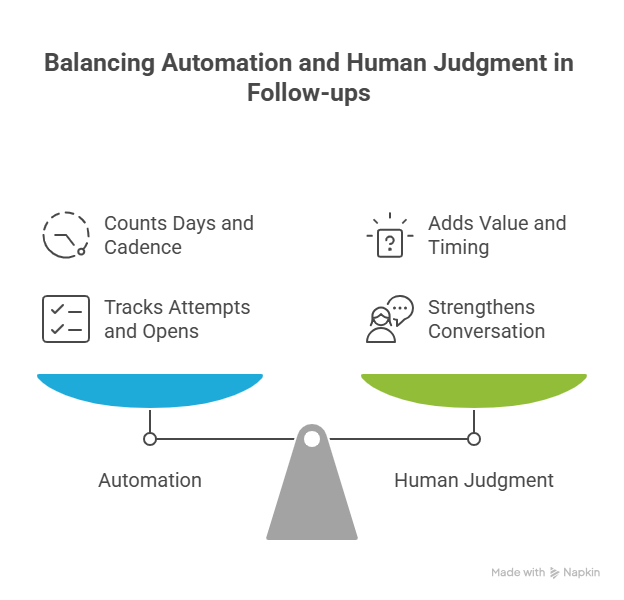
Automation is excellent at counting days and enforcing cadence. But follow-ups live in ambiguity.
A system can tell you:
- How long it’s been
- How many attempts were sent
- Whether an email was opened
It cannot tell you:
- Whether another message adds value
- Whether interest cooled or timing shifted
- Whether waiting would strengthen the conversation
These decisions sit in gray areas. And gray areas don’t respond well to rigid rules.
This is why follow-ups stopped being a workflow problem and became a judgment problem.
What modern outreach systems should actually support
The role of a good system is not to force more follow-ups. It is to support better decisions.
That means:
- Making signals visible instead of ignoring them
- Automatically pausing when a human reply appears
- Allowing space for timing, not just enforcing schedules
- Removing pressure to “send something” just to stay active
This philosophy is central to how InboxIN is built.
InboxIN treats follow-ups as choices, not defaults. Automation handles execution, while humans remain responsible for intent, relevance, and restraint.
At Linkenite, we see outbound teams perform better when systems stop rewarding activity and start supporting judgment.
How high-intent teams think about follow-ups now
Teams getting consistent results from outbound aren’t sending fewer follow-ups because they care less. They’re sending fewer because they think more.
Before following up, they ask:
- Has anything changed since the last message?
- Am I adding context or just reminding?
- Does this increase urgency or remove it?
- Would waiting keep this conversation more open?
These questions don’t slow teams down. They sharpen outcomes.
The real shift
Follow-ups didn’t stop working.
Predictable follow-ups did.
What replaced them is something harder to automate and far more effective: judgment.
Judgment about timing.
Judgment about relevance.
Judgment about when silence preserves trust better than another message ever could.
InboxIN exists for this exact shift. Not to help teams send more follow-ups, but to help them send the right ones and to recognise when the best follow-up is none at all.
Because in today’s inbox, the most human signal you can send is not persistence.
It’s restraint.


.png)
.png)
.png)
.png)
.png)
.png)
.png)
.png)
.png)
.png)
.png)
.png)

.png)
.png)
.png)
.png)


.png)
.png)

.png)


.jpg)

.jpg)
.jpg)


.png)


.png)

.png)
.png)
.png)


.png)
%20(2).png)
.png)
.png)




.png)

.png)


.png)


.png)


.png)


%20BLOG%20BANNER.png)


.png)