
What Happens to Your Business When You Automate Everything Except Your Understanding
You did not automate your business. You automated your assumptions. And right now, somewhere in your stack, those assumptions are actively costing you customers.
That is not a scare tactic. That is just what happens when capable technology runs on unclear thinking.

Most Automation Failures Are an Inside Job
Most get blamed on the tool. Wrong integration, buggy workflow, bad data. Sometimes that is true.
But most of the time, the tool worked exactly as designed. The problem was the design.
A sales team builds a re-engagement sequence for churned accounts. The copy is decent, the timing makes sense. It runs for four months. What nobody caught is that the "churned" tag had also been applied to accounts that were simply paused. Customers who had a hard quarter spoke to a real person, and were told "no problem, we will check back when you are ready."
The sequence checked back in. Every week. For sixteen weeks. With increasing urgency.
Nobody complained. They just stopped picking up the phone.
The automation did not fail. It succeeded at the wrong thing.
The Gap Nobody Talks About
Here is what nobody tells you when they sell you an automation platform. It will do exactly what you tell it to do, at a scale and speed you cannot supervise.
If your segmentation logic is slightly off, it is slightly off across ten thousand contacts. If your brand voice guidelines are vague, the output will be vague at volume.
Before you built your current stack, did you write down what a good lead looks like versus a bad fit? Did you define the exact point where a customer relationship requires a human, not a trigger?
If the answer is no, you did not give your automation a strategy to execute. You gave it a process to repeat.

AI will execute your strategy perfectly. The problem is most businesses have never actually written their strategy down.
It lives in the founder's gut. In the senior rep's instincts. In the one person who just knows when to call versus when to email. That knowledge is what makes your business feel human. And it is almost never the thing that gets transferred into the system before it goes live.
What Getting It Right Actually Looks Like
The businesses that win with automation do not start with the tool. They start with the thinking.
Before a single workflow gets built, they get clear on who their customer is at each stage of the relationship. They define where human judgment is non-negotiable. They document what the brand sounds like under pressure. They identify which signals mean a customer is about to buy and which nearly identical signals mean they are about to leave.
Once that clarity exists, the automation compounds it. Strategy first. System second. That order is everything.
One Thing Worth Remembering
Automation does not replace judgment. It locks judgment in place.
If the judgment it locks in is clear and considered, it compounds over time. Every touchpoint sharper, every interaction more consistent, the business stronger without more people in the loop.
If it is vague, it compounds that too.
You aren't configuring software. You are deciding what your business will say and do, at scale, without you in the room.
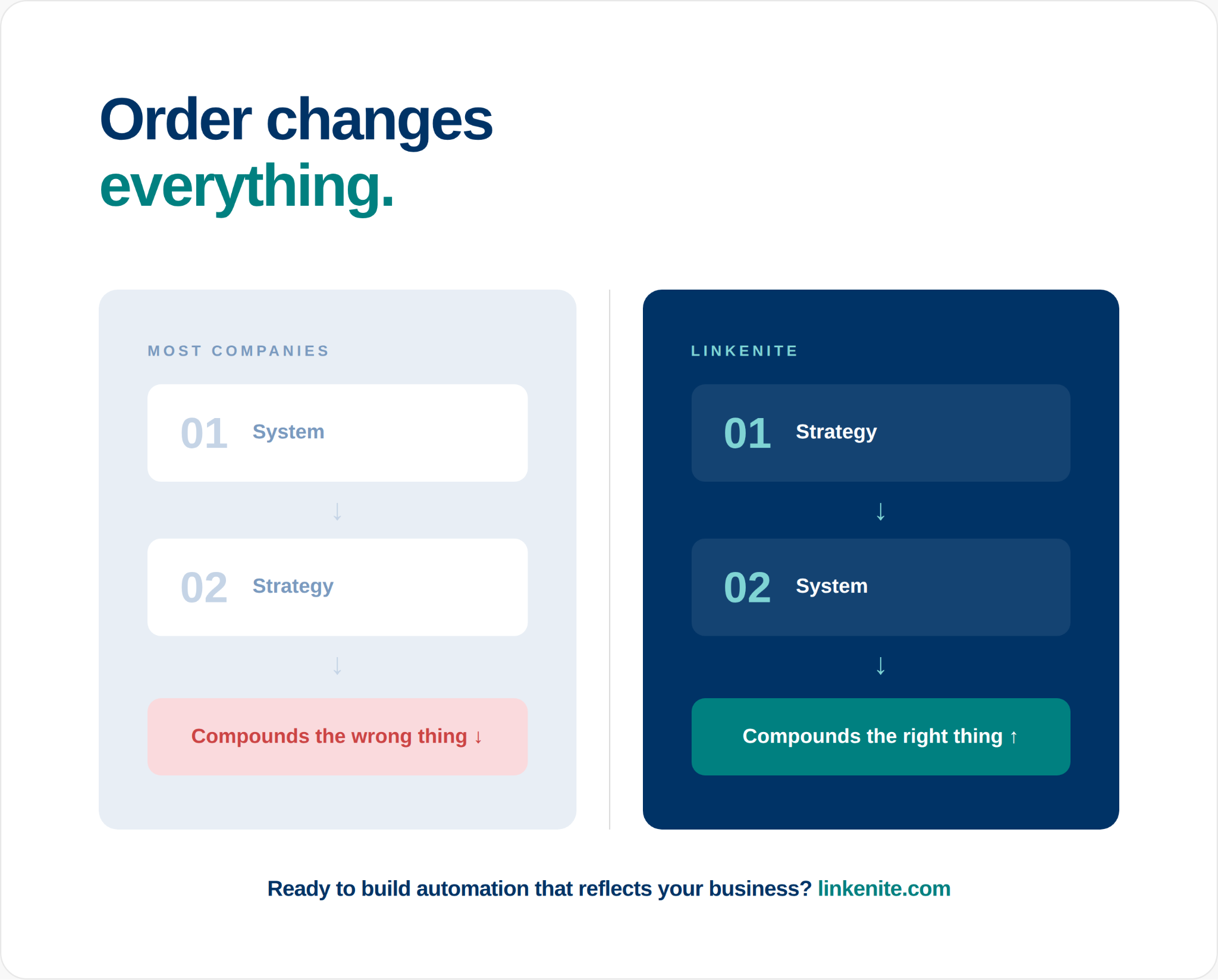
That is exactly why Linkenite exists. We do not start by building your system. We start by understanding your business, the strategy that lives in your founder's gut, the judgment calls your best rep makes without thinking, the moments that require a human and the ones that do not. Then we build automation that reflects all of it.
The stack is only as good as the thinking behind it. We help you get the thinking right first.
Ready to build automation that actually reflects your business? Visit www.linkenite.com or reach us at info@linkenite.com


.png)
.png)
.png)
.png)
.png)
.png)
.png)
.png)
.png)
.png)
.png)
.png)

.png)
.png)
.png)
.png)


.png)
.png)

.png)


.jpg)

.jpg)
.jpg)


.png)


.png)

.png)
.png)
.png)


.png)
%20(2).png)
.png)
.png)




.png)

.png)


.png)


.png)


.png)


%20BLOG%20BANNER.png)


.png)