
If everyone is publishing more, why does it feel like fewer people are noticing?
That question comes up again and again in conversations with founders, marketers, and operators. Content output is up. Tools are better. Distribution channels are mature. And yet, discovery feels fragile. Attention feels expensive.
The instinctive reaction is to blame platforms, algorithms, or declining reach.
This blog exists to explain why that instinct is understandable, but misplaced.
Attention didn’t disappear. The rules for earning it changed.
What actually changed in how people give attention
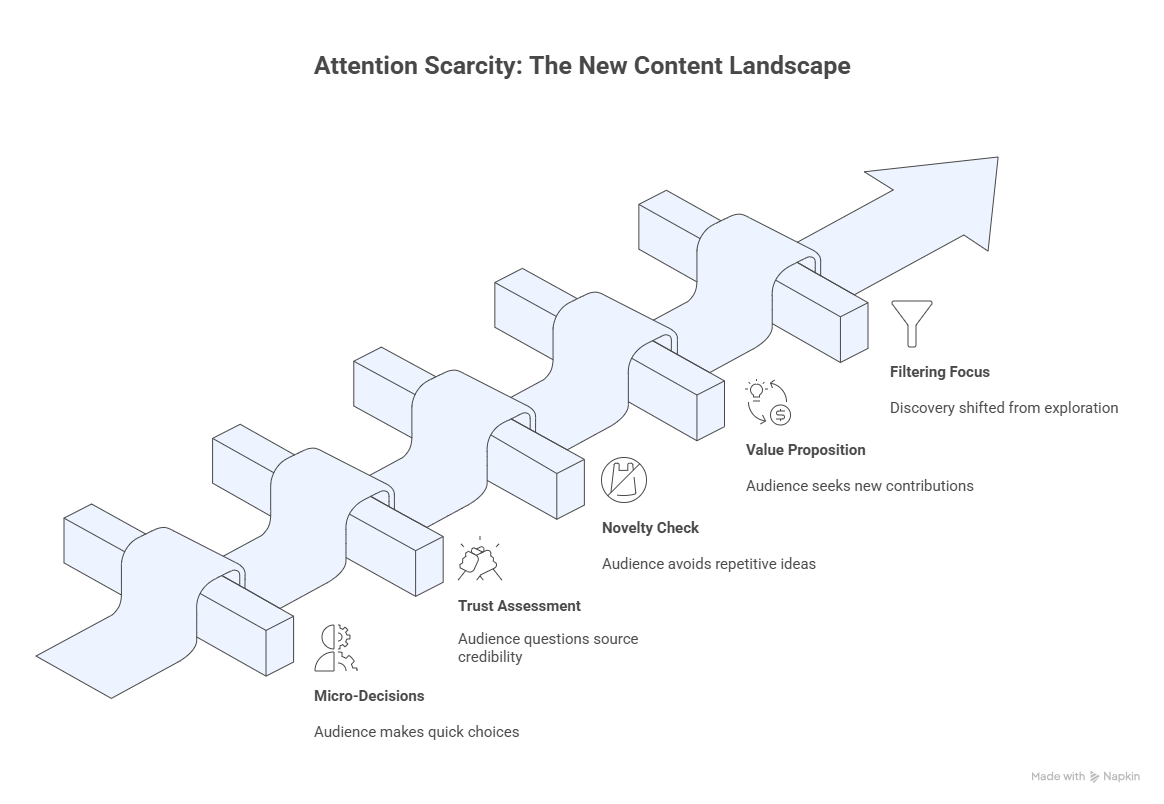
The internet did not run out of attention. People simply became more selective with it.
Today’s audience is constantly making micro-decisions:
- Is this worth my time right now?
- Do I trust where this is coming from?
- Have I seen this idea before?
- Will this add anything new for me?
These decisions happen in seconds, often subconsciously.
As a result, discovery shifted from exploration to filtering. People are no longer browsing to discover. They are scanning to exclude.
That single shift explains why visibility feels harder even when content quality improves.
Why reach stopped converting into attention
For years, reach acted as a reliable proxy for success. If enough people saw something, a portion would engage. That assumption no longer holds.
Today, reach without context behaves differently:
- It creates awareness without recall
- It produces spikes without continuity
- It attracts attention without trust
Trust is now the conversion layer between visibility and engagement.
Without trust, reach is transient. With trust, even modest reach compounds.
This is why brands with smaller audiences but consistent thinking often outperform larger, noisier ones in actual impact.
The hidden cost of chasing spikes
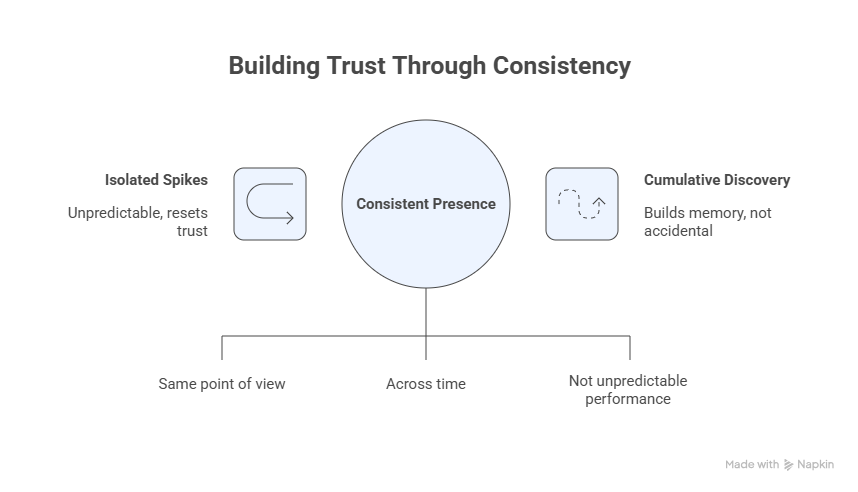
Many teams still optimise for moments. Viral posts. High-performing campaigns. Sudden traffic jumps.
The problem is not that spikes are useless. The problem is that spikes are isolated.
Audiences don’t build familiarity through peaks. They build it through patterns.
Patterns come from:
- Repeated exposure to the same point of view
- Consistent tone across time
- Predictable quality, not unpredictable performance
When content appears once and disappears, it resets trust every time. When it shows up consistently, discovery becomes cumulative instead of accidental.
Spikes feel exciting. Presence builds memory.
What visibility really means now
Visibility today is not about being seen everywhere. It’s about being recognised when seen.
Recognition happens when people think:
- “I’ve seen this perspective before”
- “These people think clearly about this space”
- “This usually adds value for me”
That recognition lowers friction. It makes attention easier the next time, and the time after that.
This is where many brands misinterpret visibility. They optimise distribution before earning recognition.
Distribution amplifies what already exists. It doesn’t create trust on its own.
Why consistency outperforms intensity
In selective attention environments, consistency beats intensity almost every time.
Consistency signals:
- Stability
- Confidence
- Intentionality
Intensity often signals urgency or insecurity.
Brands that publish calmly, clearly, and regularly don’t need to fight for attention. Over time, attention comes to them because familiarity reduces cognitive effort for the audience.
This is not about posting more. It’s about showing up the same way.
How teams are adapting to selective attention
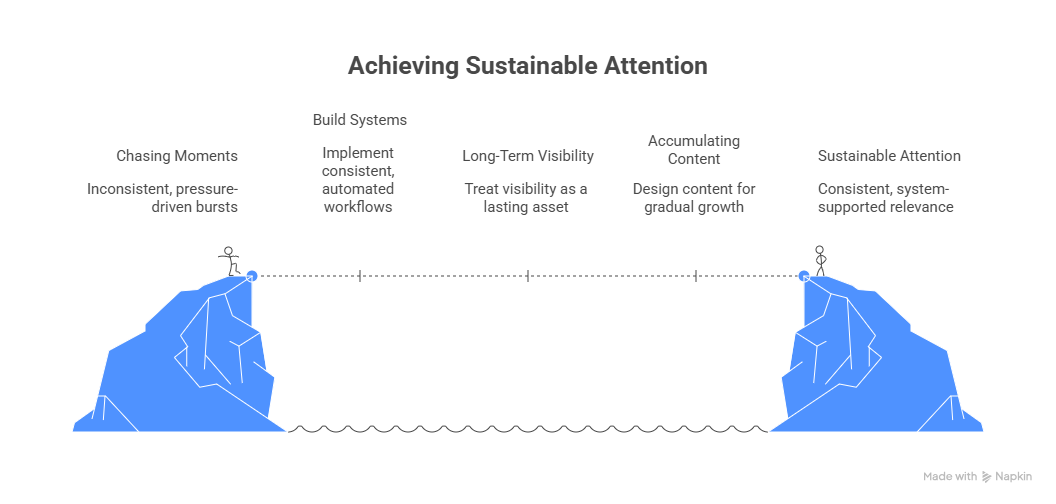
The teams adjusting best are changing how they think about discovery.
They are:
- Building systems instead of chasing moments
- Treating visibility as a long-term asset, not a campaign outcome
- Designing content to accumulate, not peak
At Linkenite, we see this shift clearly across content, outreach, and discovery workflows. Sustainable attention comes from consistency supported by systems, not pressure driven bursts. Automation helps maintain rhythm, but human judgment ensures relevance doesn’t erode.
Attention isn’t captured once. It’s earned repeatedly.
The real takeaway
Visibility didn’t break.
Discovery didn’t disappear.
Attention didn’t vanish.
It became selective.
The brands that win are not louder or faster. They are clearer, more consistent, and easier to trust over time.
In a world where people protect their attention carefully, the strongest strategy is not chasing reach, but becoming recognisable enough that attention feels like a safe investment.
That is what visibility looks like now.


.png)
.png)
.png)
.png)
.png)
.png)
.png)
.png)
.png)
.png)
.png)
.png)

.png)
.png)
.png)
.png)


.png)
.png)

.png)


.jpg)

.jpg)
.jpg)


.png)


.png)

.png)
.png)
.png)


.png)
%20(2).png)
.png)
.png)




.png)

.png)


.png)


.png)


.png)


%20BLOG%20BANNER.png)


.png)