
How to Turn FAQs, Objections, and Call Notes into AEO-Ready Content Across Web, Social, and Sales Decks
Your best AEO prompts are hiding in your sales calls.
Most teams look for AEO opportunities in keyword tools, trend reports, or AI-generated ideas.
Meanwhile, their best inputs are already sitting in:
- Sales call notes
- Objection handling docs
- Support tickets
- Live chat transcripts
- LinkedIn comments
These are not just conversion assets.
They are real questions phrased in real human language, which is exactly what AI systems prioritize when deciding what content to surface.
This blog shows how to turn those questions into a repeatable content ops system across your website, LinkedIn, and sales assets.
Step 1: Mine real questions from buyer-facing touchpoints
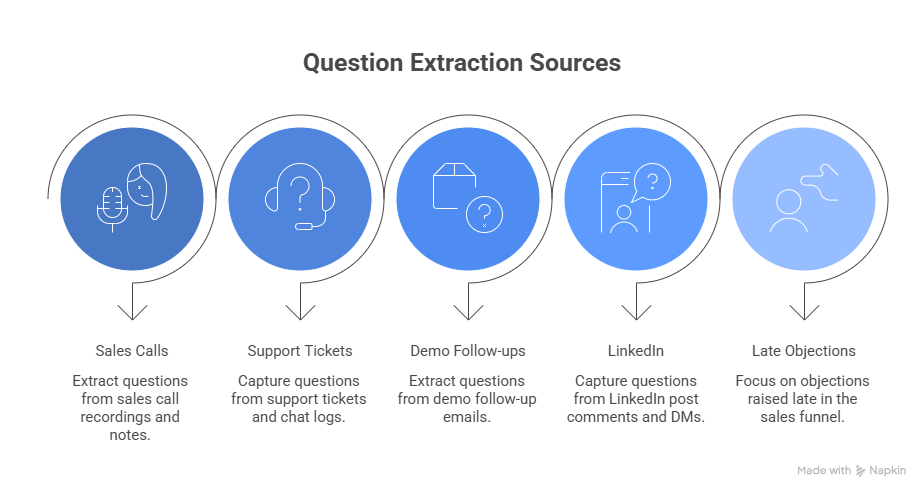
AEO works best when content mirrors how people actually ask questions.
Where to extract questions from
Focus on sources where users speak freely:
- Sales call recordings and notes
- Support tickets and chat logs
- Demo follow-up emails
- LinkedIn post comments and DMs
- Objections raised late in the funnel
What to look for
Ignore statements. Capture questions.
- “Does this replace X or work alongside it?”
- “How long does this take to set up?”
- “Why is this priced higher than alternatives?”
- “What happens if we scale volume?”
If a question keeps repeating across channels, it deserves to exist in public content.
Step 2: Turn those questions into website FAQs
Your website is the foundation layer.
Every core page should answer the questions buyers ask before they convert.
How to structure website FAQs
- Use the exact question wording from calls or chats
- Place FAQs at the bottom of high-intent pages
- Answer in 30 to 50 words
- Keep language neutral and factual
Best practices
- Only include questions people genuinely ask
- Avoid marketing language in answers
- Make sure FAQ answers match how your sales team explains things verbally
Once FAQs exist on the page, reinforce them with matching FAQPage schema so AI systems can confidently extract them.
Step 3: Turn the same questions into LinkedIn content
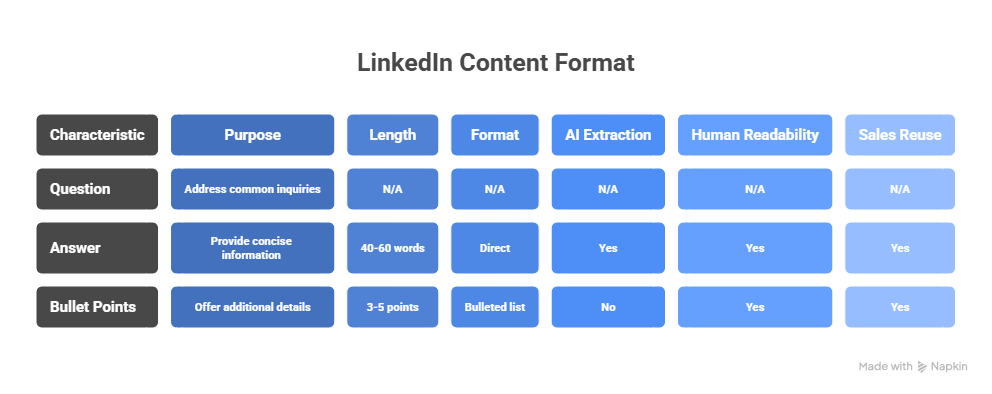
LinkedIn is where these questions often appear first.
So reuse them intentionally.
Proven LinkedIn format for AEO and engagement
Use this structure:
Question
40 to 60 word direct answer
3 to 5 bullet points for context or nuance
Example
Does this replace our existing CRM?
No. It works alongside your CRM by handling outreach logic, inbox behavior, and follow-ups, while your CRM remains the system of record.
• No data migration required
• Syncs activity automatically
• Designed to reduce manual work, not replace systems
This format works because:
- AI can extract the short answer
- Humans get scannable context
- Sales teams can reuse it in conversations
Step 4: Turn questions into sales decks and one-pagers
Sales assets are often written as features and benefits.
AEO-ready assets are written as questions and answers.
How to structure slides and one-pagers
- Use the question as the section header
- Follow with a short, quantified answer
- Add supporting proof points below
Example slide header
How long does implementation take?
Answer:
Most teams are fully live within 2 to 5 days, depending on inbox volume and integrations.
Supporting points:
- Guided onboarding
- No code setup
- Existing tools stay in place
This mirrors how buyers think and how AI systems summarize.
Step 5: Maintain a shared “AEO question bank”
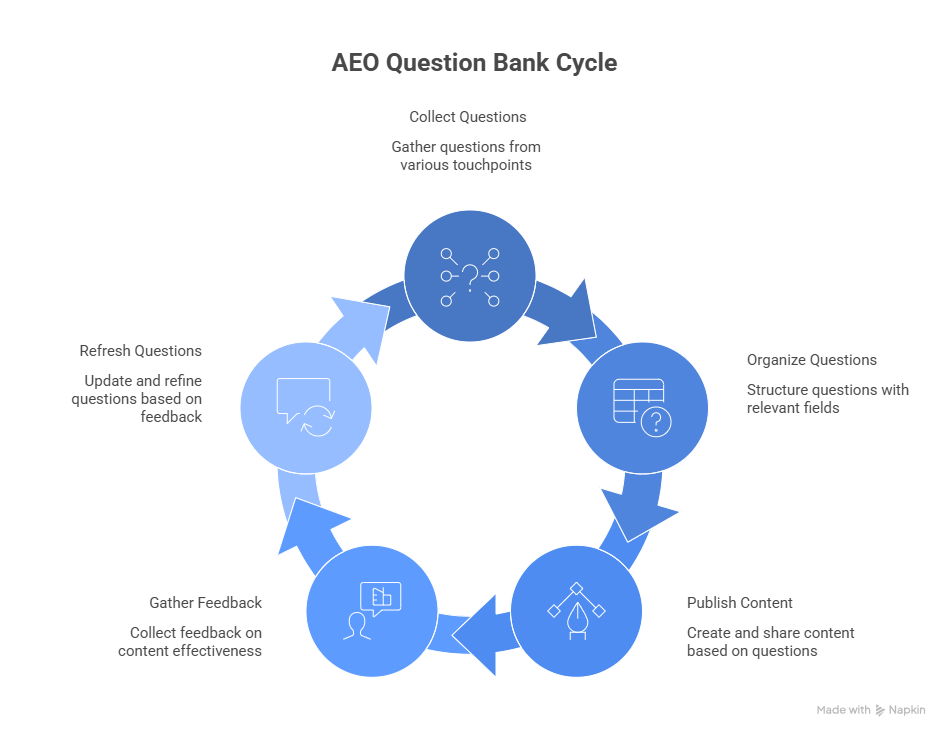
To make this repeatable, centralize questions.
What the question bank should include
Store it in Notion or Airtable with fields like:
- Question
- Source (sales, support, LinkedIn, demo)
- Funnel stage
- Primary page or asset
- Status (unused, published, refreshed)
Why this matters
- Content teams stop guessing
- Sales teams feel heard
- Messaging stays consistent across channels
- AI-facing content improves over time
This becomes a living system, not a one-off exercise.
Step 6: Measure what actually changes
Traditional metrics miss AEO impact.
What to track instead
- Featured snippets and rich results
- AI citations in ChatGPT and Perplexity
- Quality of inbound emails and replies
- Sales calls where buyers say, “I already read this on your site”
Look for better-informed conversations, not just more traffic.
The workflow that ties it all together
At a high level, the system looks like this:
Sales calls and chats
→ Question bank
→ Website FAQs and answer blocks
→ Blog content
→ LinkedIn posts
→ Sales decks and one-pagers
One question.
Multiple surfaces.
Consistent answers everywhere.
Final thought
The strongest AEO strategies do not start with AI tools.
They start with listening.
When you treat buyer questions as first-class content inputs, your website becomes clearer, your social content becomes sharper, and your sales conversations become shorter and more confident.


.png)
.png)
.png)
.png)
.png)
.png)
.png)
.png)
.png)
.png)
.png)
.png)

.png)
.png)
.png)
.png)


.png)
.png)

.png)


.jpg)

.jpg)
.jpg)


.png)


.png)

.png)
.png)
.png)


.png)
%20(2).png)
.png)
.png)




.png)

.png)


.png)


.png)


.png)


%20BLOG%20BANNER.png)


.png)