Last week, Anthropic quietly dropped a feature that made software stocks tank.
Not a new model. Not a benchmark. A mouse click.
Claude Anthropic's AI can now take control of your Mac. Open apps. Navigate browsers. Fill spreadsheets. Export files. Attach documents to calendar invites. All autonomously. All while you're walking to your car, drinking your coffee, or doing literally anything else.
They paired it with a feature called Dispatch, which lets you assign Claude tasks from your phone. Text Claude from your commute, and by the time you sit down at your desk, the work is done.
And investors immediately understood what this means.
Everyone's Talking About the Wrong Thing
The headlines are all about "Claude can click a mouse" as if the story is a parlor trick about cursor movement.
It's not.
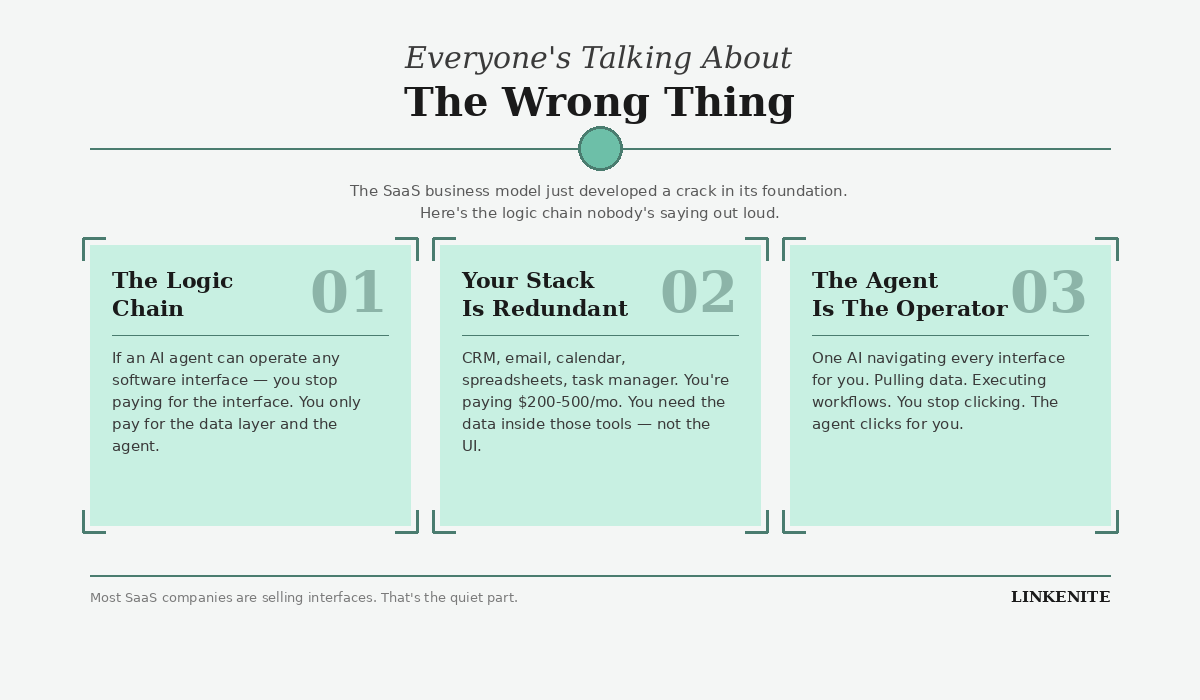
The story is that the entire SaaS business model just developed a crack in its foundation.
Here's the logic chain:
If an AI agent can operate any software interface → you stop paying for the interface → you only pay for the data layer and the agent → most SaaS companies are selling interfaces.
That's the quiet part that nobody's saying out loud.
Think about your current tool stack. CRM, email automation, calendar, spreadsheets, task manager, design tool, analytics dashboard. You're paying $200-500/month across all of them. What you actually need is the data inside those tools. The UI is just how you interact with the data.
Now imagine an AI agent that can interact with all of them for you. Navigate the interfaces. Pull the data. Execute the workflows. You stop being the operator. The agent is the operator.
So why would you pay premium prices for a beautiful UI that nobody's looking at?
This Isn't Automation. It's Delegation.
There's an important distinction that most people are missing.
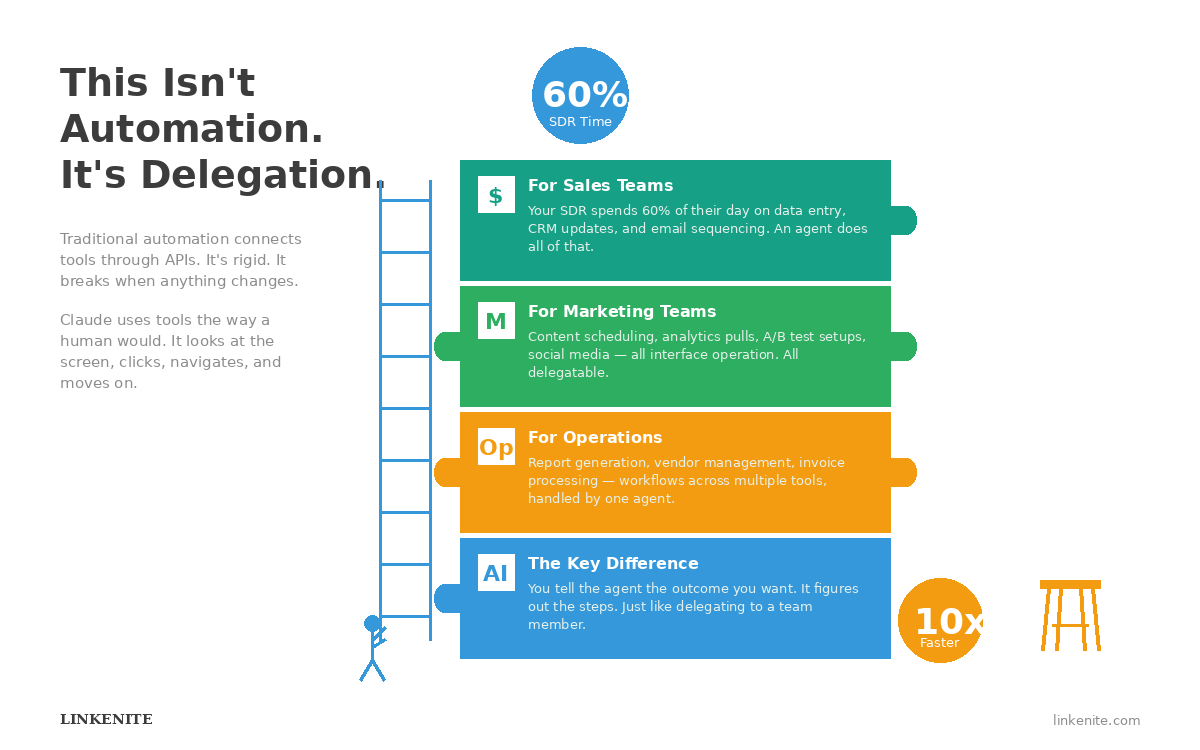
Traditional automation (Zapier, Make, n8n) connects tools through APIs. "When X happens in Tool A, do Y in Tool B." It's rigid. It breaks when anything changes. It requires someone to set it up and maintain it.
What Claude is doing is fundamentally different. It's not connecting APIs. It's using the tools the way a human would. It looks at the screen, decides what to click, navigates menus, fills in forms, and moves on to the next step.
This is delegation, not automation. You tell the agent what outcome you want, and it figures out the steps. Just like you'd delegate to a team member.
The implications are massive:
For sales teams: Your SDR spends 60% of their day on data entry, CRM updates, and email sequencing. An agent can do all of that while the SDR focuses on actual conversations.
For marketing teams: Content scheduling, analytics pulls, A/B test setups, social media management, all of it is interface operation. All of it is delegatable.
For operations: Report generation, data reconciliation, vendor management, invoice processing these are workflows that involve navigating multiple tools. An agent that can use those tools eliminates the need for someone to sit there clicking.
The First-Mover Advantage Is Real
Here's what's going to separate the winners from the losers in the next 12 months:
Companies that adopt agentic workflows now will be operating at 5-10x the speed of companies that are still manually clicking through software. Not because the AI is 10x smarter, but because it doesn't take breaks, doesn't context-switch, and doesn't forget where it was.
The compounding effect is brutal. While your competitor's team is manually updating Salesforce, preparing reports, and scheduling follow-ups, your agent is doing all of that in the background, and your team is spending 100% of their time on strategy and relationships.
This is the gap that will widen every single month as these tools improve.
What We've Been Building at Linkenite
At Linkenite, we don't just use AI tools. We build AI agents that do the work.
Our products like InboxIn, Approachin, and SalesLink are purpose-built agentic systems for sales, marketing, and operations. We've been designing for this future since before "agentic AI" became a buzzword.
Claude's Computer Use feature validates what we've been saying: the future isn't better software. It's agents that operate software for you.
The question isn't whether this transition will happen. It has already started. The question is whether you're building for it or waiting for it to happen to you.
The Bottom Line
Claude learned to click a mouse. That sounds trivial. But it means an AI can now operate any software tool on your computer, from a prompt on your phone, while you do something else.
That's not a feature update. That's the beginning of the end for software-as-a-UI.
Stop clicking. Start delegating.
Linkenite is an agentic engineering company building AI-powered automation for sales, marketing, and operations. Learn more at linkenite.com.


.png)
.png)
.png)
.png)
.png)
.png)
.png)
.png)
.png)
.png)
.png)
.png)

.png)
.png)
.png)
.png)


.png)
.png)

.png)


.jpg)

.jpg)
.jpg)


.png)


.png)

.png)
.png)
.png)


.png)
%20(2).png)
.png)
.png)



.png)

.png)


.png)


.png)


.png)


%20BLOG%20BANNER.png)


.png)