
Over the last two years, AI has changed how businesses think about software. Every week there’s a new AI sales assistant, an AI meeting recorder, an AI email writer, an AI CRM, an AI support platform or an AI agent promising to transform the way companies operate. The message is always the same: buy one more tool, automate one more process and your business will become dramatically more efficient.
The problem is that most growing companies aren’t suffering from a lack of AI.
They’re suffering from an overload of software.
Recently, during a discovery call with the founder of a growing agency, he said something that perfectly summarised what we’ve been hearing from more and more business leaders.
“I’m not looking for another tool. I’m looking for one or two tools that can replace the stack I’m already paying for.”
That one sentence captures a much bigger shift happening across modern businesses.
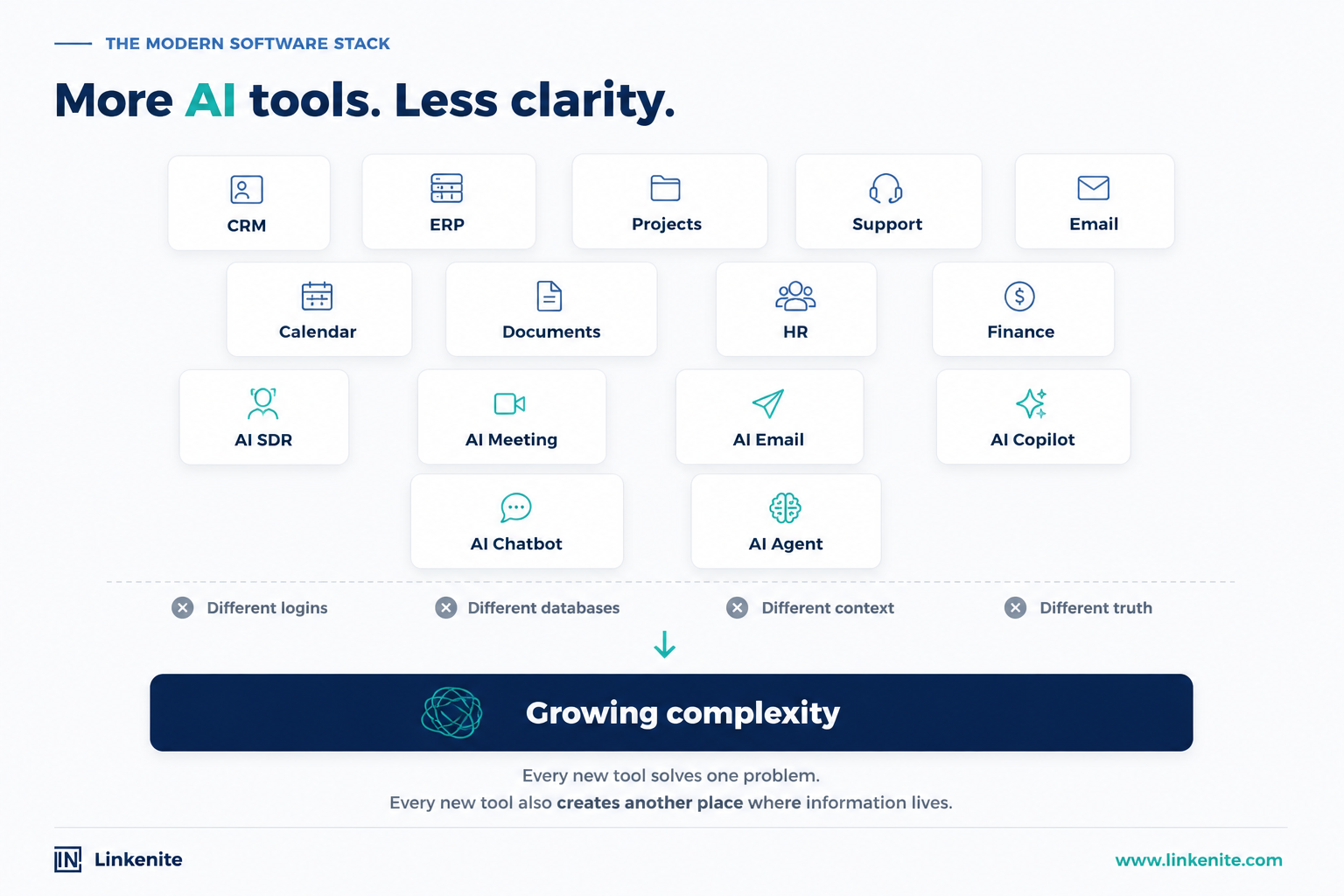
For years, companies have solved every new challenge by adding another application. Sales adopted one platform. Marketing chose another. Operations implemented an ERP. Customer support introduced its own software. HR purchased another system. Finance exported everything into spreadsheets because nothing else talked to each other properly.
Every decision made sense on its own.
Together, they created something nobody intentionally designed: a business where information is fragmented across dozens of systems.
The irony is that AI has accelerated this problem rather than solving it.
Instead of replacing complexity, many organisations are simply adding AI on top of complexity. One AI writes emails. Another joins meetings. Another qualifies leads. Another summarises documents. Before long, companies aren’t managing ten software platforms anymore. They’re managing ten software platforms and ten AI assistants that barely know the others exist.
Technology has become incredibly powerful.
Businesses haven’t become proportionally simpler.
The next challenge isn’t artificial intelligence. It’s orchestration.
For years, enterprise software has been built around specialised applications.
Customer data lives inside the CRM.
Projects live inside project management software.
Invoices belong to finance systems.
Support conversations stay inside ticketing platforms.
Documents live somewhere else entirely.
Each application becomes exceptionally good at solving its own problem, but very few understand what’s happening across the rest of the business.
Ask a seemingly simple question like “What’s the latest status of this customer?” and the answer rarely exists in one place. Someone checks the CRM, another searches email, someone else opens meeting notes, while operations looks inside the ERP. The information exists, but it’s scattered across systems that were never designed to think together.
This isn’t a software problem anymore.
It’s an orchestration problem.
The next generation of enterprise AI won’t be defined by who builds the smartest individual application. It will be defined by who makes every existing application work as though it were part of one intelligent operating system.
That shift changes the question founders should be asking.
Instead of asking:
“Which AI tool should we buy next?”
The better question is:
“Why do we still need another tool at all?”
Growing companies don’t need more software. They need fewer surfaces.
As businesses scale beyond ten or twenty people, operational complexity increases much faster than revenue. More customers create more projects. More projects require more approvals. More approvals generate more conversations. Before long, every department has optimised its own workflow using different software, yet nobody has a complete view of what’s happening across the company.
This is why founders often feel that their business becomes slower even though they’ve invested heavily in technology.
The issue isn’t productivity.
The issue is fragmentation.
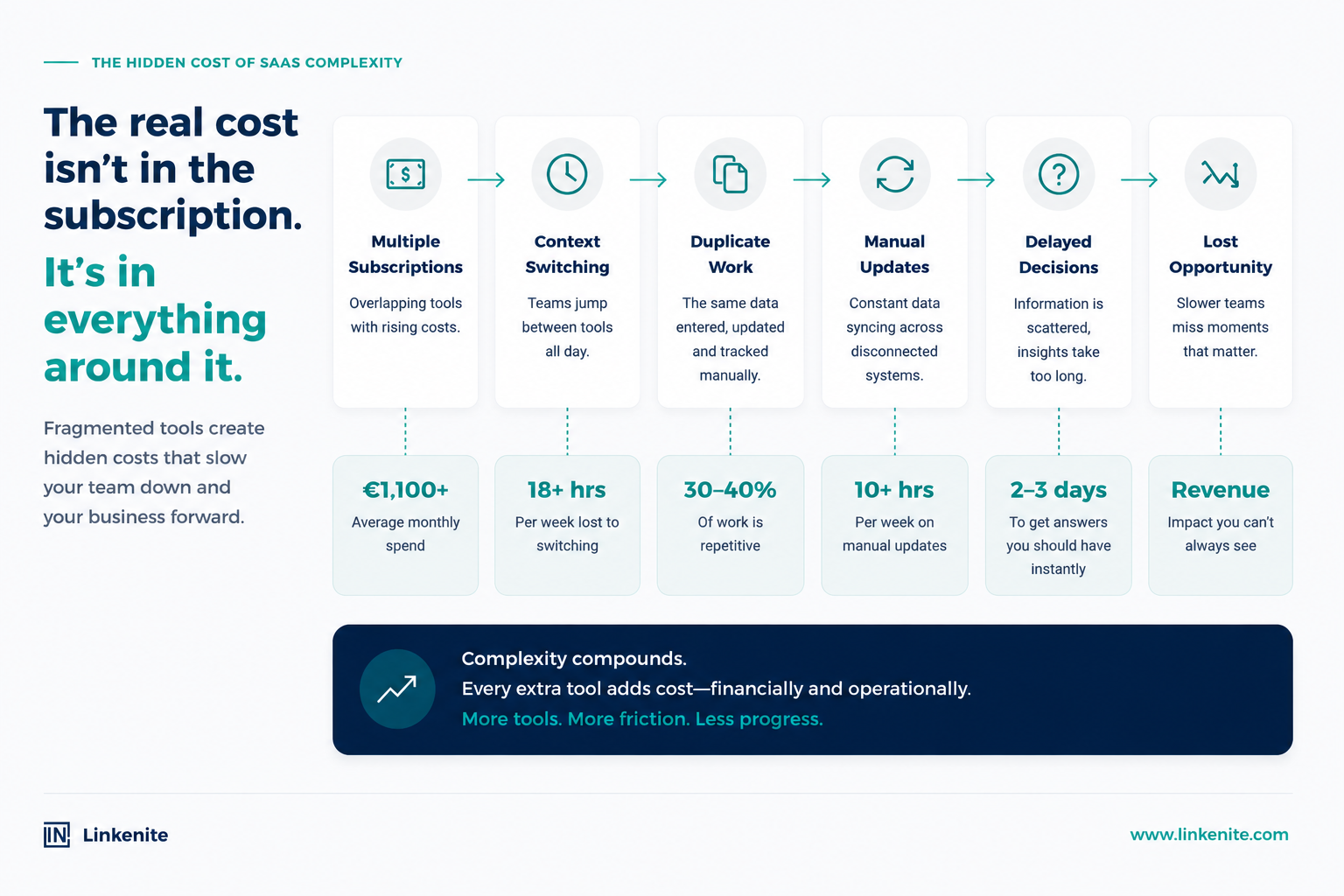
Every new platform creates another login, another database, another API, another subscription and another place where critical business information can disappear.
The goal shouldn’t be to build a larger software stack.
The goal should be to make the existing one behave like a single system.
The future isn’t another application. It’s an intelligence layer above the ones you already have.
For decades, enterprise software has been built by adding another layer to the stack.
Need better customer management? Buy a CRM.
Need project visibility? Add a project management platform.
Need automation? Connect another integration.
Need AI? Buy another AI application.
The assumption has always been that the next problem requires the next tool.
What if that’s the wrong assumption?
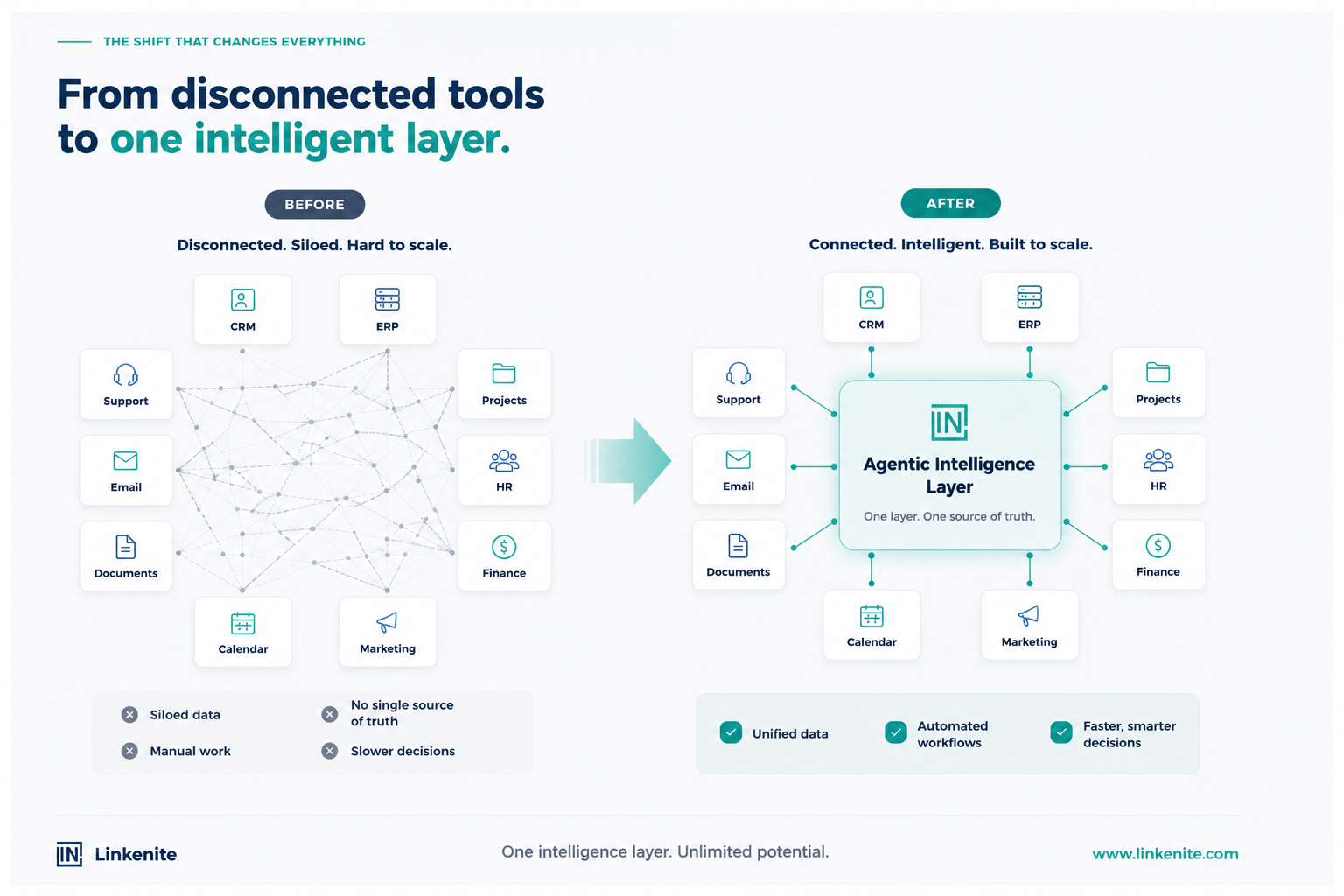
Instead of replacing the software businesses already rely on, a better approach is to connect it through a single intelligence layer that understands every customer, project, conversation, document and workflow, regardless of where that information originally lives.
Think of it less as another application and more as an operating layer sitting above your existing stack.
Your CRM continues doing what it does best.
Your ERP continues managing operations.
Your email platform continues sending emails.
Nothing disappears.
Instead, an orchestration layer connects them, understands the relationships between them and allows people and AI agents to work from the same source of truth instead of isolated pockets of information.
That changes the role of AI completely.
Instead of having dozens of disconnected assistants, you have one intelligence capable of understanding your business as a whole.
That’s exactly why we built the Agentic Intelligence Layer.
The idea didn’t begin as a product roadmap.
It began as a frustration.
Like many growing businesses, we found ourselves paying for an increasing number of specialised platforms. CRM software, outreach tools, LinkedIn automation, meeting assistants, project management, internal workflows and operational systems all worked well individually, but together they created unnecessary complexity.
Every new subscription solved one challenge while introducing another.
More logins.
More integrations.
More data synchronisation.
More software to maintain.
Instead of accepting that as the cost of growth, we asked a different question.
What if the software wasn’t the product anymore?
What if intelligence became the product?
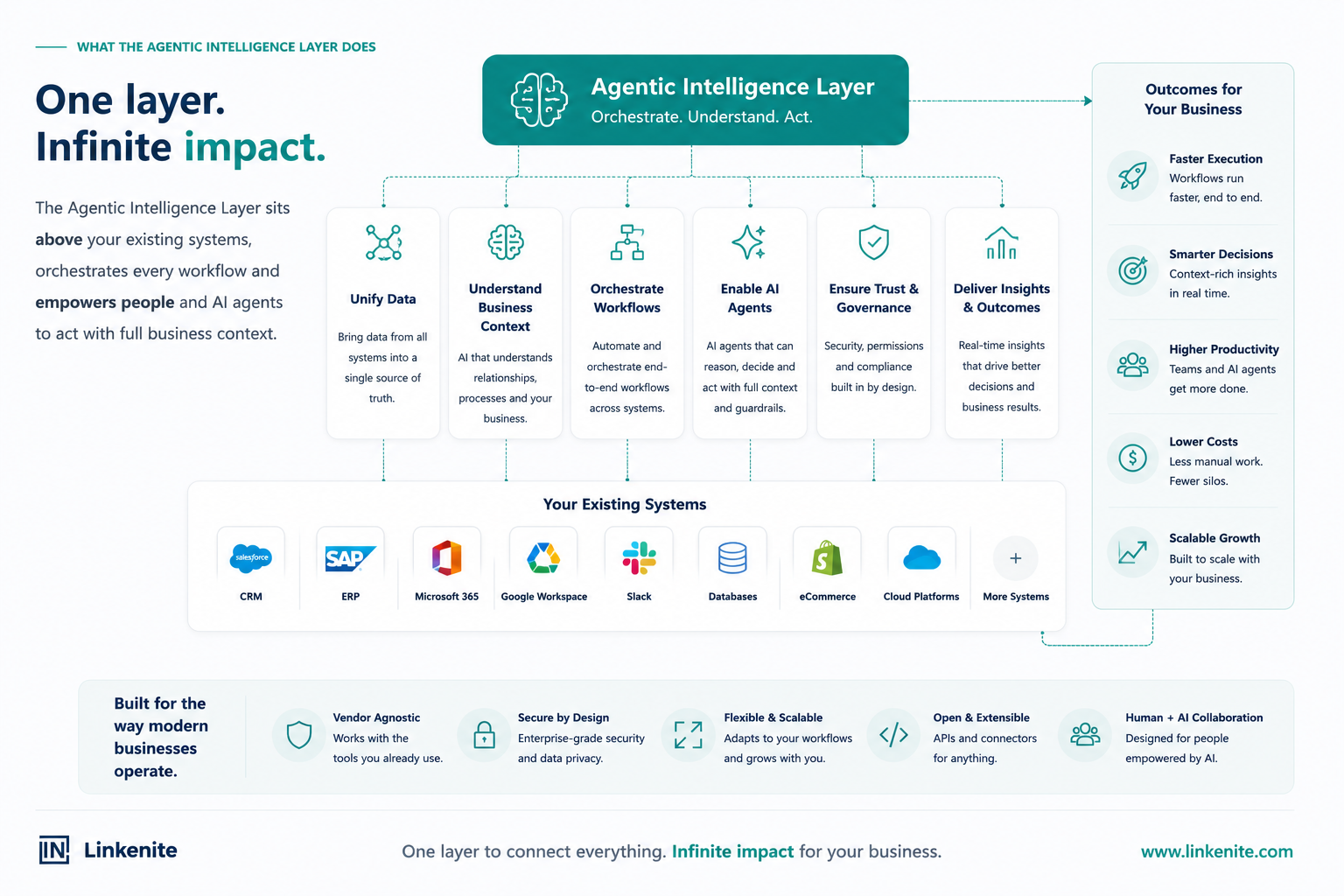
That thinking eventually became Linkenite’s Agentic Intelligence Layer, an orchestration layer designed to sit above existing business systems rather than replace them.
It connects customer data, projects, support, finance, purchasing, people, outreach, emails, calendars and AI agents into one connected operational surface.
The objective isn’t to force companies into another ecosystem.
It’s to make the ecosystem they already have behave like one.
Replacing your ERP or CRM is usually the wrong decision.
One of the biggest misconceptions we encounter is that companies believe digital transformation requires ripping out existing software and starting again.
In reality, that’s rarely necessary.
Most organisations have already invested years into configuring their CRM, ERP and operational processes. Those systems contain valuable business knowledge that shouldn’t be discarded simply because a newer technology appears.
The real opportunity lies in making those systems communicate intelligently.
Instead of replacing the foundation, the intelligence layer connects to it.
Existing workflows remain familiar.
Historical data stays where it belongs.
Teams continue using the tools they already know, while AI begins orchestrating information and repetitive work across them.
That approach dramatically reduces change management, shortens implementation time and avoids one of the biggest reasons enterprise software projects fail: forcing people to abandon everything they already understand.
Less software. More leverage.
One unexpected benefit of this approach is cost.
When companies stop thinking in terms of individual applications and start thinking in terms of connected capabilities, they often discover significant overlap across their software stack.
Multiple tools performing similar functions.
Several subscriptions solving adjacent problems.
Features being paid for but rarely used.
By consolidating workflows through an orchestration layer and combining proven open-source technologies where appropriate, businesses can often simplify both their operations and their software spend without sacrificing capability.
In our own implementation, this approach reduced software costs by approximately €2,000 per month while creating a far more connected operating environment.
The savings were valuable.
The operational clarity was even more valuable.
Because when information finally stops competing between systems, teams stop searching for answers and start making decisions.
Who benefits most from an intelligence layer?
Not every company needs an orchestration layer.
If you’re a team of two or three people, a handful of SaaS tools is rarely the bottleneck. At that stage, speed matters more than optimisation.
The challenge begins once the business grows.
More customers lead to more projects. More projects introduce more approvals. More approvals generate more conversations across more platforms. Before long, information becomes fragmented, decisions slow down and every department starts operating from a slightly different version of reality.
That’s typically when founders begin asking questions like:
- Why are we paying for so many software subscriptions?
- Why does every department use a different system?
- Why does it take so long to answer simple operational questions?
- Why are we spending more time managing software than growing the business?
If those questions sound familiar, the problem probably isn’t your team.
It’s the way your systems work together.
Frequently Asked Questions
Will I need to replace my CRM or ERP?
No. The goal isn’t to replace the systems you’ve already invested in. The Agentic Intelligence Layer connects with your existing applications, allowing them to work together while preserving your current workflows and historical data.
Can I continue using Google Workspace or Microsoft 365?
Yes. The platform is designed to integrate with existing business environments. Whether your organisation relies on Google Workspace, Microsoft 365 or other widely used business platforms, the intelligence layer is built to orchestrate across them rather than replace them.
How is pricing different from traditional SaaS?
Unlike subscription-heavy software stacks, the Agentic Intelligence Layer is primarily implementation-driven. The focus is on connecting your existing systems, configuring workflows and deploying an environment tailored to your organisation. Ongoing maintenance is typically a fraction of the combined subscription costs many businesses already pay.
Where does our company data live?
Every deployment is hosted on infrastructure dedicated to your organisation. Your business retains ownership of its data, while benefiting from an AI-powered orchestration layer built around your existing environment and security requirements.
What is an Agentic Intelligence Layer?
An Agentic Intelligence Layer is an orchestration layer that sits above your existing software stack. Rather than replacing your CRM, ERP, email, support platform or project management tools, it connects them into one operational surface where people and AI agents work from the same source of truth.
The next competitive advantage won’t be another AI tool.
Every major shift in enterprise technology follows the same pattern.
First, companies compete by adopting new software.
Eventually, everyone has access to similar software.
The advantage then shifts to how well those systems work together.
Artificial intelligence is following the same path.
The companies that outperform over the next decade won’t necessarily own the most AI tools.
They’ll build the most connected businesses.
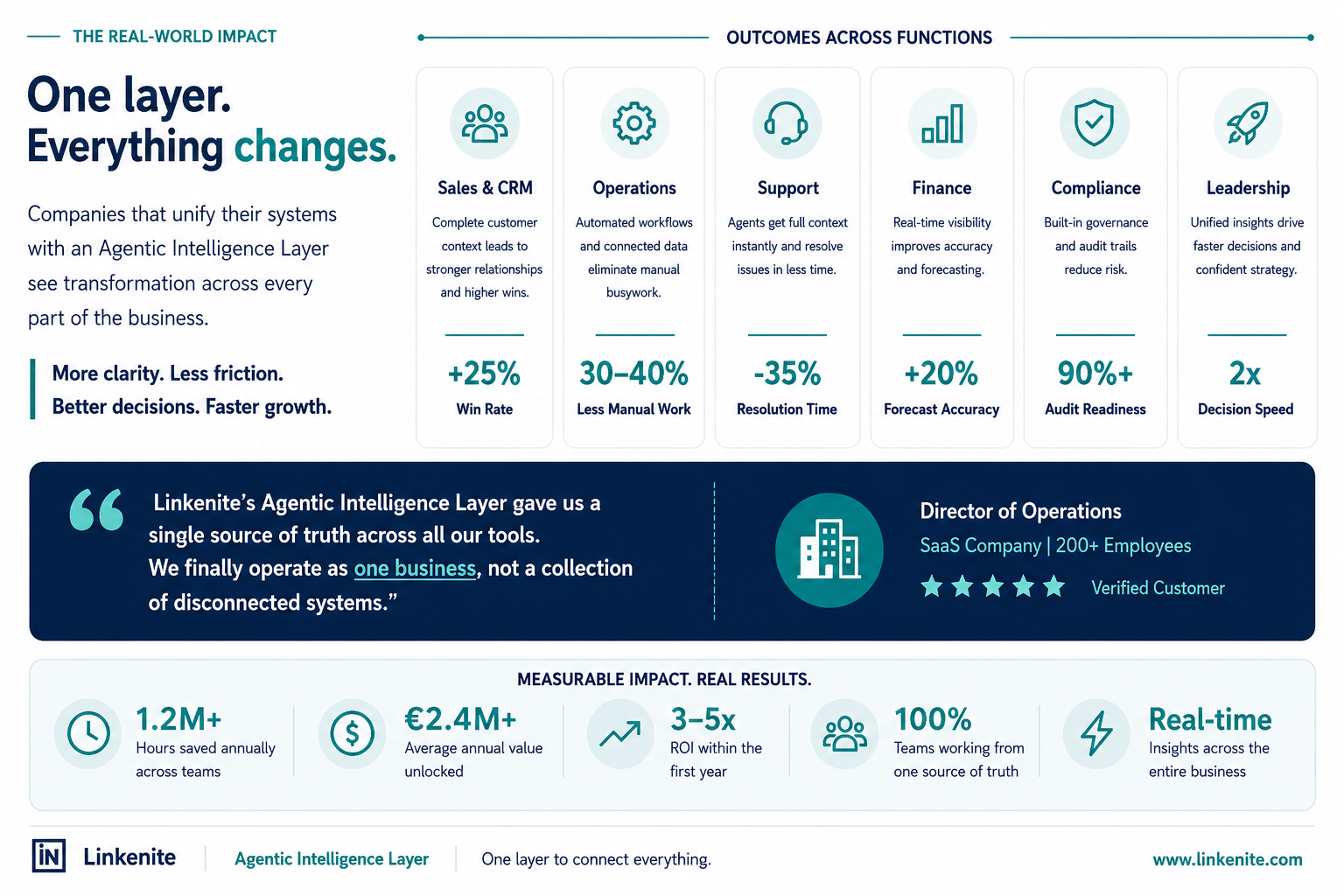
Because when every department, every workflow and every AI agent operates from the same source of truth, decisions become faster, collaboration becomes easier and growth no longer depends on adding more people or more software.
The future of enterprise AI isn’t another application.
It’s intelligent orchestration.
See what your business looks like when everything works together
Every company has a different software stack, different workflows and different operational challenges. That’s why there isn’t a one-size-fits-all implementation.
In a 30-minute walkthrough, we’ll map your current technology stack, identify overlapping tools, explore where orchestration can reduce complexity and show how an Agentic Intelligence Layer can connect the systems you already use.
Whether you decide to work with Linkenite or not, you’ll leave with a clearer understanding of where your operational complexity comes from and what your next steps could look like.
Book your 30-minute walkthrough and discover what happens when your business runs as one connected system, not a collection of disconnected tools.


.png)
.png)
.png)
.png)
.png)
.png)
.png)
.png)
.png)
.png)
.png)
.png)

.png)
.png)
.png)
.png)


.png)
.png)

.png)


.jpg)

.jpg)
.jpg)


.png)


.png)

.png)
.png)
.png)


.png)
%20(2).png)
.png)
.png)




.png)

.png)


.png)


.png)


.png)


%20BLOG%20BANNER.png)


.png)