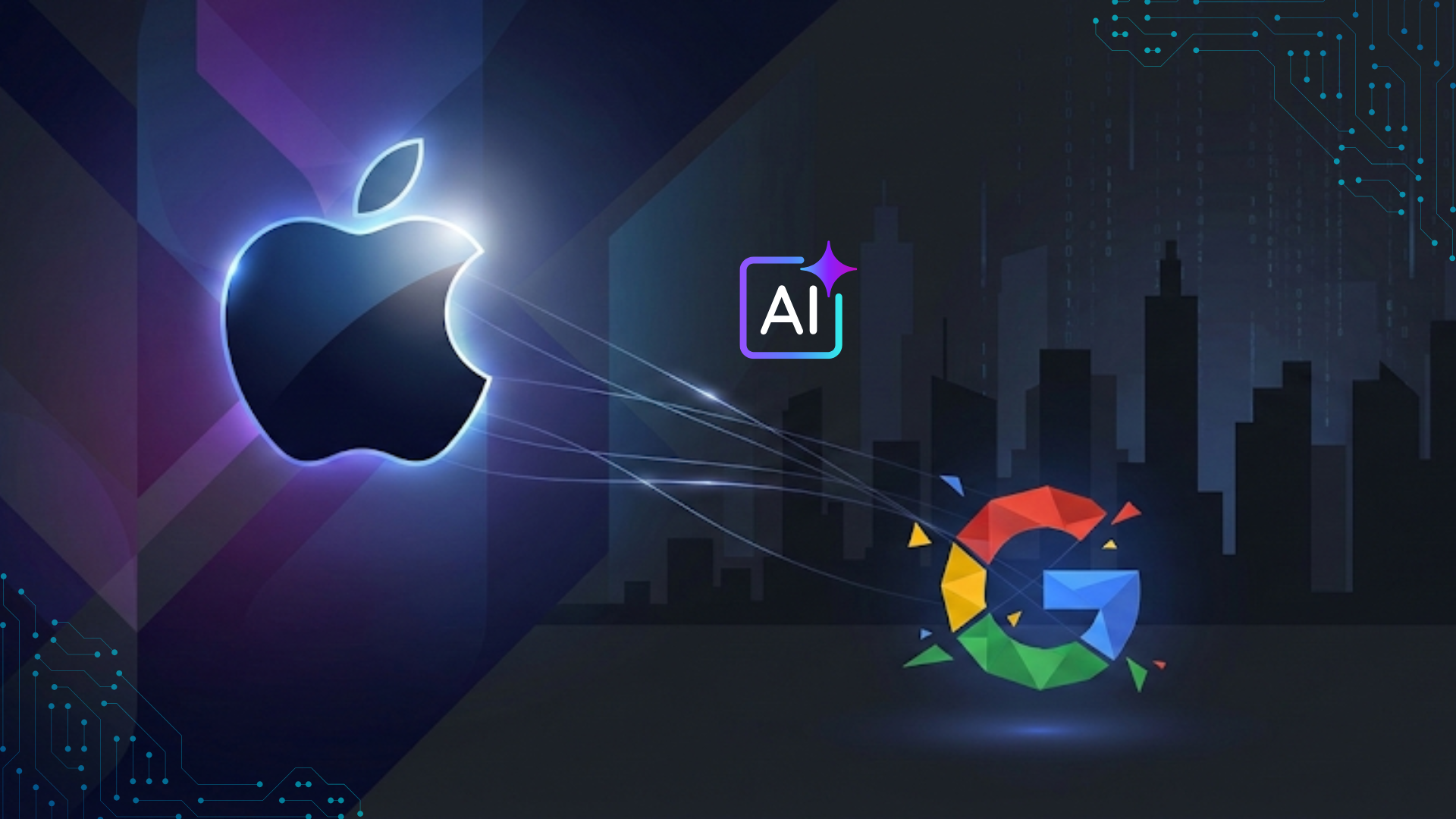
Something big shifted at Apple in late 2025. Not a product launch. Not a flashy keynote. It was a single hire — and it told us more about where the company is headed than a dozen keynote slides ever could.
When Apple publicly announced that Amar Subramanya — a 16-year Google veteran who led the engineering behind Gemini, and who had most recently held the title of Corporate Vice President of AI at Microsoft — was joining as their new VP of AI, the tech world sat up and paid attention. This wasn't a quiet backfill. This was Apple planting a flag.
And it came at the exact moment Apple needed it most. After a year of delayed Siri upgrades, embarrassing AI-generated notification blunders, and an internal team some employees had started jokingly calling "AI/MLess," the pressure was on. The hiring of Subramanya wasn't just a talent acquisition. It was a statement: We're serious about this. We're catching up. And we're doing it our way.
The Talent Play That Changed the Game
Let's zoom in on why this particular hire matters so much. Subramanya didn't just work at Google — he was the person who built the engineering backbone for Gemini, arguably the most capable AI system Google has produced. Before his brief stint at Microsoft, he spent nearly two decades in the Google ecosystem shaping the models that now power everything from Search to Android.
At Apple, he now reports to Craig Federighi (the software chief) and oversees three critical domains: Apple Foundation Models, ML research, and AI Safety & Evaluation. That's essentially the entire future of Apple Intelligence under one person's umbrella.
But here's what makes this hiring decision uniquely "Apple." The company doesn't typically announce VP-level hires publicly. They don't do press releases for engineering leaders. The fact that they did for Subramanya signals something deliberate — Apple wanted the market, its investors, and its competitors to know that the old playbook is being rewritten.
"They basically said that this year, don't bother us about AI, and we'll blow you away by what we show next year." — Gene Munster, Deepwater Asset Management
The leadership change went deeper than one hire. John Giannandrea — the former Google executive who had led Apple's AI efforts since 2018 — announced his retirement. His responsibilities were redistributed across COO Sabih Khan, services chief Eddy Cue, and of course, Subramanya. It's a restructure that suggests Apple's AI isn't one team's project anymore. It's becoming the company's central nervous system.
Why On-Device AI Is Apple's Secret Weapon
Now, here's where things get really interesting — and where Apple's strategy diverges sharply from everyone else in the room.
While OpenAI, Google, and Meta are pouring hundreds of billions into data centers and training trillion-parameter cloud models, Apple has been quietly perfecting something different: a roughly 3-billion-parameter language model that runs entirely on your iPhone.
Think about that for a second. No internet connection needed. No data leaving your device. No server latency. Just a capable AI model sitting right there on Apple silicon, ready to go.
☁️ Cloud-Based AI (The Others)
Your queries travel to massive data centers. Faster for heavy tasks, but raises privacy concerns, requires internet, and costs money per API call. Your data lives on someone else's servers.
📱 On-Device AI (Apple's Bet)
The model lives on your phone. Responses are instant, work offline, and your data never leaves your pocket. Smaller model, but optimized with techniques like 2-bit quantization for Apple silicon.
Apple released their Foundation Models framework with iOS 26, and for the first time, third-party developers can tap directly into this on-device LLM with just a few lines of Swift code. Apps are already using it — from biology education tools that generate personalized explanations, to journaling apps that understand your writing context, to task managers that parse natural language into structured to-dos. All without a single byte hitting the cloud.
Is the on-device model as powerful as GPT-4 or Gemini Ultra? No, not yet. But that's not the point. Apple isn't trying to win the benchmark wars. They're trying to win the daily experience war — the one where your phone understands what you need before you finish typing, where your AI assistant works on an airplane, and where your private thoughts stay private.
Here's the key insight most analysts are missing: Apple doesn't need the most powerful model. They need the most useful model. And usefulness, for two billion iPhone users, means speed, privacy, and seamless integration into the apps they already use every day.
The Numbers Behind Apple's AI Pivot
Those numbers paint an interesting picture. While competitors have been burning through cash on data center buildouts — with some investors now openly questioning whether the AI spending "bubble" is sustainable — Apple has maintained fiscal discipline. They've kept over $130 billion in cash reserves, giving them enormous flexibility to make strategic moves exactly when the timing is right.
And that distribution network? Over two billion active devices. That's not a customer base — that's an AI deployment platform unlike anything else in the industry. Every iOS update can instantly deliver new AI capabilities to more people than any standalone app or chatbot ever could.
The Siri Question: 2026 Is Make-or-Break
Let's address the elephant in the room. Siri. The voice assistant that's been the punchline of tech jokes for years. The one Apple promised to overhaul in 2024, delayed to 2025, and then pushed to 2026.
It's been frustrating, there's no sugarcoating it. While ChatGPT, Claude, and Gemini have been having flowing, intelligent conversations with users, Siri has been... well, still misunderstanding your restaurant reservations.
But 2026 is shaping up differently. Here's what we know is coming:
The Google Gemini partnership is fascinating. Apple — a company that prides itself on vertical integration — is effectively admitting that it needs help. And not from just anyone, but from its oldest rival in mobile. A custom Gemini model will handle complex queries through Apple's Private Cloud Compute infrastructure, while the on-device Apple model handles everything else. It's a hybrid approach that plays to both companies' strengths.
Does it feel like a concession? Maybe. But it might also be the smartest move Apple has made in the AI era. Instead of rushing out a mediocre in-house model to compete on benchmarks, they're using Google's best technology as a bridge while their own models catch up — all while ensuring user data stays protected through Private Cloud Compute's secure architecture.
The Privacy Advantage Nobody's Talking About
Here's something that gets lost in the horse-race coverage of AI: regular people are starting to care deeply about where their data goes.
Every time you ask ChatGPT a sensitive question, that query hits a server. Every time you use Google's AI features, it feeds into an ecosystem built on advertising. Apple's pitch is fundamentally different: your AI interaction stays on your device. Full stop.
Their Foundation Models tech report makes this explicit — Apple does not use private personal data or user interactions to train their foundation models. The on-device model processes your requests locally. When something does need cloud power (through Private Cloud Compute), the data is processed on Apple silicon servers with a hardened OS that even Apple's own employees cannot access. Independent security researchers can verify these privacy claims.
The Privacy-AI Trade-off Is a Myth
Apple is betting that you don't have to choose between smart AI and private AI. Their Foundation Models framework gives developers free, offline AI inference with zero data collection. It's not just a feature — it's a philosophical statement about how AI should work in a world that's increasingly skeptical of tech companies' data practices.
This positioning could prove prescient. As regulatory scrutiny intensifies globally — from the EU's AI Act to increasing data protection legislation — companies that built their AI on massive data collection may find themselves on the defensive. Apple, having built privacy into the architecture from day one, won't have that problem.
What This Means for the AI Landscape
Zoom out for a moment and consider the competitive landscape heading into 2026.
OpenAI is building a hardware device with Jony Ive (ironically, Apple's former design chief) that it hopes will rival the iPhone. Google is embedding Gemini into everything from Search to Android to Workspace. Meta is open-sourcing its models and building an AI ecosystem around social interaction. Microsoft has woven Copilot into every corner of the enterprise.
Apple's play is different from all of them. They're not trying to build the biggest model or the most autonomous agent. They're trying to make AI disappear into the device experience — so natural, so integrated, so private that you barely notice it's there.
Think about it this way: Apple didn't invent the MP3 player, the smartphone, or the tablet. They entered each category late and redefined it by obsessing over the experience rather than the specifications. There's a reasonable case to be made that they're running the same playbook with AI.
The Risks Are Real
Of course, this could also go wrong. The Siri delays have eroded trust. The embarrassing AI-generated notification summaries — like the one that falsely reported someone had shot themselves — damaged Apple's reputation for polish. There's a real talent war happening, and despite the Subramanya hire, reports suggest Apple has lost AI researchers to OpenAI, Google, and Meta over the past year.
And there's a deeper strategic question: if LLMs do become commoditized (as some Apple leaders apparently believe), then the value shifts entirely to the platform and distribution layer. That's great news for Apple. But if frontier model capabilities continue to matter — if the quality gap between a 3-billion-parameter on-device model and a trillion-parameter cloud model stays meaningful — then Apple could find itself permanently playing catch-up on the intelligence side.
One analyst called 2026 a "make-or-break year" for Apple's AI credibility. That might be slightly dramatic, given Apple's hardware dominance and loyal customer base. But it's not far off. The window for Apple to prove it can deliver a genuinely competitive AI experience is narrowing.
The Bottom Line
Apple's AI story in 2026 isn't the simple "behind and catching up" narrative that gets clicks. It's more nuanced than that. Yes, they're late. Yes, they've stumbled. But they're also sitting on a distribution platform no AI company can match, a privacy architecture that's becoming a competitive moat, over $130 billion in dry powder, and now — with Subramanya — a leader who knows exactly how Google and Microsoft's AI machines work from the inside.
The next six months will tell us a lot. Will the revamped Siri actually deliver? Will the Google Gemini partnership feel seamless or like a band-aid? Will Apple's on-device models evolve fast enough to keep pace with cloud-first competitors?
One thing is clear: Apple isn't sitting this one out. They've reshuffled leadership, partnered with their biggest rival, opened their models to developers, and hired someone who can speak Google's and Microsoft's language fluently. Whether that's enough to win the AI era — or just survive it — is the trillion-dollar question.
And honestly? After watching Apple be counted out in music, phones, watches, and tablets, I wouldn't count them out here either.
What's Your Take?
Can Apple's privacy-first, on-device approach beat the cloud giants? Or are they simply too far behind? The AI race is just getting interesting.


.png)
.png)
.png)
.png)
.png)
.png)
.png)
.png)
.png)
.png)
.png)
.png)

.png)
.png)
.png)
.png)


.png)
.png)

.png)


.jpg)

.jpg)
.jpg)


.png)


.png)

.png)
.png)
.png)


.png)
%20(2).png)
.png)
.png)



.png)

.png)


.png)


.png)


.png)


%20BLOG%20BANNER.png)


.png)