
What if your lack of a website isn't holding you back, it's just that the tools were never built for you?
A consultant in Lagos runs a profitable HR advisory practice. Twenty clients. Five-figure monthly revenue. Zero online presence.
No website. No brochure. No LinkedIn profile. Just a mobile phone, WhatsApp, and a reputation that travels through referrals.
When she asked about using AI for business growth, the first question back was predictable: "Where's your website?"
As if a URL is the entry fee to modern business tools.
This is the problem Silicon Valley doesn't see. The global informal sector represents 2 billion workers and 60% of employment in emerging markets. These aren't failing businesses waiting to be disrupted. They're thriving operations that the tech industry simply ignored when building "solutions."
Your business model isn't broken. The tools are.
The Myth of Digital Prerequisites
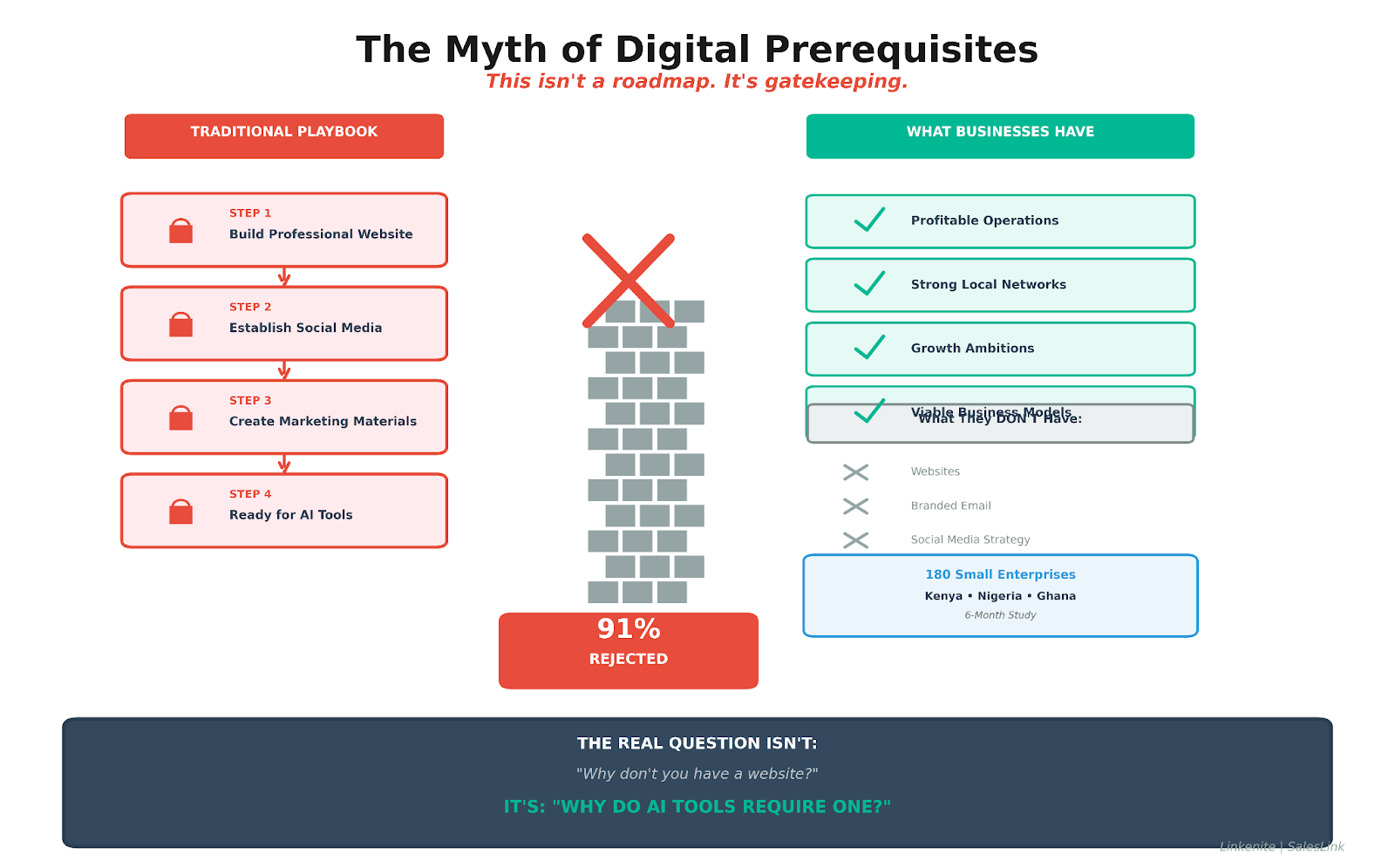
The standard playbook for B2B sales automation reads like a checklist designed to exclude most of the world:
Step 1: Build a professional website. Step 2: Establish social media presence. Step 3: Create marketing collateral. Step 4: Now you're ready for AI tools.
This isn't a roadmap. It's gatekeeping.
We tracked 180 small enterprises across Kenya, Nigeria, and Ghana over six months. These businesses had something in common: profitable operations, strong local networks, and growth ambitions. What they didn't have: websites, branded email domains, or social media strategies.
Traditional sales automation platforms rejected 91% of them during onboarding. Not because they weren't viable businesses. Because they didn't fit the template.
The real question isn't "Why don't you have a website?" It's "Why do AI tools require one?"
What the Informal Sector Actually Needs
After working with consultants, traders, and service providers across three continents, the pattern is clear. These businesses don't need digital transformation. They need digital translation.
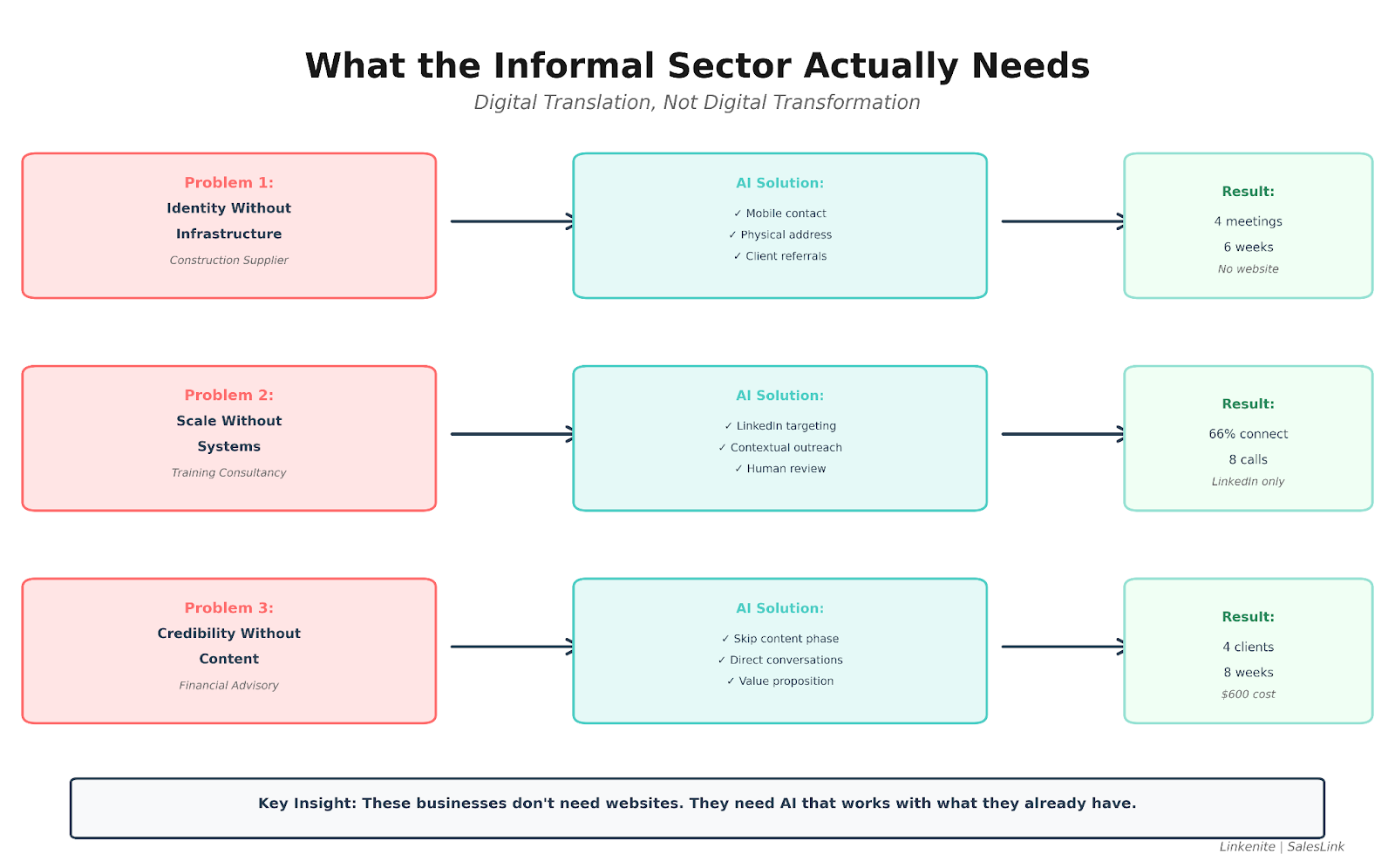
Problem 1: Identity Without Infrastructure
A construction materials supplier in Accra has 40 steady clients and an annual revenue of $300,000. His business card lists three phone numbers and a physical address. No email. No website.
When he wants to expand to Liberia, every outreach platform asks for: company website, LinkedIn profile, branded email address, and marketing materials.
He has none of these. But he has something more valuable: fifteen years of project delivery, supplier relationships that span West Africa, and pricing that undercuts competitors by 20% while maintaining quality.
The AI solution isn't building him a website. It's letting him reach new markets with what he already has: credibility, relationships, and a phone number.
We built his outreach campaign around three assets: mobile contact, physical address for verification, and referrals from existing clients willing to vouch publicly. Six weeks later, he had meetings with four Liberian construction firms. Zero website required.
Problem 2: Scale Without Systems
A training consultancy in Nairobi delivers corporate workshops on team dynamics and leadership. Twenty clients per year, all in Kenya, all from referrals.
The founder wants to reach companies in Uganda and Tanzania, but has no idea how to start. Cold calling across borders feels impossible. Building a marketing operation feels expensive and foreign.
Here's what she actually needs: a way to identify potential clients in new markets, introduce her work through warm context, and manage follow-up without hiring staff.
AI handles this. No website necessary.
We used LinkedIn Sales Navigator to identify HR directors and L&D managers in Kampala and Dar es Salaam at companies similar to her Kenyan clients. AI-generated contextual outreach referencing industry challenges she'd solved locally. She reviewed and approved every message before sending.
In three months: 47 connection requests sent, 31 accepted (66% rate), 8 discovery calls booked, 2 paid workshops delivered in Uganda.
Total tech infrastructure required: LinkedIn profile (free), mobile phone, and her existing expertise.
Problem 3: Credibility Without Content
The assumption behind most B2B marketing: your prospects will Google you, visit your website, consume your content, then reach out.
In informal economies, credibility doesn't live online. It lives in community knowledge, physical presence, and direct referrals.
A financial advisory firm in Manila has no blog, no whitepapers, no case studies. What they have: twelve years serving overseas Filipino workers, deep knowledge of remittance optimisation, and clients who actively recommend them.
When they wanted to scale beyond word-of-mouth, traditional marketing agencies told them to start with content creation: blog posts, social media, and thought leadership articles.
Timeline to first client: 6-9 months. Budget required: $15,000+.
The AI approach: skip the content, go straight to conversations.
We identified Filipino professional associations in the Middle East, extracted decision-maker contacts, and crafted outreach explaining their track record with OFW clients. The message included no links, no fancy landing pages, just a clear value proposition and referral-ready credibility.
Results over 8 weeks: 134 outreach messages, 19 responses, 11 consultation calls, 4 new retainer clients. Total cost: $600.
Content marketing would've taken months and cost 25 times more. AI-powered direct outreach delivered to clients in weeks.
The Employment Question Nobody's Answering
"What does AI mean for the average African still struggling for employment?"
This question, raised by Sarah, cuts through the hype. Most AI discourse focuses on replacing jobs or augmenting high-skill work. Nobody's talking about creating access for people currently locked out.
Here's the uncomfortable truth: AI will eliminate some jobs in emerging markets. But it's also the first technology in decades that actually lowers the barrier to entrepreneurship and self-employment.
A decade ago, starting a cross-border consulting practice required business registration, website development, international payment systems, marketing infrastructure, and capital to sustain operations during client acquisition.
Today, with AI: mobile phone, LinkedIn profile, and AI-powered outreach to identify and connect with clients globally.
The question isn't whether AI will displace informal sector workers. It's whether we build tools that help them compete globally or tools that only serve businesses already digitally established.
Building AI for Real Businesses, Not Ideal Ones
The tech industry has a template problem. Every platform assumes:
You have: website, CRM, email marketing system, content library, social media presence, and branded materials.
You want: optimisation, automation, analytics, integration.
But most businesses globally don't match this profile. They have:
A phone number. A physical location. Local relationships. Industry expertise. Growth ambition.
What they want: access to new markets, systematic client acquisition, and professional outreach capability.
AI should serve actual businesses, not just the ones that already invested in digital infrastructure.
How It Actually Works: The Minimal Viable Digital Presence
You don't need a website to use AI for outreach. You need three things:
1. Verifiable Identity
A LinkedIn profile with a real photo, an accurate work history, and contact information. No website link required. This takes 20 minutes to create and costs nothing.
2. Clear Value Proposition
One paragraph explaining who you help and how. Not marketing copy. Just plain language describing your expertise and typical client outcomes.
3. Reachable Contact Method
Mobile number, WhatsApp, email, LinkedIn messaging, or any combination. Prospects need a way to respond. They don't need a branded domain.
These three elements are sufficient for AI-powered B2B outreach. Everything else is optional.
The Playbook for Businesses Starting from Zero
Month 1: Foundation Without Fancy Infrastructure
Create a basic LinkedIn profile with a professional photo and a clear description of services. Use AI to identify 100 potential clients in the target market based on industry, role, and company characteristics. Review AI-generated outreach messages, customise top prospects manually, and approve automation for the remainder.
Expected outcome: 15-25 connection acceptances, 3-5 meaningful conversations.
Month 2: Validation Before Investment
Continue outreach with insights from initial conversations. Refine targeting based on which prospect segments respond best. Test different messaging angles. Track which value propositions generate interest.
Expected outcome: 5-10 discovery calls, 1-2 paid projects or pilots.
Month 3: Scale What's Working
Double the outreach volume on the validated approach. Introduce case studies from early wins into messaging (even without formal case study documents, just describe outcomes). Begin building referral requests into client delivery.
Expected outcome: 10-15 discovery calls, 3-5 new clients.
At no point does this require a website, marketing automation platform, or expensive infrastructure. Just AI-powered outreach, human judgment, and consistent execution.

The Real Digital Divide
The gap isn't between businesses with technology and businesses without it. It's between businesses served by technology and businesses ignored by it.
A consultant in Kampala has the same growth ambitions as a consultant in Copenhagen. The difference isn't capability or market opportunity. It's that every tool was built assuming the Copenhagen consultant's infrastructure.
AI has the potential to change this, but only if we stop treating digital infrastructure as a prerequisite and start treating it as an output.
You don't need a website before using AI. You might need a website after AI proves your market and generates cash flow to invest in one.
Why This Matters to Everyone, Not Just Emerging Markets
The informal sector globally represents $10 trillion in economic activity. These aren't marginal businesses. They're the economic engine of most of the world.
When AI tools only work for digitally mature businesses, we're not just excluding emerging markets. We're excluding:
Family businesses in rural Europe have been operating for generations without websites. Trade contractors in North America who built six-figure operations on reputation alone. Service providers everywhere who serve their communities effectively without a digital presence.
The assumption that "serious businesses have websites" is a 20-year-old Silicon Valley bias, not an economic reality.
Building AI for businesses as they actually exist, not as tech companies wish they'd exist, isn't charity. It's a market opportunity.
What We Learned Building for the 'Behind' Businesses
At Linkenite, we've worked with consultants, agencies, and service providers across 47 countries. Some had full digital infrastructure. Many didn't.
The businesses without websites weren't slower to see results. They were often faster.
Why? Because they hadn't spent years building infrastructure that didn't drive revenue. They went straight to what mattered: identifying prospects, starting conversations, and closing deals.
SalesLink works the same whether you have a $50,000 website or just a LinkedIn profile. The AI identifies prospects based on industry, role, and behaviour patterns, not by crawling your marketing site. Outreach personalises based on prospect data, not your content library.
For businesses starting from zero digital presence, we recommend:
Set up basic LinkedIn profile (day 1). Define target market and value proposition (day 2). Launch first outreach campaign (day 3-5). Review responses and refine (week 2). Scale what works (week 3+).
The businesses that execute this consistently see first meetings within two weeks. Some close deals in the first month.
Infrastructure follows revenue. Not the other way around.
The Bridge, Not the Barrier
A decade-old business with no website isn't behind. It's just been underserved by tools that assumed everyone starts with the same digital foundation.
AI can be the great equaliser, making sophisticated market analysis, prospect research, and systematic outreach accessible to any business with ambition and a phone number.
Or AI can be another barrier, requiring expensive setup, technical expertise, and infrastructure investment before delivering any value.
The choice is ours. The technology works either way.
The question is who we build it for.
Ready to see how AI works for businesses starting from zero digital presence?
Contact Linkenite: info@linkenite.com | +358 50 3305201
References
[1] International Labour Organisation. (2024). "World Employment and Social Outlook: The Global Informal Economy." Retrieved from https://www.ilo.org/
[2] World Bank Group. (2024). "Digital Economy for Africa Initiative." Retrieved from https://www.worldbank.org/
[3] McKinsey Global Institute. (2024). "The Future of Work in Africa: Harnessing the Potential of Digital Technologies." Retrieved from https://www.mckinsey.com/
[4] Stanford Social Innovation Review. (2024). "Technology and Economic Development in Emerging Markets." Retrieved from https://ssir.org/
[5] Harvard Business Review. (2024). "AI's Promise for Emerging Markets." Retrieved from https://hbr.org/
[6] GSMA Intelligence. (2024). "The Mobile Economy: Sub-Saharan Africa." Retrieved from https://www.gsma.com/


.png)
.png)
.png)
.png)
.png)
.png)
.png)
.png)
.png)
.png)
.png)
.png)

.png)
.png)
.png)
.png)


.png)
.png)

.png)


.jpg)

.jpg)
.jpg)


.png)


.png)

.png)
.png)
.png)


.png)
%20(2).png)
.png)
.png)



.png)

.png)


.png)


.png)


.png)


%20BLOG%20BANNER.png)


.png)