You get LinkedIn lead data without scraping by exporting your own account: LinkedIn's own Download your data tool gives you every 1st-degree connection and your full message history as a file you can keep. That archive is the only LinkedIn lead database you actually have a right to, and for most sellers it is already larger and warmer than anything they would have bought.
Reach is a LinkedIn tool that runs as a Chrome extension inside your own logged-in session, imports that export, and scores the people already in it against your ideal customer profile. No server of ours calls LinkedIn, and nothing is sent until a human approves the exact words.
What happened to the LinkedIn scraping business in 2026?
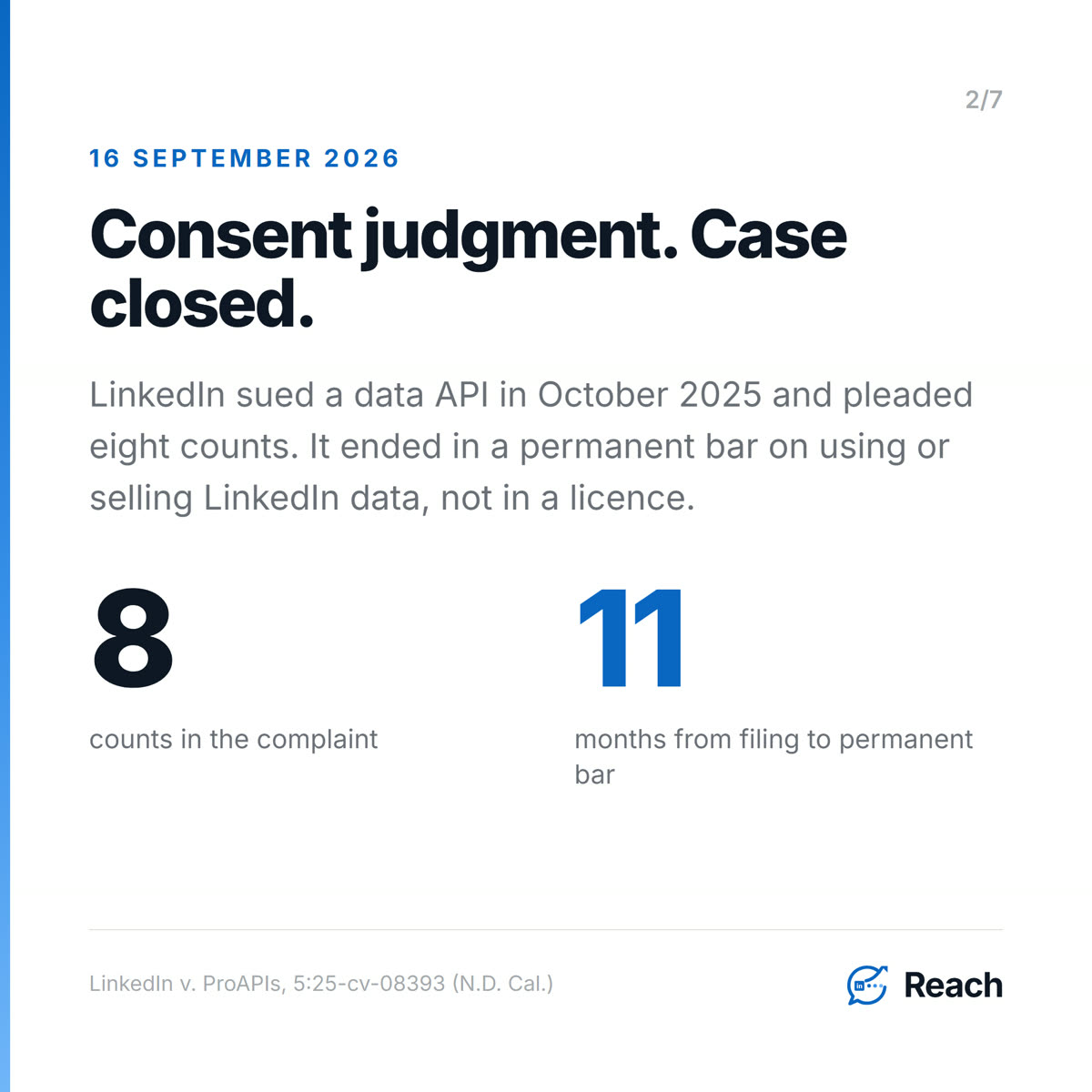
The court closed one of the larger ones this week. On 16 September 2026 a consent judgment was entered in LinkedIn Corporation v. ProAPIs Inc., case 5:25-cv-08393 in the Northern District of California, and the case was terminated the same day. Bloomberg Law reported it on 17 September: ProAPIs and its employees were "banned from accessing the website's data through fake accounts, bots or other automated technologies and from selling the company's data."
Look at what LinkedIn actually pleaded when it filed in October 2025. Breach of contract. Fraud and deceit. The Computer Fraud and Abuse Act. California's Comprehensive Data Access and Fraud Act. Unfair business practices. The Lanham Act. Misappropriation. Trespass to chattels. Eight counts against a data API and its founder, and it ended in a permanent bar rather than a licence deal.
That is the doorway. The point is not that one company lost. The point is what it does to anyone building a pipeline on bought profile data, because the vendor can disappear between one quarter and the next and take your lead source with it.
Is scraping LinkedIn legal?
We are not lawyers, so treat this as the practical version. Separate from any question of law, scraping LinkedIn breaks the contract you personally agreed to when you made the account. The LinkedIn User Agreement, effective 3 November 2025, says in its Dos and Don'ts that you will not:
"Develop, support or use software, devices, scripts, robots or any other means or processes (such as crawlers, browser plugins and add-ons or any other technology) to scrape or copy the Services"
And, in the same section:
"Copy, use, display or distribute any information (including content) obtained from the Services, whether directly or through third parties (such as search tools or data aggregators or brokers), without the consent of the content owner"
Read that second clause slowly, because it is the one that catches buyers rather than builders. Buying a list from a data broker who scraped it puts you inside the same sentence as the broker. You did not run the crawler and you are still using information obtained from the Services through a third party.
Where do you get LinkedIn lead data without scraping?
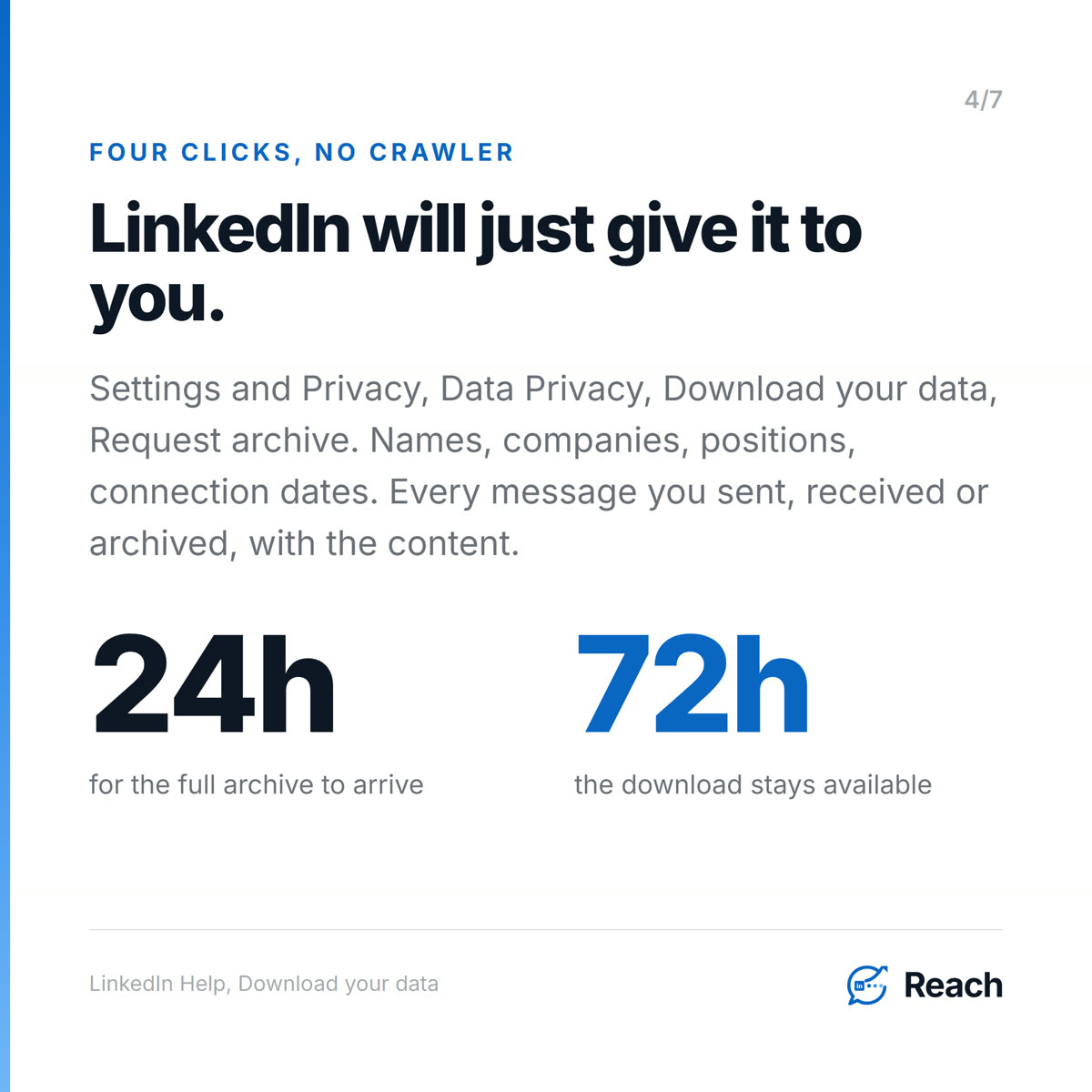
From the account you already own. LinkedIn gives every member a Download your data tool, and it is the boring, entirely permitted route that most sellers have never opened. The help page lists what comes out. The connections file "contains the first and last name, public profile URL, email address, company, position, and connection date for all 1st degree connections." The messages file "contains information related to messages sent, received, and archived. Messages include the date it was sent or received, subject line, content, and the member's public profile URL."
A specific request arrives "within minutes." A larger archive lands "within 24 hours." You click Me, then Settings & Privacy, then Data Privacy, then Download your data, then Request archive.
Nobody scraped anything. Those are your connections and your conversations, handed over by the platform to the person they belong to.
What is actually inside your LinkedIn data export?
More than a list of names, and that is the part people miss. The message history is the asset.
Our own account is the example we can check. Reach reports 18,750 outbound messages in this account's history, and Reach itself sent 180 of them. The other 18,570 were typed by hand, over years, before any tool touched the account. No broker sells that. A scraped record tells you a stranger's job title. Your own archive tells you that you and this person spoke in 2023, what you offered, what they said back, and that they went quiet in March.
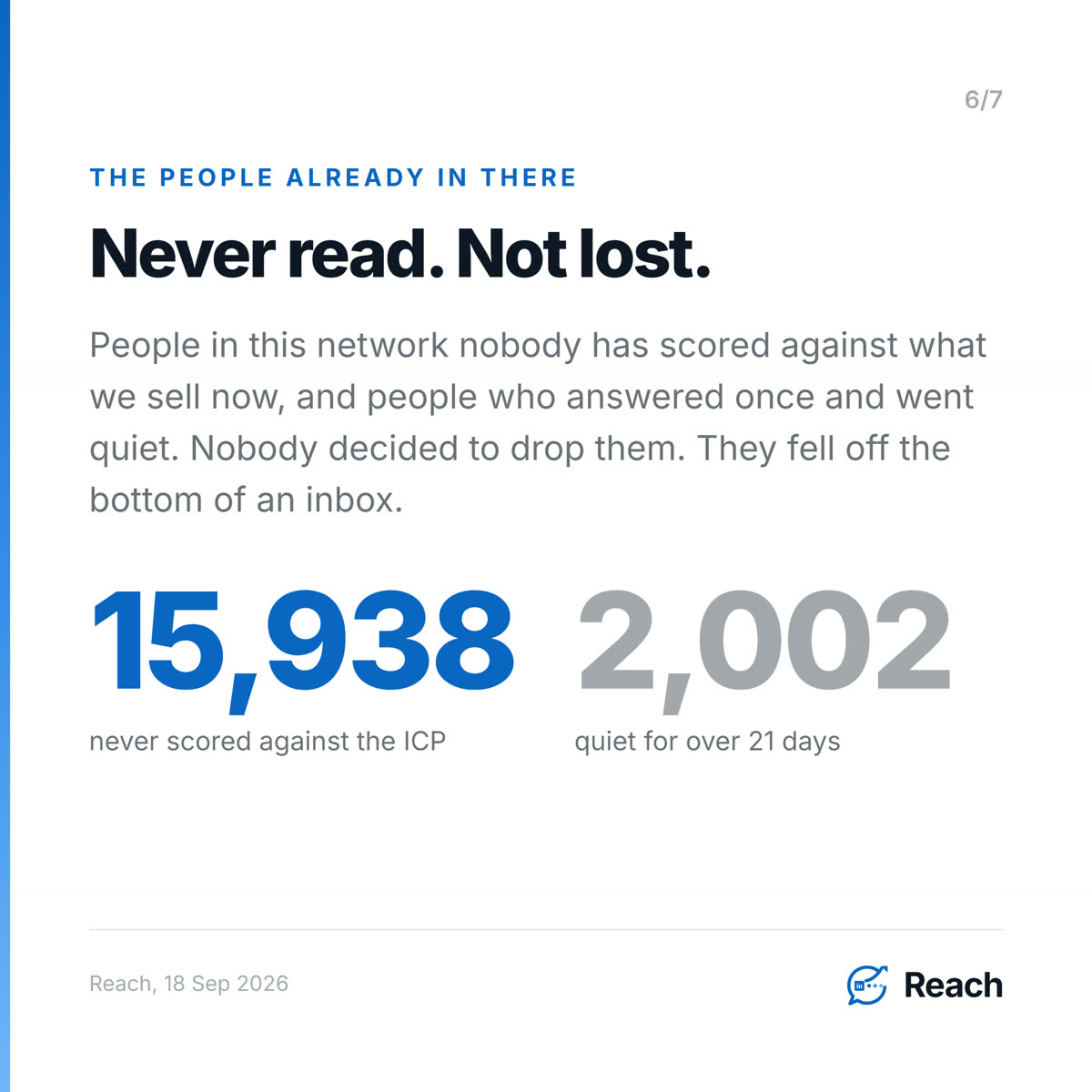
The same account carries 15,938 people who have never been looked at against a current ideal customer profile, and 2,002 who engaged at some point and have been silent for more than 21 days. Nobody decided to drop those. They just fell off the bottom of an inbox.
How Reach turns that export into lead data
Import the archive, and then the work is reading rather than acquiring. Reach ingests the connections and the message history, resolves people to one record per human across both files, and scores each one against a target audience and product you write down. You get a shortlist out of your own network, with the reason attached, and the prior conversation sitting next to the name.
Sending stays deliberately narrow. The extension runs in your browser on your session, so the server never holds your LinkedIn credentials. Weekly limits are enforced on the server side and the agent cannot raise them. A reply stops the follow-up sequence for that person. A human approves the exact text before anything goes out, and the approval binds to those words.
You can see the mechanism at reach.linkenite.com. The step before this one, scoring a network you have already imported, is written up in find leads in your existing LinkedIn network, and the CRM-shaped version of the same import is in turn LinkedIn connections into a CRM.
What this does not fix
Your export only covers people you are already connected to. If your ideal customer is a stranger in a market you have never sold into, this gives you nothing, and you will need a different motion.
The export is also a snapshot. It is accurate the day you download it and it ages like everything else, so you re-export or you sync.
And using member-owned data does not make your account untouchable. LinkedIn's terms restrict automated access and automated messaging as a separate matter from where your data came from, and no tool can promise you will never be restricted. Anyone who tells you otherwise is selling you the thing the court just shut down.
Common questions
Is it against LinkedIn's terms to download my own data?
No. LinkedIn provides the Download your data tool in Settings and Privacy for exactly this purpose, and the archive contains your own connections and your own messages. The clauses quoted above are about scraping the Services and about redistributing other people's information obtained through brokers.
Can I buy LinkedIn lead data instead?
You can, and the LinkedIn v. ProAPIs consent judgment of 16 September 2026 is a reasonable reason to think twice. Beyond the risk to the vendor, LinkedIn's User Agreement covers information obtained "through third parties (such as search tools or data aggregators or brokers)," so buying does not put you outside the clause.
How long does a LinkedIn data export take?
LinkedIn's help page says specific data requests are sent "within minutes" and larger downloads arrive "within 24 hours." The download stays available for 72 hours, so save the file when it lands.
Does my export include old conversations?
Yes. The messages file covers messages sent, received and archived, with the date, subject line and content. For most sellers this is the richest part of the archive and the reason the export beats a bought list.
Will importing my network get my LinkedIn account restricted?
Importing an archive is a file upload and does not touch LinkedIn at all. Sending is the part that carries risk, and it is why Reach paces sends under server-side weekly caps, stops a sequence the moment someone replies, and holds every message for a human to approve.
Reach is at reach.linkenite.com.
Sources
Every source below was opened and read this run, on 18 September 2026.
Trend, primary court record
LinkedIn Corporation v. ProAPIs Inc., No. 5:25-cv-08393, United States District Court for the Northern District of California. Docket read on CourtListener.
- Date filed: 2 October 2025. Assigned to Judge P. Casey Pitts.
- Docket entry 1, complaint, verbatim: "(1) BREACH OF CONTRACT; (2) FRAUD AND DECEIT (CAL. CIV. CODE §§ 1572, 1710); (3) BREACH OF THE COMPUTER FRAUD AND ABUSE ACT, 18 U.S.C. § 1030; (4) BREACH OF THE CALIFORNIA COMPREHENSIVE DATA ACCESS AND FRAUD ACT (CAL. PENAL CODE § 502); (5) UNLAWFUL, UNFAIR OR FRAUDULENT BUSINESS PRACTICES (CAL. BUS. & PROF. CODE § 17200 ET SEQ.); (6) VIOLATION OF THE LANHAM ACT, 15 U.S.C. § 1125(C); (7) MISAPPROPRIATION; (8) TRESPASS TO CHATTELS"
- Docket entry 36, 16 September 2026: "Judgment - Consent". The docket records "Terminate Civil Case" on the same date.
- <https://www.courtlistener.com/docket/71527603/linkedin-corporation-v-proapis-inc/>
Trend, news report
Bloomberg Law, "Startup Banned From Using LinkedIn Data in Scraping Lawsuit", published 17 September 2026. Verbatim: "ProAPIs and its employees were banned from accessing the website's data through fake accounts, bots or other automated technologies and from selling the company's data."
- <https://news.bloomberglaw.com/artificial-intelligence/startup-banned-from-using-linkedin-data-in-scraping-lawsuit>
The contract
LinkedIn User Agreement, effective 3 November 2025, section 8.2, Dos and Don'ts.
- Clause 2, verbatim: "Develop, support or use software, devices, scripts, robots or any other means or processes (such as crawlers, browser plugins and add-ons or any other technology) to scrape or copy the Services"
- Clause 4, verbatim: "Copy, use, display or distribute any information (including content) obtained from the Services, whether directly or through third parties (such as search tools or data aggregators or brokers), without the consent of the content owner"
- <https://www.linkedin.com/legal/user-agreement>
The permitted route
LinkedIn Help, "Download your data".
- Connections file, verbatim: "Contains the first and last name, public profile URL, email address, company, position, and connection date for all 1st degree connections."
- Messages file, verbatim: "Contains information related to messages sent, received, and archived. Messages include the date it was sent or received, subject line, content, and the member's public profile URL."
- Timing, verbatim: specific data requests are sent "within minutes", larger downloads arrive "within 24 hours", and the download remains available for "72 hours".
- Steps, verbatim: "Click the Me icon at the top of your LinkedIn homepage." then "Select Settings & Privacy from the dropdown." then "Click the Data Privacy on the left rail." then "Under the How LinkedIn uses your data section, click Download your data." then "Select the data that you're looking for and Request archive."
- <https://www.linkedin.com/help/linkedin/answer/a1339364>
First-party
Reach account data for pravin@linkenite.com, read 18 September 2026 via get_account_state and get_results.
- Results caveat, verbatim: "Reach sent 180 of 18750 outbound messages in this history — the rest were sent by hand on LinkedIn."
conflicts.untriagedPeople: 15,938.- Account note, verbatim: "2002 engaged leads have gone quiet for over 21 days and have no draft waiting; they can be re-approached with send_or_propose."
Feature
Network import and sync, company-level canonical people, and lead qualification against versioned target audiences and products, all listed under "Working product" in docs/STATE-OF-THE-SYSTEM.md. Send-side constraints named in the piece (browser-local extension worker, server-side weekly caps, reply auto-pause, human approval bound to the approved text) are from the same file's deliberate decisions and safety invariants.


.png)
.png)
.png)
.png)
.png)
.png)
.png)
.png)
.png)
.png)
.png)
.png)

.png)
.png)
.png)
.png)


.png)
.png)

.png)


.jpg)

.jpg)
.jpg)


.png)


.png)

.png)
.png)
.png)


.png)
%20(2).png)
.png)
.png)



.png)

.png)


.png)


.png)


.png)


%20BLOG%20BANNER.png)


.png)