
An AI sales agent with a human in the loop does the preparation - account research, list building, first drafts and follow-up timing - while a person approves each message before it goes out and takes over once someone replies. That is where sales teams are landing in 2026, and on LinkedIn it is also the safer way to run outreach.
Reach is a LinkedIn tool that runs in your own browser, on the network you already have. Its AI agent prepares the outreach, and a human approves it before anything is sent.
Which sales tasks are AI agents taking over in 2026?
The preparation work. On 8 September 2026 Apollo published a breakdown of nine sales tasks agents now handle, and Stacker syndicated it to news sites a few days later. The nine are account research, list building, first-touch drafting, CRM logging, scheduling, transcription, signal monitoring, follow-up timing and pipeline hygiene. Almost every item on that list happens around a conversation, and none of them is the conversation itself.
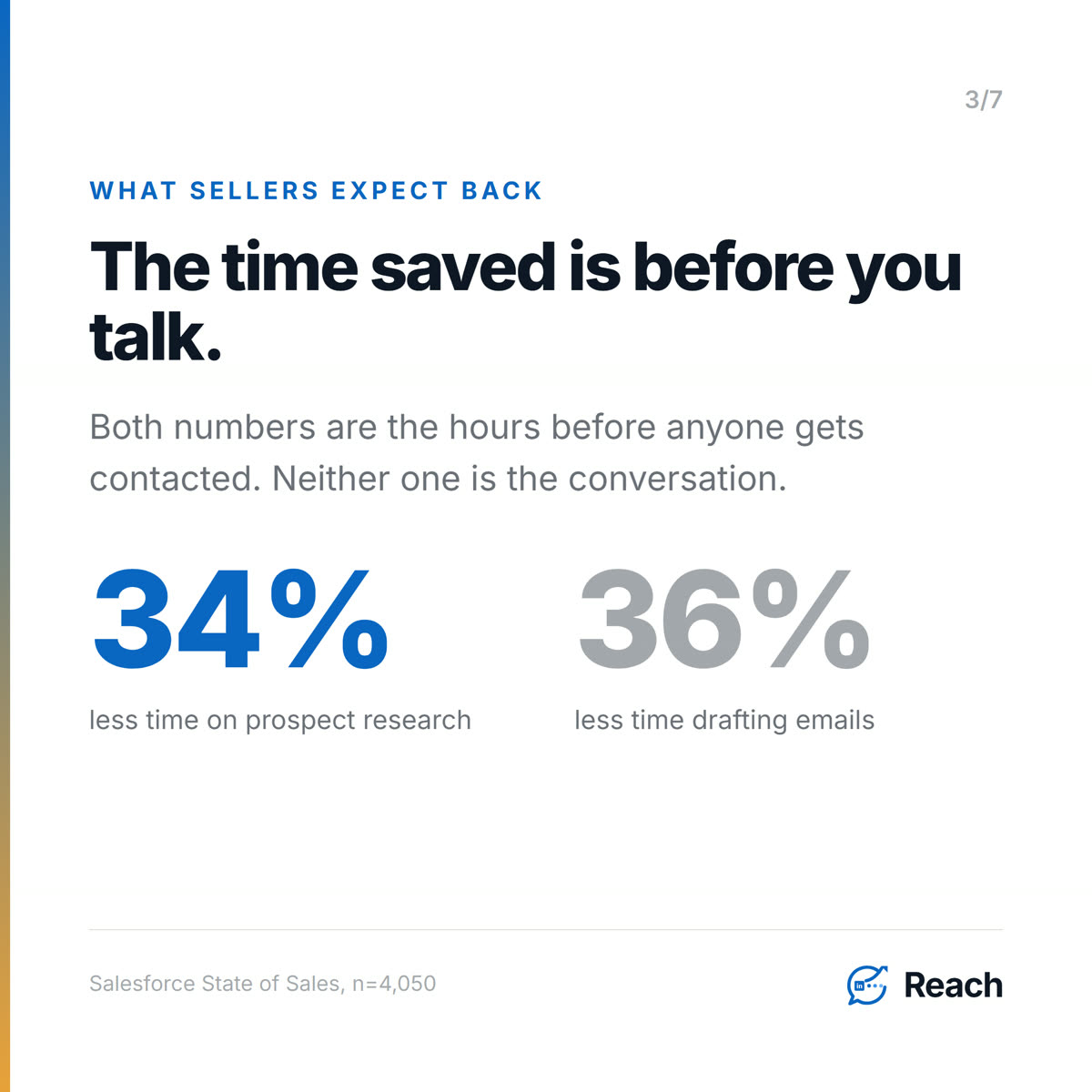
The survey data underneath points the same way. Salesforce's State of Sales report, a double-anonymous survey of 4,050 sales professionals in 22 countries, found that 54% of sellers have already used agents and nearly 9 in 10 plan to by 2027. Once agents are fully implemented, sellers expect them to cut prospect research time by 34% and email drafting by 36%.
Read those two numbers carefully. Research and drafting are the hours before you contact anyone, and neither figure says anything about the relationship itself.
What should stay human when you use an AI sales agent?
Deciding who deserves your time, and anything that happens live. Apollo's list of tasks humans still own has four items: live negotiation, relationship work across the several people in a buying group, reading a room, and deciding which deals deserve human time. Its line on that last one is the cleanest summary of the whole debate: "Knowing when and where to spend human time should always stay with reps and managers."
We watched this play out in our own account this week. A teammate ran a campaign to C-level executives who were already connected to us. Of 108 messages sent, 17 people replied, around 16%. Most of those replies were a polite thanks. Two people asked to hear more about the product and the services behind it.
A reply classifier can sort that pile in seconds. What to do with the two was still a judgement call. The call was to ask each of them one more question first, and send a meeting link only if the interest held. An agent optimised to book meetings would have sent the link straight away, and quite possibly to the polite-thanks replies too. That is the exact failure people mean when they say AI outreach feels like spam.
Should an AI sales agent send LinkedIn messages without approval?
For most small teams, no. A LinkedIn message goes out under your own name, to people who can see your photo and your job history, and many of them are one introduction away from someone you know. A bad cold email lands in a spam folder and is forgotten. A bad LinkedIn message gets remembered by a person you spent years getting to know.
There is a platform reason as well. LinkedIn is the account you sell from, and it restricts accounts it suspects of automated activity. No tool makes a restriction impossible. What keeps the risk low is pacing under a limit and sending to people who are likely to answer, at a volume a person can actually read and stand behind. We covered the pacing side in how many LinkedIn connection requests per day is safe.
The case for full autonomy is speed. On a warm network, speed was rarely the bottleneck. Even Salesforce's EVP of Sales, Adam Alfano, described the goal as killing the busywork "so our teams can focus on what actually moves deals forward: building relationships and driving success." Reading a drafted message and pressing approve takes a fraction of the time it took to write it, so the approval step keeps nearly all of the time saved.
How does human-in-the-loop work in Reach?
The agent prepares and the human decides, and the system enforces that split instead of trusting anyone to remember it. In practice:
- The agent reads people in your network, matches them against who you sell to, and drafts personalised messages and LinkedIn posts. Each draft lands in an approval queue, and the owner's screen says it plainly: "Nothing reaches anyone on LinkedIn until you decide on it."
- An approval is bound to the exact text the person was shown. If the draft changes between being shown and being approved, the approval is rejected, and an agent that never showed a person anything has nothing to approve with.
- The agent cannot change the objective the owner set, and it cannot raise the weekly limits. Those caps are enforced on the server, so a confused agent runs into a wall long before it reaches your LinkedIn account.
- When someone replies, automated follow-up to that person stops and the thread is yours.
- All of it runs in your own browser on your own LinkedIn session, so nobody else ever holds your password.
You can see the product at reach.linkenite.com.
Does a human in the loop slow outreach down?
A little, and it is worth it. The honest admission first: approval queues back up. The account running Reach has 13 drafted posts waiting for a decision at the time of writing, because the person approving them also has a company to run. A queue that waits is a much cheaper failure than an agent that sends the wrong thing to hundreds of people who know you.
The second point is about where results come from. In that same account, Reach sent 140 of 18,678 outbound messages in the message history. The rest were sent by hand on LinkedIn. So the value of an agent was never typing more messages. It was finding the right people in a network that already existed and preparing something worth a human's approval. We made the same argument from the drafting side in does personalized LinkedIn outreach at scale still work.
Common questions
What does human in the loop mean for an AI sales agent?
The agent researches and drafts, and a person approves what actually gets sent and handles the conversation once someone responds. So the agent does the preparation and the person keeps the decision.
Which sales tasks can AI agents handle safely?
Preparation work like account research, list building, first drafts, CRM logging and follow-up timing. Salesforce's State of Sales survey found sellers expect agents to cut prospect research time by 34% and email drafting by 36% once fully implemented.
Is it safe to let an AI agent send LinkedIn messages automatically?
It carries real risk. Messages go out under your name to people who know you, and LinkedIn restricts accounts it suspects of automation. Approving each send and pacing under a weekly cap is the safer setup, though no tool can promise an account is never restricted.
Does Reach send messages without my approval?
By default, drafted messages and posts wait in an approval queue until you approve them, and each approval is bound to the exact text you were shown. The agent cannot change your objective or raise the weekly limits.
What happens when a prospect replies?
Automated follow-up to that person stops and the conversation passes to you. Deciding what to say next, and whether they are ready for a meeting, is a human job.
Sources
Every URL below was opened this run (2026-09-15) and the quoted wording checked against the downloaded page text.
Trending item (the hook)
- Apollo, "9 Sales Tasks AI Agents Now Handle, and 4 Humans Still Own", published 8 Sep 2026 by The Apollo Team. https://www.apollo.io/magazine/9-sales-tasks-ai-agents-now-handle-and-4-humans-still-own
- Nine tasks: account research, list building, first-touch drafting, CRM logging, scheduling, transcription, signal monitoring, follow-up timing, pipeline hygiene.
- Four human tasks: live negotiation, multi-threaded relationship work, reading a room, deciding which deals deserve human time.
- Verbatim: "Knowing when and where to spend human time should always stay with reps and managers."
- Syndication (freshness signal): Stacker, "9 sales tasks that agents are taking over in 2026, and 4 that humans have kept", published 10-11 Sep 2026 across local news sites, e.g. https://keyt.com/stacker-ai/2026/09/11/9-sales-tasks-that-agents-are-taking-over-in-2026-and-4-that-humans-have-kept/
Primary survey data
- Salesforce, "The Productivity Gap: New Survey Shows 9 in 10 Sellers Are Betting on AI and Agents To Help" (State of Sales 2026 announcement), published 3 Feb 2026. https://www.salesforce.com/news/stories/state-of-sales-report-announcement-2026/
- Methodology verbatim: "a double-anonymous survey of 4,050 sales professionals ... The survey was conducted in August through September 2025" (22 countries listed).
- Verbatim: "54% of sellers say they've used agents, and nearly 9 in 10 plan to by 2027. Once fully implemented, sellers expect agents to cut prospect research time by 34% and email drafting by 36%"
- Verbatim, Adam Alfano, EVP of Sales at Salesforce: "We want to kill the busywork so our teams can focus on what actually moves deals forward: building relationships and driving success."
Not cited: the Gartner "3.7x more likely to meet quota" and "13 times more likely" figures that Apollo quotes - the Gartner primary was not opened this run.
First-party - Reach, this account (read 2026-09-15)
- Campaign results: "C-level executives India Region Existing network" (people already connected to the account) - 108 messages sent, 17 replied, about 16%.
- Approval queue: 13 drafted LinkedIn posts waiting for the owner's decision. The owner-decision screen reads, verbatim: "Nothing reaches anyone on LinkedIn until you decide on it."
- Who typed the messages: Reach sent 140 of the 18,678 outbound messages in this account's message history. The rest were sent by hand on LinkedIn.
- Weekly limits: enforced on the server per LinkedIn identity (125 invitations and 200 messages a week on the main sender).
- Team meeting, 15 Sep 2026 (internal, teammate anonymised): of the campaign's replies, two people asked to hear more about the product and services and the rest were polite acknowledgements such as "thanks". The agreed next step was to ask each of the two a further question and send a meeting link only if the interest held.
- Feature grounding (shipped): human approval is the default for nurture and content work. Limits are enforced server-side. Agents cannot change the owner's objective or raise limits. Approvals are bound to the exact approved text. A reply stops automated follow-up for that person.
Internal links (verified to resolve, 2026-09-15)
- https://reach.linkenite.com
- https://linkenite.com/blogs/2026-09-14-how-many-linkedin-connection-requests-per-day ("How many LinkedIn connection requests per day is safe?")
- https://linkenite.com/blogs/2026-09-11-personalized-linkedin-outreach-at-scale ("Does personalized LinkedIn outreach at scale still work?")


.png)
.png)
.png)
.png)
.png)
.png)
.png)
.png)
.png)
.png)
.png)
.png)

.png)
.png)
.png)
.png)


.png)
.png)

.png)


.jpg)

.jpg)
.jpg)


.png)


.png)

.png)
.png)
.png)


.png)
%20(2).png)
.png)
.png)




.png)

.png)


.png)


.png)


.png)


%20BLOG%20BANNER.png)


.png)