
For two years I have been making it easy for a person to find us. The landing page, the reviews, the search terms, the posts. All of it built for a human who opens a browser, types a few words, reads, compares, and picks. Yesterday I watched a machine do the finding instead, and I nearly missed that the door had moved.
Here is what happened, and it was not on our side of the screen.
A teammate was trying to get some work done with an AI assistant. Nothing to do with us. She wanted to change a spreadsheet, and on the plan she was using the assistant could not touch the file itself. So it did not give up and it did not send her to Google. It went looking. It searched the connectors it could reach, came back with three or four tools that could do the job, gave her a one-line description of each, and then named the one it thought fit her case best. She clicked connect, gave it the permission it asked for, and the work got done. Nobody read a landing page. Nobody compared reviews. The choosing happened inside the assistant, in a few seconds, and a person just said yes at the end.
I have spent two years optimising for the step that got skipped.
The finder changed. I was looking at the wrong one.
For as long as I have sold anything, the person doing the finding and the person doing the deciding were the same human. You made yourself easy for that human to find, because being found was the start of everything. Get into their search, get onto their shortlist, get read.
That human is still there. But increasingly they are not the one doing the finding. They ask an agent, the agent hits a wall it cannot cross on its own, and the agent goes and finds the tool. The first look at you is no longer a pair of eyes. It is a model reading a description and deciding whether you belong on the list it hands back.
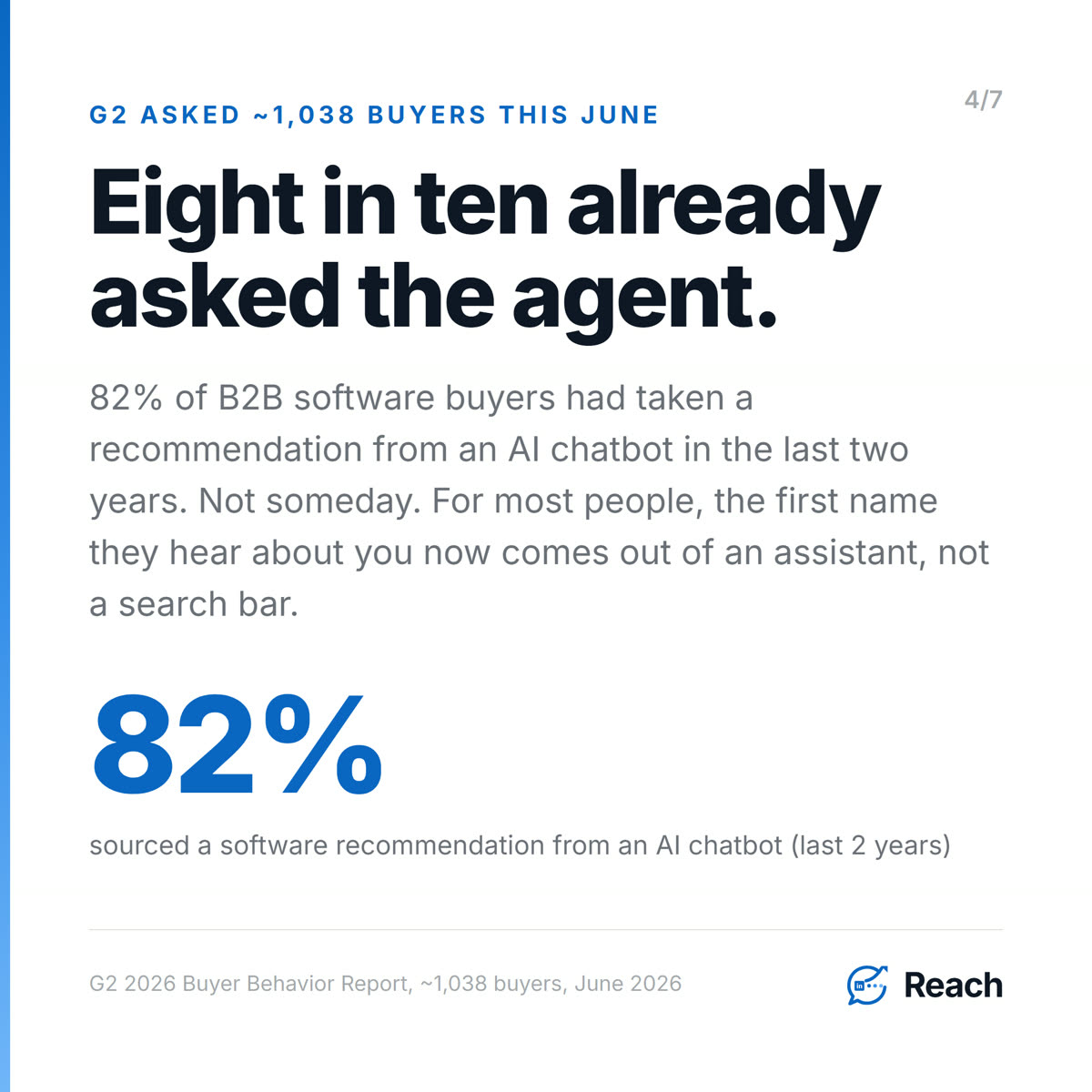
This is not a prediction I am making up to sound early. G2 ran their 2026 buyer behaviour survey in June, about 1,038 B2B software decision-makers across North America, Europe and Asia, plus 55 interviews with go-to- market leaders. Eight out of ten of those buyers - 82% - had sourced a software recommendation from an AI chatbot in the last two years. Not someday. Already. For most people buying software now, the first name they hear about you comes out of an assistant, not a search bar.
So the thing I built for two years, the being-found-by-a-human step, has a new gatekeeper in front of it. And I almost did not notice, because from where I sit it looks the same. The signups still land. The messages still come in. What changed was one layer up, in a room I am not in, where a machine decided whether to say our name at all.
The part that stops this from being a panic
Now the honest half, because there is one, and it is the half that made me put the laptop down and think instead of react.
The agent finds. It does not buy. The same G2 study is very clear about where the line sits. 61% of buyers use an agent or plan to in their buying process. Under half - 47% - would even let the agent do the research and make a recommendation, and every one of those keeps the final call with a human. Only 9% are comfortable letting an agent actually purchase inside guardrails. Two percent without a human checking first. G2's own line for it is the cleanest summary I have read: agents are welcomed into the process as researchers and analysts, not as decision-makers.
Read that the right way and it is not a threat, it is a map. The agent got you found. It got you onto the list. Then it handed the list to a person, and the person still decides the way people have always decided. G2's chief innovation officer put the whole shift in one sentence: AI has taken most of the friction out of finding software, but it raised new questions about cost, security, and internal trust. Easier to find. Not easier to buy. In their numbers the evaluation stage is now the longest part of the journey, longer than the research it used to trail.
So there are two jobs where there used to be one. Be a tool an agent can find and describe accurately, so you make the list. Then be a tool a human still trusts once it is on the list, because that is where the yes actually happens. The first job is new. The second job was always the job.
I already had the proof for the second half
The reason I trust the second half is that our own outreach has been telling me the same thing for months, long before any agent was involved.
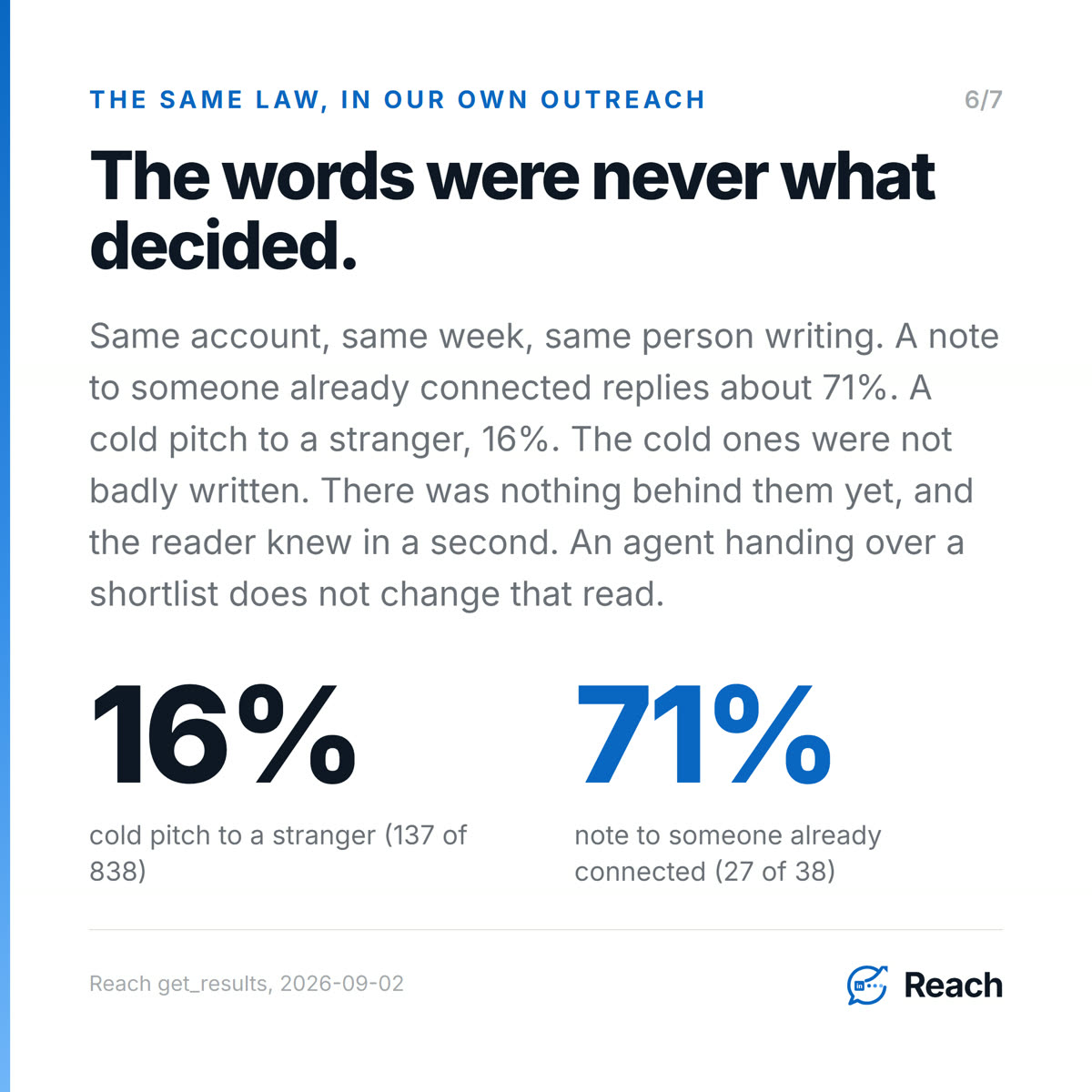
Same account, same week, same person writing the messages. A note to someone already connected to me replies about 71% of the time - 27 of the last 38. A cold pitch to a stranger, the polished company one that opens "we at Linkenite specialise in custom AI solutions", replies 16% - 137 of
- The cold ones are not badly written. Somebody spent real time on them. There is just nothing behind the words yet, and the reader can feel the difference in about a second. When people reply, the median is under an hour, so this is not slow deliberation. It is a fast read of whether there is trust behind the message or not.
An agent handing someone a shortlist does not change that read. It changes who does the finding. It does not change what makes a person say yes once they are looking at you, and what makes them say yes has never been the polish of the sentence. It is whether there is something real underneath it that they can check.
What I am actually doing about it
The tempting move is to go pour everything into being the agent's favourite
- game the descriptions, chase the ranking, treat the machine as the new customer to be won. I think that is half right and it is the easy half. Being findable and clearly described to an agent is real work and worth doing. But if you win the shortlist and there is nothing underneath, you have just made it faster for a person to reach the same no.
So the work splits, and neither half is a slogan. Make yourself something an agent can find and describe truthfully, because that is the new front door and eight in ten people are already walking through it. And keep building the thing a human trusts on sight, because the agent walked them to you, it did not decide for them, and the deciding was always the part that mattered.
I spent two years making the product easy for a person to find. The person is still the one who says yes. It is the finding that stopped being theirs, and I nearly kept polishing a door nobody uses any more.
Sources
First-party - Reach team meeting transcript, 2026-09-02
Drive doc 15_qOf1MesVyzGrI0vIK9cvgNjzYDCnVEKpFxyzYE6vQ, Transcript section (read in full, not the Gemini summary).
- Pravin Luthada, on the next marketing move being discovery by AI agents rather than by people: "Until now we are marketing for people. So people have to discover, people have to find... but then the next stage is I think agents who are already almost equal to human are now looking for this type of tools. So the discoverability we really have to make it really go high."
- Pravin, on the mechanism: "the next best marketing move where agents automatically make that decision whenever somebody says... I want to figure out something on my LinkedIn then they recommend" the tool.
- Tisha Singh's lived example, used as the opening anecdote (anonymised as "a teammate", spreadsheet/tool details kept generic): on a free plan her AI assistant could not edit a Google spreadsheet directly, so "it suggested that okay wait let me look for the relevant applications... MCP servers that are connected and published... it itself suggested three different tools... gave the name and description for each one... and recommended that out of all three or four options auto sheet is the accurate one for my use case. So I connected it."
Deliberately excluded from the meeting: the KYC / stuck-funds thread, the company re-registration / business-ID thread, the Rio/Simon contract thread, and the Yanic invoicing thread. All internal or financial, none the story.
Secondary (opened + verified verbatim) - G2 2026 Buyer Behavior Report
- G2 newsroom: https://company.g2.com/news/buyer-behavior-2026
- G2 / PRNewswire release, "AI Is Making Software Easier to Find and Harder to Buy": https://www.prnewswire.com/news-releases/ai-is-making-software-easier-to-find-and-harder-to-buy-according-to-new-g2-research-302831346.html
Both opened this run. Methodology: ~1,038 B2B software decision-makers across North America, EMEA and APAC, fielded June 2026, plus 55 interviews with go-to-market leaders. Figures used, verbatim:
- 82% ("eight out of ten") sourced a software recommendation from an AI chatbot in the last two years.
- 61% currently use or plan to use AI agents as part of the buying process.
- 47% ("less than half") would allow an agent to conduct research and make recommendations while humans retain all final decision-making authority.
- 9% comfortable with agents executing purchases within guardrails; 2% without pre-approval.
- G2's framing: "agents are being welcomed into the evaluation process as researchers and analysts, not as decision-makers."
- Direct quote, attributed to Tim Sanders, Chief Innovation Officer at G2: "AI has taken most of the friction out of finding software, but it raised new questions about cost, security, and internal trust."
- Evaluation is now the longest stage of the journey (40%), ahead of research (36%).
First-party - Reach get_results, 2026-09-02 (this run)
- By approach:
shared_asset(a note to someone already connected) replyRate 0.711 (27 of 38), median 4.2h. - By opening line: cold corporate pitch "I hope you are doing well. We at Linkenite specialize in custom AI solutions" replyRate 0.163 (137 of 838).
- Overall median time-to-reply 0.8h.
- Caveat carried from get_results: these describe the ACCOUNT's outreach, most of it sent by hand, not Reach campaigns - worth copying, not attributing.
Not cited (and why)
- Gartner "40% of enterprise apps will feature task-specific AI agents by 2026" and the "33% of enterprise apps agentic by 2028" figures surfaced but were set aside: the first was already used on 2026-08-31, and the buyer-behaviour angle is carried better by G2's directly-on-topic buyer data.
- Various IDC / TrustRadius "80% of buyers use AI agents" numbers appeared in search summaries but the primaries were not opened this run, so they are not cited. The G2 report is the single opened anchor.


.png)
.png)
.png)
.png)
.png)
.png)
.png)
.png)
.png)
.png)
.png)
.png)

.png)
.png)
.png)
.png)


.png)
.png)

.png)


.jpg)

.jpg)
.jpg)


.png)


.png)

.png)
.png)
.png)


.png)
%20(2).png)
.png)
.png)




.png)

.png)


.png)


.png)


.png)


%20BLOG%20BANNER.png)


.png)