
I send about forty LinkedIn messages a week, and for a long time I wrote them the way you are told to. A clean line about what we do. "We at Linkenite specialize in custom AI solutions to enhance business efficiency." I worked on that sentence. I moved the words around. I sent it to more than eight hundred people.
137 of them wrote back. About one in six.
Then there is a line I barely wrote at all. Somebody changes jobs, and I say "Congrats on the new role." Five words. No thought in them. I sent that to 107 people and 64 wrote back. Sixty percent. The same for a promotion - 38 people, 21 replies, fifty-five percent. Put the two congratulations together and it is 85 replies out of 145. Almost four times the pitch I actually worked on.
Same sender. Same week. Same network. So it was not me getting better at writing, because I did not write the good one. I want to be honest about what actually moved the number, because for a while I had it backwards.
It was never the words
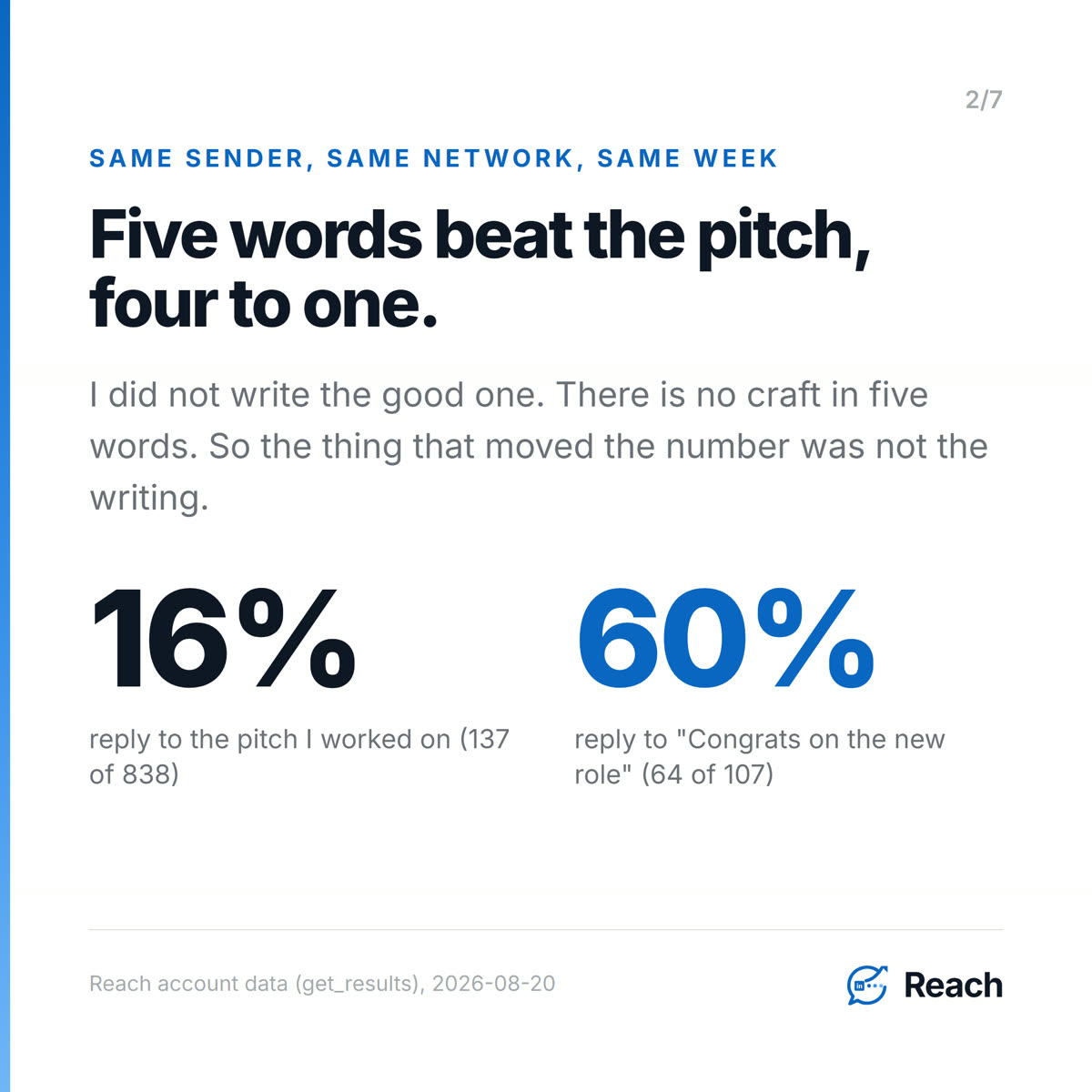
A congratulations is five plain words anyone could type. There is no craft in it. If the words were the thing, the sentence I labored over would win, and it loses badly.
What the congratulations has that the pitch does not is a day. It lands on the day something changed for that person. They just started somewhere. They are telling their own network about it. They are, for about a week, actually thinking about their work and open to talking about it. The pitch lands on a random Tuesday when nothing has happened, from a stranger, about the stranger.
So the variable was not how well I wrote. It was whether anything was going on in the other person's life when the message arrived. I was spending my effort on the one part that barely matters and ignoring the part that does.
Look at the rest of our own numbers and it is the same story every time. The openers that work all have one thing in common, and it is not that they are well written. "Congrats on the new role." "Congrats on the promotion." A short note to someone I am already connected to. Every winner is about the other person, right now. Every loser is about us, in general, forever.
A real number, to who they used to be
This morning the team spent an hour on the opposite case, and it is the cleanest illustration of the point I have seen in a while.
Someone on our side had pulled a list of contacts to cold-call. The list came back fast and it came back confident. It was also mostly wrong. We ran the numbers against it - close to half the contacts scored below ninety percent on identity, and a lot of the phone numbers were toll-free lines, switchboards, or a number in the wrong country entirely. When we dug into why, the answer was almost poetic. The numbers were real. They just belonged to a job the person used to have. A loose match on the name and the company, and the tool handed back the desk they had already left.
So there is the whole thing in one example. A perfectly real phone number is worthless if it reaches who someone used to be. And a five-word congratulations is worth sixty percent if it reaches who they are today, on the day it matters.
It is not really about phone numbers or LinkedIn. It is about timing and about whether the person on the other end is a stranger or someone who already knows you. Reach the old desk of a stranger, you get nothing. Reach a real moment for someone in your network, you get a conversation.
The catch, and it is a big one
Here is where I have to be honest with myself, because it would be easy to end on "so send congratulations" and that would be wrong.
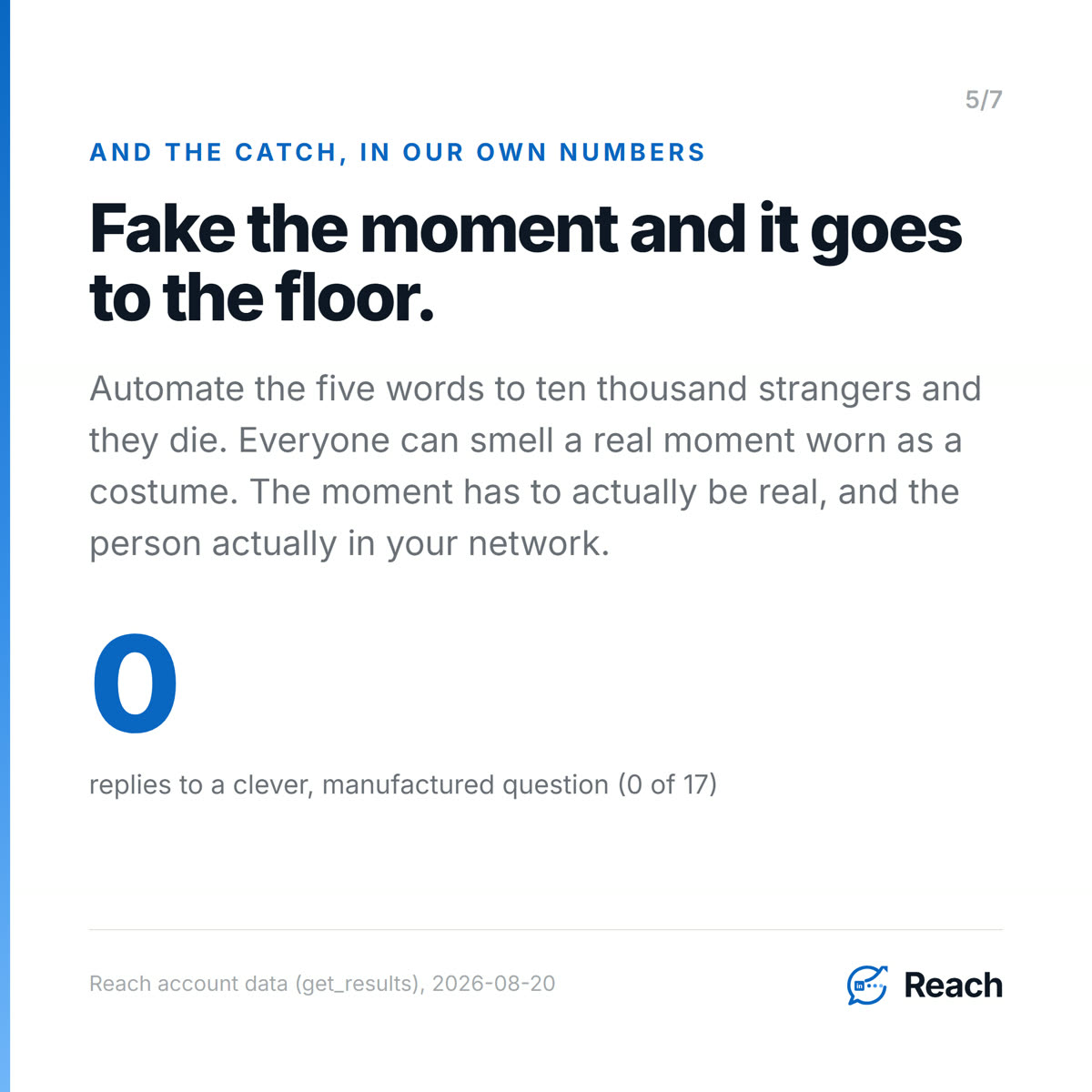
The moment you take the five words that worked and automate them to ten thousand strangers, they stop working. Everyone can smell it. It becomes one more broadcast wearing a real moment as a costume. The reason the congratulations lands is that the moment is real and the person is actually in your network. Fake either one and it collapses.
We have the proof of that in our own numbers too. At one point we tried a clever manufactured opener - "here is a quick question, how many separate SaaS tools is your company paying for." A question, engineered to feel personal. We sent it to 17 people. Zero wrote back. Not a low number. Zero. When the moment is manufactured, the reply rate does not just drop, it goes to the floor.
So the lesson is not a line to copy. It is almost the opposite of a line. It is: stop trying to write a cleverer message, and start paying attention to when something is actually happening for someone you actually know.
What this means for the work
Almost everyone spends their outreach effort in the wrong place. They polish the message and blast it wide. The message is the five percent that barely moves, and "wide" is how you guarantee you are landing on random Tuesdays for strangers.
The moments that matter are already happening, every day, inside the network you already have. Someone you are connected to changed jobs this week. Someone got promoted. Someone posted a question they actually want an answer to. That is the day. That is the person. You do not need a better sentence for them. You need to notice, and mean it, and only reach out where it is real.
That is the whole idea behind how we built Reach. It works the network you already have, it watches for the moment worth a note, it drafts something, and a human approves every message before anything is sent. Nothing is blasted. Nothing goes out from a server. It is not a machine for writing better lines to strangers. It is a way to not miss the real moments with the people who already know you.
I spent months getting the wrong part right. The good news is the right part is easier and it is already sitting in your connections list. Nothing extraordinary. You just have to message people on a day that means something to them.
Sources
Every figure in this story is first-party, pulled live this run from the Reach account, and cross-checked against the raw get_results output. No web statistic is cited (see the note at the end for why).
First-party — Reach account data (get_results), 2026-08-20
Opening-line slice, byOpeningLine, this account, mostly hand-sent on LinkedIn, shown with n. Directional, not a controlled test - but same sender, same network, same week, which is the whole point of the comparison.
| Opener | Sent | Replied | Reply rate | |---|---|---|---| | "We at Linkenite specialize in custom AI solutions to..." | 838 | 137 | 16% | | "We at Linkenite specialize in custom AI solutions to enhance business efficiency" | 220 | 31 | 14% | | "Congrats on the new role!" | 107 | 64 | 60% | | "Congrats on the promotion!" | 38 | 21 | 55% | | Both congratulations combined | 145 | 85 | 59% | | "Here is a quick question, how many separate SaaS tools is your company paying for" | 17 | 0 | 0% |
Claims traced:
- "137 of more than 800 wrote back, about one in six" → 137 / 838 = 16.3%.
- "five words beat the pitch almost four to one" → 60% vs 16% ≈ 3.7x; combined congratulations 59% vs 16% ≈ 3.6x.
- "64 of 107 ... 21 of 38 ... 85 of 145" → verbatim from the slice.
- "17 people, zero replies" → the manufactured-question opener, 0 / 17 = 0%.
Note: the pitch rows report medianHoursToReply: 0, which is a data artefact (unmeasured/instant), so no time-to-reply comparison is made in the story.
First-party — team meeting transcript, 2026-08-20
Drive, folder 1drHKlrUpEv7jqPybpRS3_CVyiVUtgfId, file "Team Meeting 2026 – 2026/08/20 07:17 EEST". Read the Transcript section in full, not the Gemini summary. Garble corrected (the product/tool names the auto-transcript mangles).
Used, in aggregate and with no colleague named and no prospect described as struggling:
- A cold-call contact list came back confident and substantially wrong. Root-cause analysis: roughly 40-45% of contacts scored below 90% identity confidence; the bad entries were toll-free numbers, switchboards, or numbers in the wrong geography (Tisha, 00:05:25 - 00:08:34).
- The deeper cause: numbers were attributed to a lead's previous position via a loose match on name and company domain rather than the person's current identity (Rameshver: "the numbers again are from the previous positions held by the leads", 00:13:26).
- The through-line Pravin returned to twice: it no longer matters who builds the software, the network and the trust a salesperson already has is what closes ("nowadays it's much easier to build software but the network and the trust... is what matters", ~00:59:36 - 01:00:44). This is the same argument the opener numbers make, one level up.
Deliberately NOT cited — the web
Searched for job-change / trigger-event outreach reply-rate benchmarks. Every result was a vendor blog (Autobound, PhantomBuster, firstsales.io, GrowthList, PredictLeads, linkedotter). Opened firstsales.io/blog/job-change-trigger-email: its headline figures ("18% vs 3.4%") carry no attributed primary source, and the only named source on the page is UserGems, itself a vendor. Per the house rule (§3 / §7: no figure that is not in a source I opened and could attribute), none of these numbers are used. The trigger-event / job-change-window idea appears in the story only qualitatively, as a long-known sales instinct, never as a borrowed statistic. The argument stands entirely on the first-party numbers above.


.png)
.png)
.png)
.png)
.png)
.png)
.png)
.png)
.png)
.png)
.png)
.png)

.png)
.png)
.png)
.png)


.png)
.png)

.png)


.jpg)

.jpg)
.jpg)


.png)


.png)

.png)
.png)
.png)


.png)
%20(2).png)
.png)
.png)




.png)

.png)


.png)


.png)


.png)


%20BLOG%20BANNER.png)


.png)