
A partner asked me to sign an NDA this week, before we went any further. It came from a good place. He wanted to protect the thing we had built so nobody could walk off with it. And I said no. I want to be honest about why, because the reason is not the one you would expect, and it changed how I think about what actually keeps a small company alive.
I run an industrial company alongside Linkenite. About 20 to 25 people, close to 5 million in revenue. So I am not against protecting things. When you have spent two years building something you do get a little protective of it, that is normal. For a long time I thought the build was the moat. Get the product right, keep it close, and you are safe. That is the instinct behind every NDA a small company signs.
Here is the problem with it. An NDA only works if you can enforce it, and enforcing it means a legal team. A 20-person company does not have a legal team, and I am not going to hire one to send threatening letters. So the NDA becomes a piece of paper that makes everyone feel careful and protects nothing. It is theatre. I would rather not do the theatre.
And the deeper thing, the thing I actually said in the meeting, is that it will get copied anyway. I know this will be copied. Not this exact thing, but the idea of it, the shape of it. That used to take a competitor a year and a real team. Now it does not.
The cost of building fell, and so did the cost of copying
This is not just my feeling. Someone who writes about B2B software put it in one line that stuck with me. "AI collapsed the cost of building software to near zero. More importantly, it collapsed the cost of copying it." That second half is the part people skip over. Every wave before this one made some cost cheaper next to the product. This one made building the product itself cheap, for you and for whoever wants to rebuild what you made.
If a capable version of your thing can be shipped over a weekend, then the build is not the scarce part anymore. Guarding it is guarding the wrong thing. You can lock the recipe in a vault and someone tastes the dish once and makes their own. The NDA does not slow that down. It just tells you that you were protecting something that was never really protectable.
So if the build is not the moat, what is.
The moat moved onto the people who already know you
The same writer answers it plainly. "The moat of today is distribution." Not the product, the distribution. Being the one people already know, already trust, already think of first when the problem shows up. That is the part a competitor cannot clone over a weekend, because it is not code. It is relationship, and relationship takes real time.
A Forbes piece by Alex Lazarow this June made the sharper version of the point. Rented distribution, the kind you borrow from an ad channel or a search engine, "disappears the moment the channel reprices." One algorithm change and it is gone. What holds is distribution you own - sitting inside a system a customer already runs, and being the name they trust when the model gets something wrong and someone has to be accountable for it. Trust is the thing that survives when everything else gets cheap.
Peter Thiel said the quiet part years ago, before any of this. "Sales matters just as much as product." Most founders, me included at times, spend 90 percent on the product and treat getting it in front of people as an afterthought. Then they wonder why a worse product with better distribution beats them. The graveyard is full of good products nobody ever heard of. Almost none of them died because someone copied them. They died because nobody knew they existed.
What I told the partner instead
So I did not sign the NDA. What I said instead was, let us make the offer fair enough that copying us is the worse deal. If a partner takes a real share, treats this as their own, and makes good money doing it, they are not going to go build a worse copy in a garage. Why would they. The fair offer prevents the theft more reliably than any contract my lawyers could not afford to enforce. It will not be about whether you can build the platform. It is going to be about whether you can figure out how to take it to market, in a region, with people who trust you, and get a good name going. That is what it comes down to now.
None of this is only a founder problem. If you sell anything, you are probably protecting the wrong thing too. You guard your pricing, your process, your list, your clever way of doing it. And the real risk is almost never that a competitor steals your clever way. The real risk is that the people who would happily buy from you do not know you, or knew you once and forgot. That is not a theft problem. That is a distribution problem, and it is the one nobody puts in a contract.
The warmest distribution is already sitting there
Here is where it comes home for us, and it is almost funny. We spend enormous energy chasing strangers and guarding secrets, and the warmest distribution any of us owns is just sitting there untouched. The people who already accepted the connection. Who already know your name.
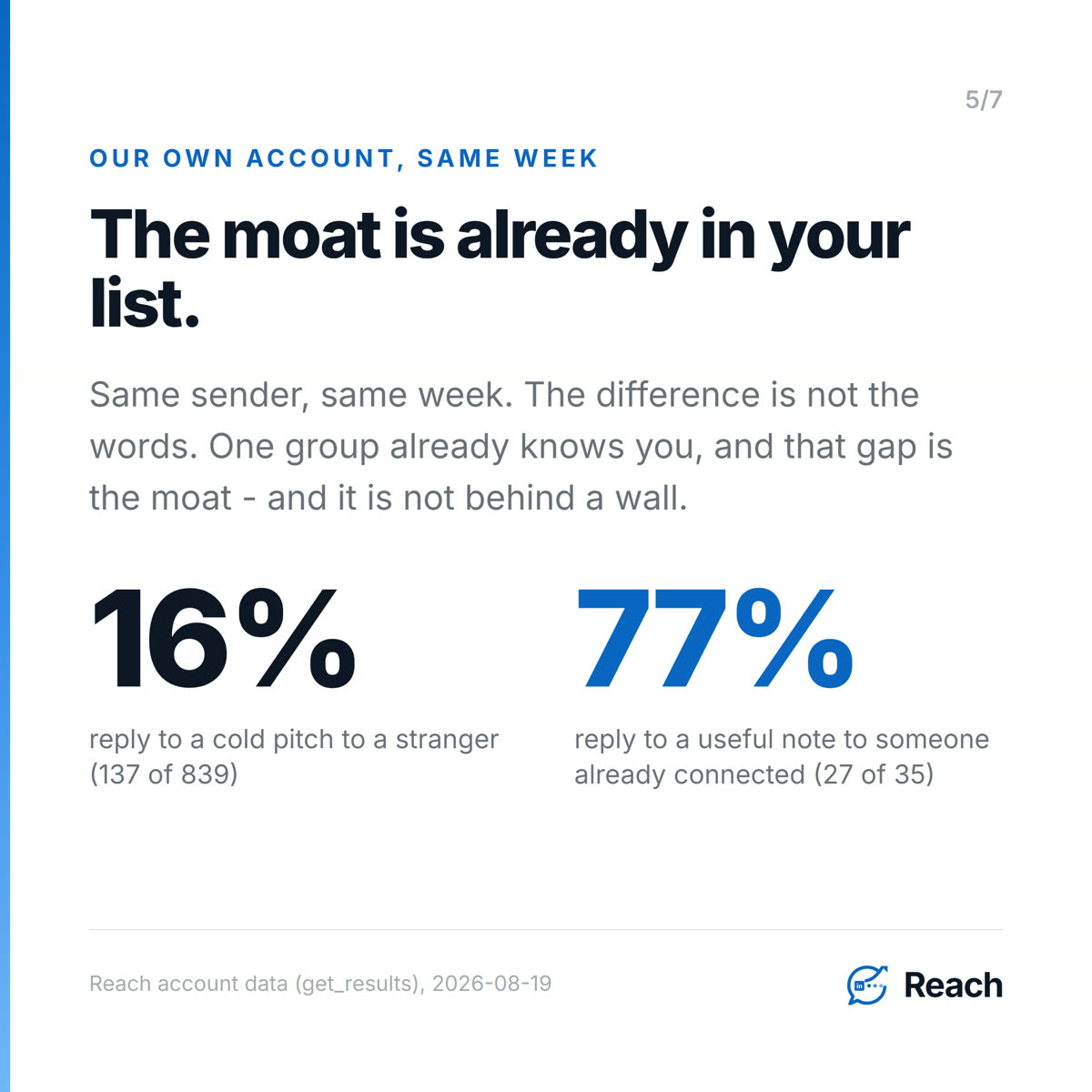
We have the numbers on this from our own account. A plain, useful note to someone already connected to us gets a reply about 77 percent of the time - 27 out of 35. The cold company pitch to a stranger gets one about 16 percent of the time - 137 out of 839. Same sender, same week. The difference is not the words. It is that one group already knows you and the other does not. That gap is the moat, and it is not behind a wall. It is in your connections list, and most people never work it.
So I said no to the NDA and yes to the boring, un-protectable thing. Show up, be useful, be the name people trust, and be fair enough that nobody wants to copy you badly. Nothing extraordinary there. It just happens to be the only part that still holds when the build costs nothing.
What are you spending more energy on right now - protecting what you built, or making sure the right people remember that you built it?
Sources
Every figure and quote below traces to a source that was opened this run.
First-party — the network signal that chose the topic
- Team meeting transcript, 2026-08-19 (Google Drive, folder
1drHKlrUpEv7jqPybpRS3_CVyiVUtgfId, doc1qOh8QsbnLXXVxj52vrjiN1mVaveaI0TB1DFn8HZSBVI, Transcript section read in full, not the Gemini summary). A partner (Brian) asked us to put an NDA in place before the next stage. Pravin declined, and the reasoning is the case: - "NDAs actually prevent anybody... the problem with NDAs is then you have to have a legal team. We don't have capacity for a legal team at this point."
- "You can always assume that people will be copying... you just need to make the offer fair enough that it kind of automatically prevents it - okay, let me just partner with these guys, they've already built and implemented this."
- "This is no longer a preventable IP theft. I know this will be copied."
- "It will not be the mode of can you build an ERP platform. It's are you able to figure out a good sales strategy in different regions, implement it, and get a good name going. That is what it will come down to." Speech, transcript garble corrected. No partner is named in the story, and no commercial terms (revenue share, regions) are disclosed. The only company reflected on is our own.
- Reach account data —
get_results, 2026-08-19. A plain, useful note to already-connected people (campaign "Reach — browser-first sellers v2") replies 77.1% (27 of 35 contacted). The cold generic company opener "We at Linkenite specialize in custom AI solutions..." replies 16.3% (137 of 839). Same sender, same account, described in the deck/post as "about 77 percent" and "about 16 percent." Mostly hand-sent and directional; shown with n throughout.
Secondary — three opened web anchors
- "The Distribution Era: B2B Software's New Moat," The GTM Newsletter — https://thegtmnewsletter.substack.com/p/distribution-era-b2b-software-moat Opened and quoted verbatim:
- "AI collapsed the cost of building software to near zero. More importantly, it collapsed the cost of copying it."
- "The moat of today is distribution."
- Alex Lazarow, "AI Is Repricing Software Which Is Splitting Old Moats," Forbes, 2026-06-29 — https://www.forbes.com/sites/alexlazarow/2026/06/29/ai-is-repricing-software-which-is-splitting-old-moats/ Opened and quoted verbatim:
- "Rented distribution disappears the moment the channel reprices."
- Durable advantage = distribution you own, sitting inside a system a customer runs, plus "trusted, accountable execution." (Used as framing; not a slide stat.)
- **Peter Thiel, Zero to One** — via Goodreads quote page (https://www.goodreads.com/author/quotes/8474721.Peter_Thiel). Verbatim:
- "Sales matters just as much as product."
Opened but deliberately not used
- Alex Lazarow's Chegg teardown (same Forbes piece): a real, public company's ~99% market-cap decline. It is a documented public struggle and would be permitted under the "published / public financials" exception - but naming a specific company as struggling adds nothing the argument needs and carries reputational cost, so it was left out on purpose. No company is named as struggling anywhere in this story.
- press.farm's Peter Thiel guide — only paraphrases the "poor distribution, not product" claim; it gives no verbatim Thiel sentence, so nothing was quoted from it. The verified Goodreads line was used instead.


.png)
.png)
.png)
.png)
.png)
.png)
.png)
.png)
.png)
.png)
.png)
.png)

.png)
.png)
.png)
.png)


.png)
.png)

.png)


.jpg)

.jpg)
.jpg)


.png)


.png)

.png)
.png)
.png)


.png)
%20(2).png)
.png)
.png)




.png)

.png)


.png)


.png)


.png)


%20BLOG%20BANNER.png)


.png)