
A founder I am already connected with wrote back to me this week and told me to stop.
There was no pitch in the message I sent him. No demo link, no price, no ask. Just something I thought he would find useful. And his reply was polite and completely clear. It comes across as disguised sales, he said. Then the line that stuck. "It seems like you are generating business, and I am generating relations. Please stay on the relation track, and if not, remove me from your network."
I will keep his name out of this. But I have been chewing on it for three days, because he was half right, and the half he was right about is the whole problem with automated outreach.
What I actually sent
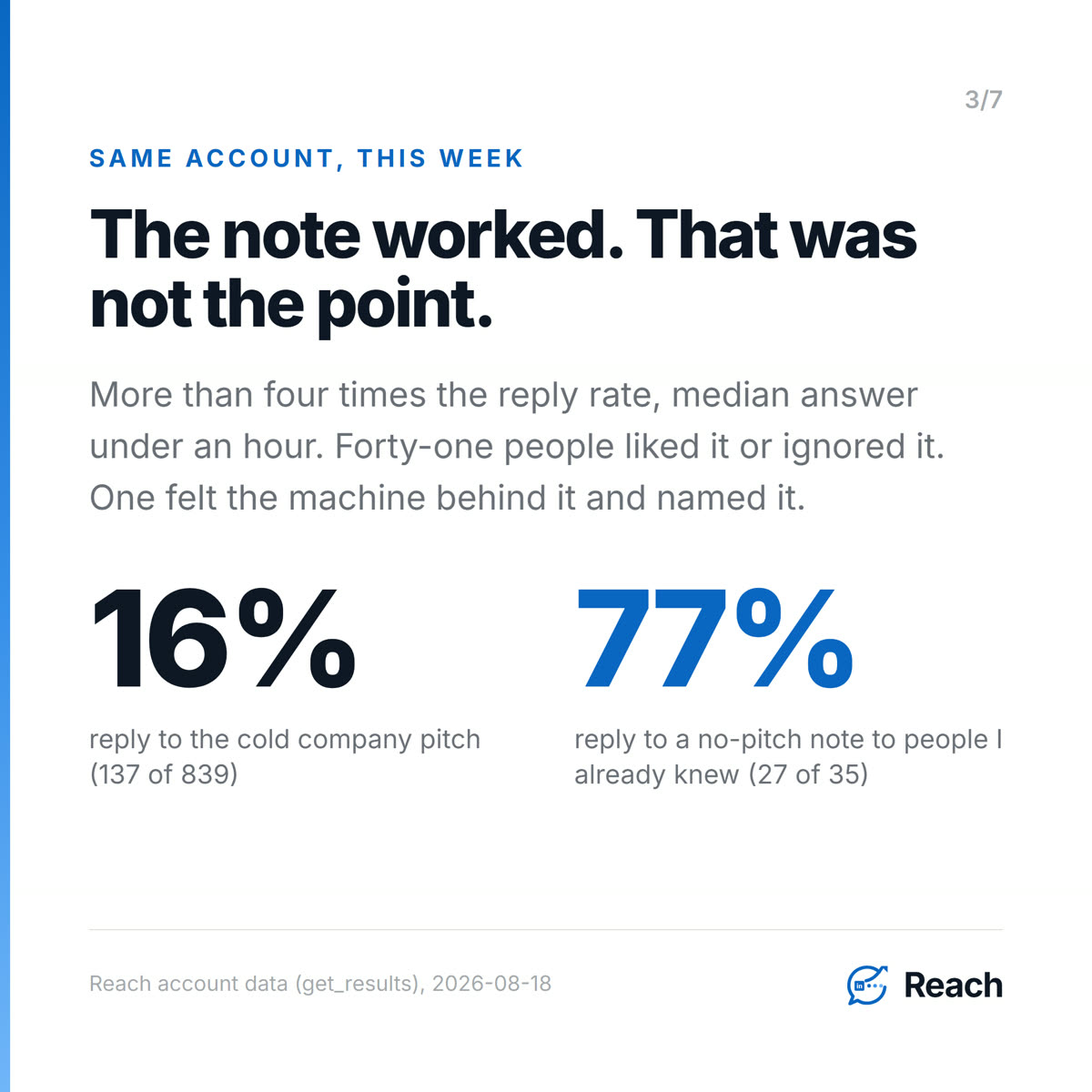
Here is the honest version. I ran a value-first motion over people I already knew. Forty-two connections, each one sent a genuinely useful thing, no sell attached. It worked, on the numbers. Of the ones it reached, about 77 percent wrote back - 27 of 35. Our old cold company pitch, the one that opens "We at Linkenite specialize in custom AI solutions," replies about 16 percent - 137 of 839. So the warm, no-pitch version out-pulled the cold one more than four times over, and the median reply came back in under an hour.
Forty-one of those people either liked it or ignored it. One saw the machinery behind it and named it out loud.
And the thing is, there was machinery. The message was real and I did mean it. But it was one of forty-two, and he could feel that. That is not a personalization problem you fix with a better first line. He did not object to the words. He objected to being on a list at all, however warm the list was.
Why the backlash is real
I went and looked at whether this is just one prickly founder or a pattern. It is a pattern, and the data on it is not subtle.
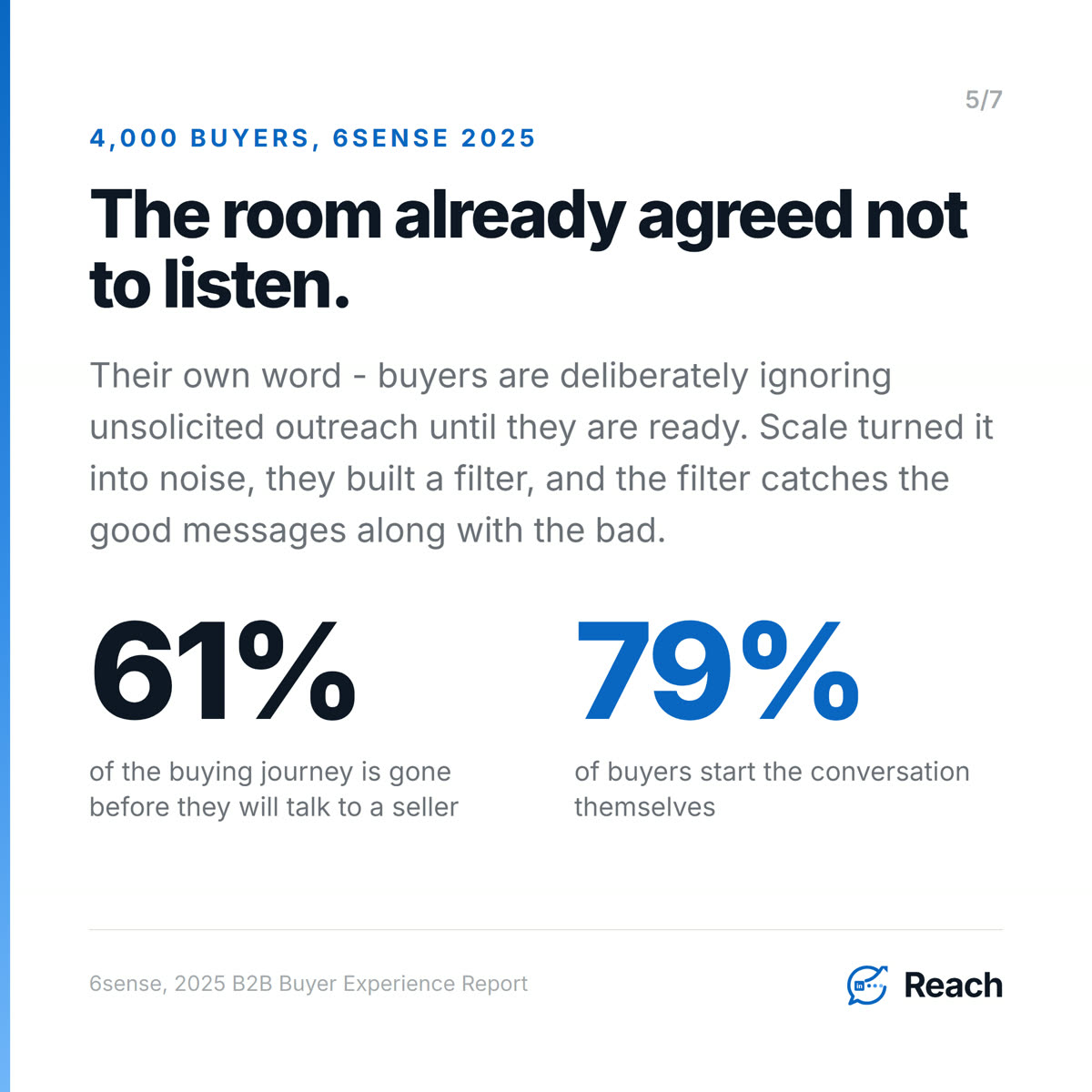
The 2025 B2B Buyer Experience Report from 6sense surveyed close to 4,000 buyers. Two findings do all the work here. First, 79 percent of buyers start the engagement themselves - they reach out to the seller, not the other way around. Second, in the report's own words, "buyers are deliberately ignoring unsolicited outreach until they're ready." They wait until roughly two-thirds of the way through their own buying process before they will talk to anyone selling.
Read those two together and the picture is bleak for the whole outbound industry. Most buyers have decided, on purpose, to tune out seller-initiated contact. They will come to you when they are ready, and until then the clever opener is landing in a room where everyone has agreed not to listen.
That is what the AI-SDR backlash actually is. It gets blamed on tone, on bad personalization tokens, on "Hi {FirstName}." But the tone is a symptom. The real thing is that scale turned outreach into noise, and buyers built a filter, and now the filter catches the good messages along with the bad ones. My useful, no-pitch note got caught in exactly that filter. The founder was the filter, working correctly.
The part I got wrong, and the part I would keep
So what do you do with that. The wrong lesson is "personalize harder" - make the machinery invisible, so the next founder does not catch it. That is just a better disguise, and disguise is the thing he was objecting to. If the fix for "this feels like manufactured relationship-building" is "manufacture it more convincingly," you have not fixed anything, you have only gotten sneakier, and these people are not stupid.
The lesson I actually take is smaller and more boring. Two things.
One, a human has to read and approve every message before it goes. Not as a compliance checkbox. As the test. If "I thought of you" is not true when you read it back, you do not send it. That kills volume, and it should. The whole reason my note out-pulled the cold pitch four to one is that it went to people I really did know, about something I really did think they would want. The moment you scale that past the point where a person can honestly stand behind each one, you are back to noise, and the founders will catch you.
Two, when someone says stop, it stops. That day. No "let me just send one more," no dropping them into a slower sequence. He said remove me, so he is removed. On a warm network that is not a nice-to-have, it is the entire asset. You get one reputation with the people you already know. Burn it with one person and they tell three.
Where I landed
I am not going to pretend this was a clean win with one grumpy outlier. He was right that there was a machine, and I would rather hear that from him now than have forty-two people quietly decide I got spammy and never say so.
The odd thing is that the answer to "your outreach feels automated" is not less automation. It is automation that makes a human slower on purpose - that puts a person in front of every message and makes it easy to stop. The tool does the finding and the drafting and the remembering. The human keeps the one thing a machine cannot fake, which is actually meaning it.
So we send fewer. We send the ones we would have sent by hand anyway. And when someone tells us to get off their relation track, we get off it the same day.
Nothing extraordinary otherwise.
Sources
Every figure below traces to a source that was opened this run.
First-party — Reach account data
get_results, 2026-08-18. The value-first, no-pitch note to already-connected people (campaign "Reach — browser-first sellers v2") replies 77.1% (27 of 35 contacted), median 4.2h. The cold generic company opener "We at Linkenite specialize in custom AI solutions..." replies 16.3% (137 of 839). Warm no-pitch out-pulls the cold pitch ~4.7x (0.771 / 0.163), described in the deck as "more than four times." Median time-to-reply across the whole account is 0.8h. Numbers are mostly hand-sent and directional; shown with n throughout.get_account_state/get_inbox, 2026-08-18. The warm campaign ran to ~42 connected people; one of them asked to be removed, calling the message disguised sales. His exact framing: "you are generating business, and I am generating relations. Please stay on the relation track, and if not, remove me from your network." Anonymized here — not named, not identifiable, and not described as struggling. The only admitted mistake is our own outreach.
Secondary — one opened web anchor
- 6sense, 2025 B2B Buyer Experience Report — https://6sense.com/science-of-b2b/buyer-experience-report-2025/ Survey of nearly 4,000 B2B buyers. Opened and quoted verbatim:
- "79% of buyers initiated engagements, compared to 82% in prior years."
- "SDR/BDR outreach plays a minimal role in influencing the Point of First Contact (POFC) with buyers; in most cases, buyers are deliberately ignoring unsolicited outreach until they're ready."
- Buyers now make first seller contact ~61% of the way through their journey (down from 69% in 2024) — i.e. roughly two-thirds through.
Opened but not used
- Gartner "67% prefer a rep-free experience" (2026-03-09 press release) and the 2025 "61%" release. Returned HTTP 403 on fetch, so not opened directly and not cited as a hard figure. The 6sense report (openable, primary, first-party survey) carries the same argument and was used instead. Gartner's 73%-avoid-irrelevant- outreach stat was already used in the 2026-08-13 story and is deliberately not reused.


.png)
.png)
.png)
.png)
.png)
.png)
.png)
.png)
.png)
.png)
.png)
.png)

.png)
.png)
.png)
.png)


.png)
.png)

.png)


.jpg)

.jpg)
.jpg)


.png)


.png)

.png)
.png)
.png)


.png)
%20(2).png)
.png)
.png)




.png)

.png)


.png)


.png)


.png)


%20BLOG%20BANNER.png)


.png)