
POV: the buyer. Written from the other side of the inbox, using our own send data - the openers we wrote, the replies we got back, and the one that finally booked a meeting.
I get maybe thirty of these a week. I am on the buying side more than people think, and my LinkedIn inbox looks like everyone else's. So here is what your outreach looks like from my chair, and here are the numbers from our own account, because we send the same kind of messages and I would rather be honest about which of ours work.
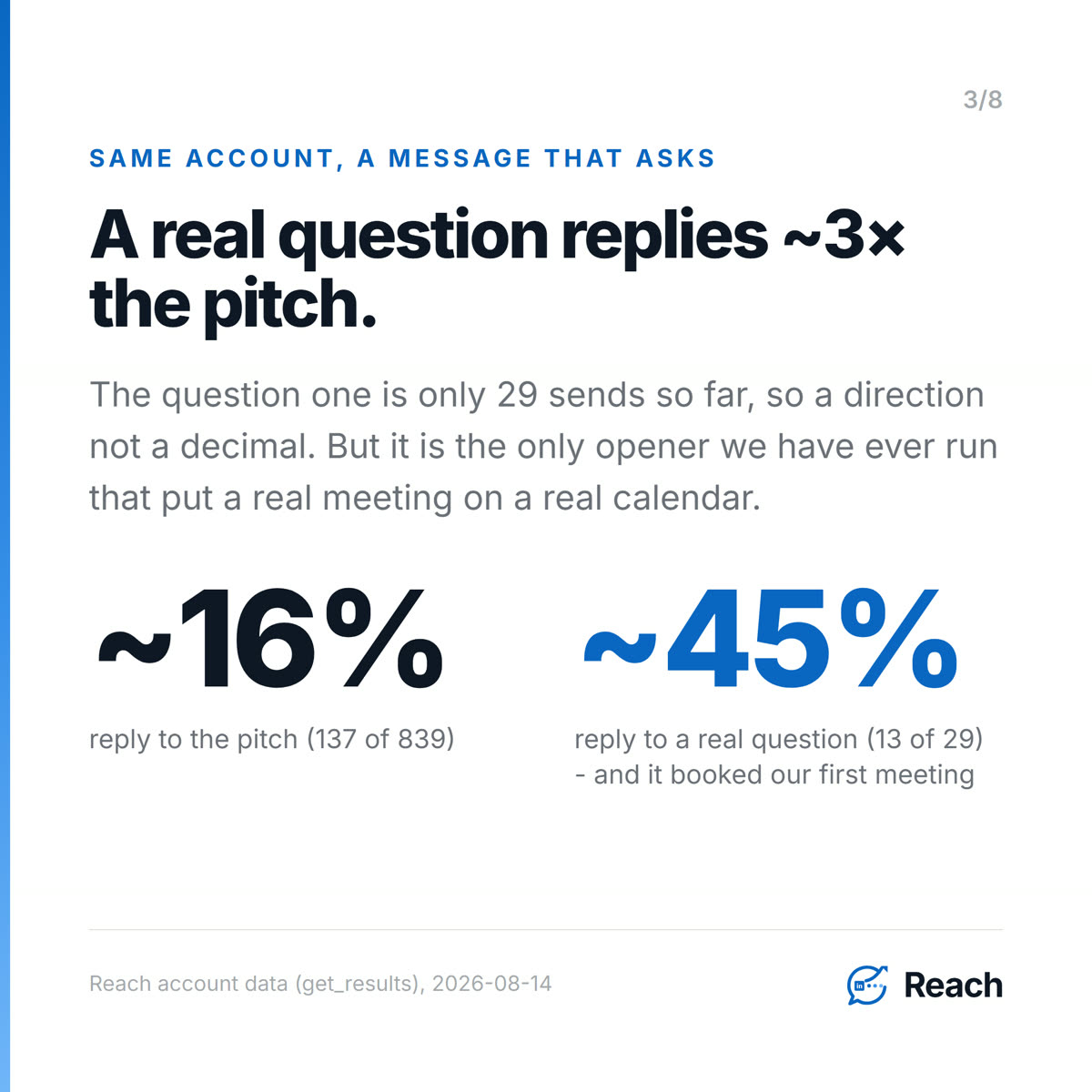
Most of what lands opens the same way. "We at Linkenite specialize in custom AI solutions to enhance business efficiency." I wrote that one. We sent it to 839 people. 137 wrote back. That is about 16%, and 16% sounds fine until you read the line as the person receiving it. It tells me nothing about me. It could have gone to any of the 839. When a message could have gone to anyone, I answer it like it went to no one.
Then every so often a message asks me something. Not "can I have 15 minutes," that is still about you. An actual question about my world. We have one opener like that. It says we are researching how ERP implementation teams are approaching a specific problem, and it asks. We have only sent it to 29 people so far, so I am not going to pretend it is a law of nature. But 13 of those 29 wrote back. That is about 45%, roughly three times the pitch. And it is the only opener we have ever run that produced an actual booked meeting - not a "sure, maybe," a real one, on a real calendar, this week. First one we have ever recorded.
So a question beats a pitch. That is not the interesting part. The interesting part is the message that ruined my theory.
The question mark that fooled nobody
We also sent this: "Here is a quick question, how many separate SaaS tools is your company paying for?" It has a question mark. It asks me something. By my own logic it should have worked.
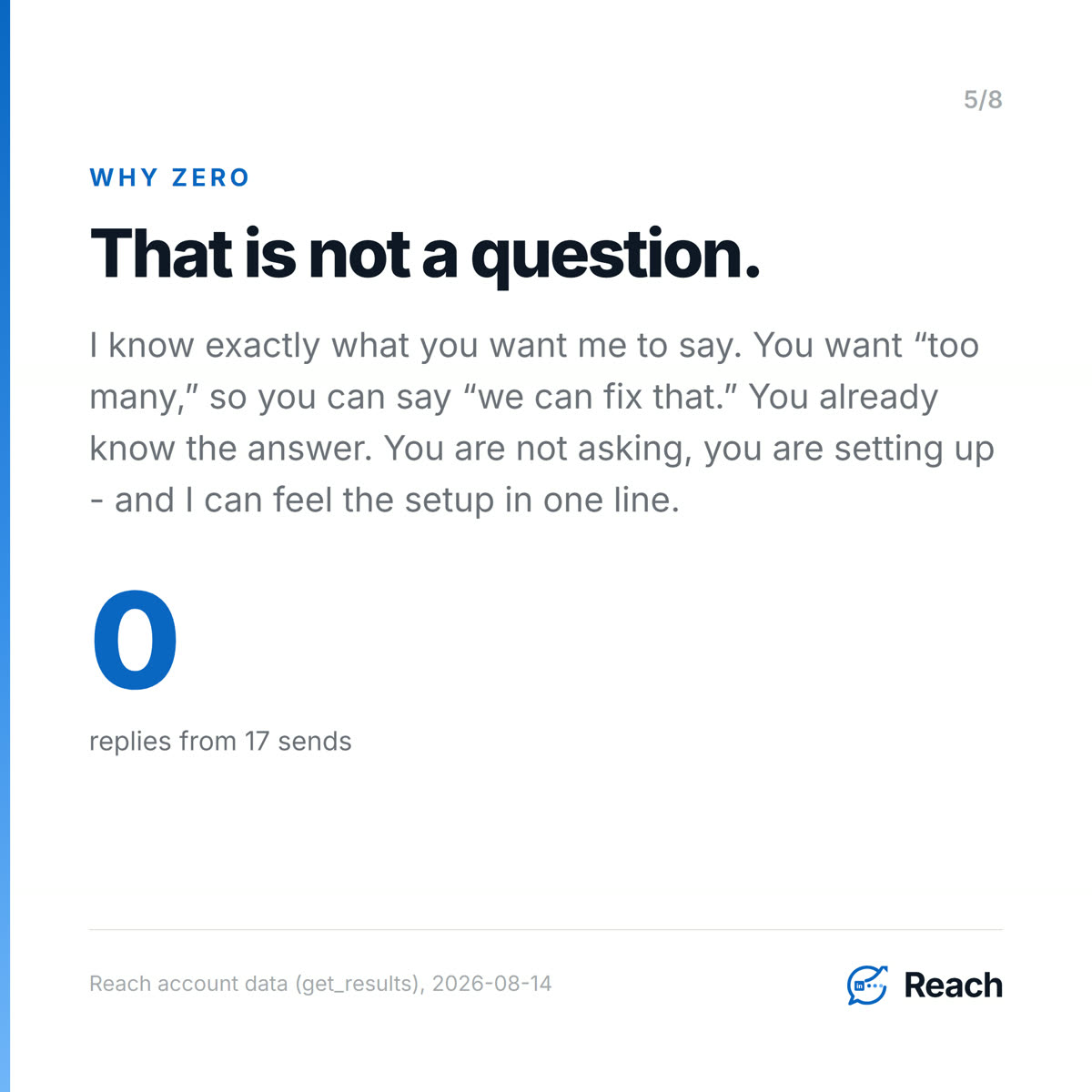
It went to 17 people. Nobody replied. Zero.
I sat with that for a while, because on paper it is a question and questions were supposed to be the thing. And then it was obvious. That is not a question. I know exactly what you want the answer to be. You want me to say "too many," so you can say "we can fix that." You already know the answer. You are not asking, you are setting up. And I can feel the setup in one line, the same way you can feel it when someone at a party asks how work is going and is really waiting to tell you about their thing.
A real question is one where you do not already know what I am going to say. "We are researching how ERP teams are approaching X" - you actually do not know how my team is approaching X, and I can tell, so I tell you. "How many tools are you paying for" - you have decided the answer is "too many" before I open my mouth, and I can tell that too, so I say nothing.
The question mark is not what does the work. Not knowing the answer is what does the work.
It is not just our inbox
I went looking to see whether this was only us. It is not.
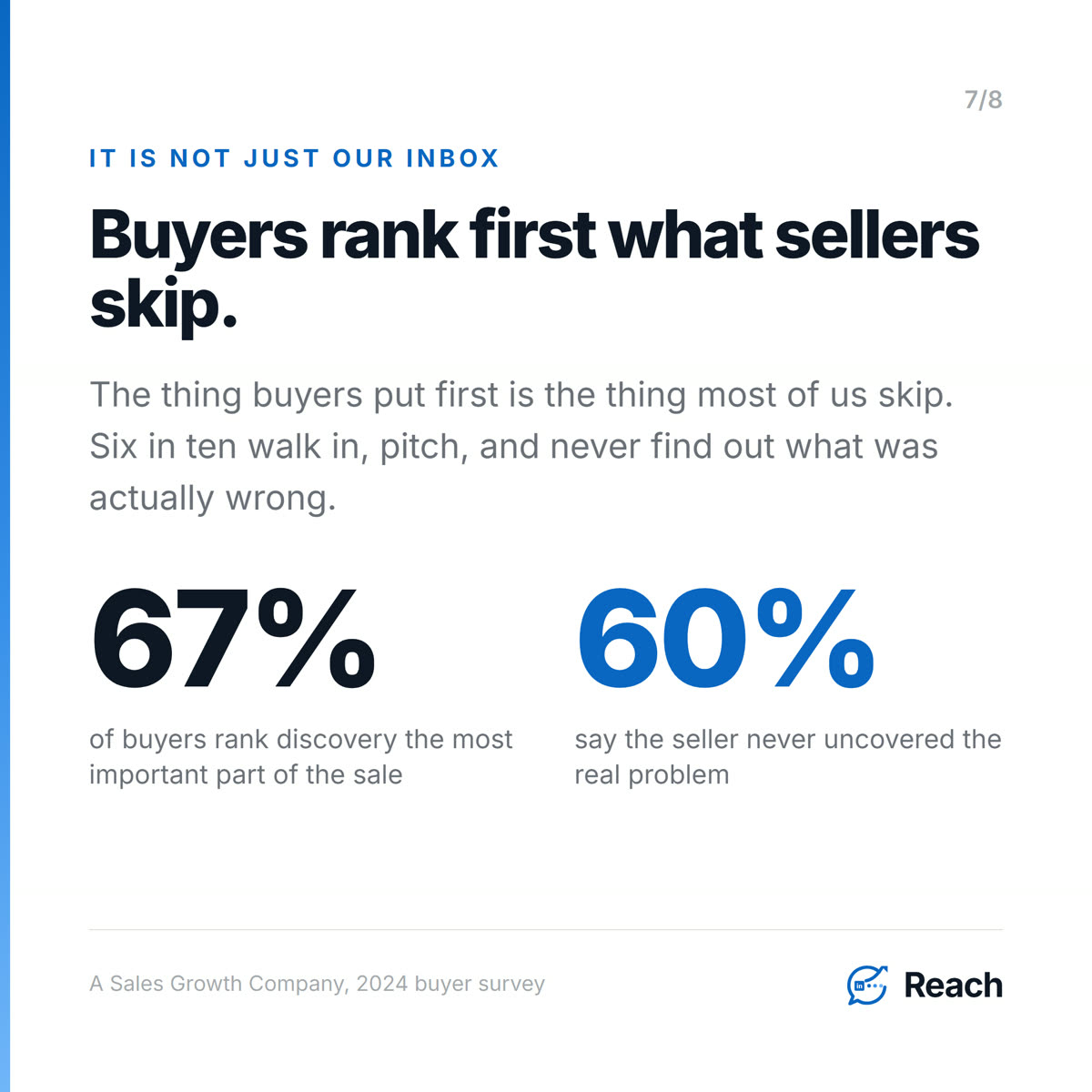
A 2024 buyer survey by A Sales Growth Company asked buyers what mattered in a sale. 67% put discovery - the part where the seller is actually trying to understand the problem - as the most important part of the whole process. And 60% said the seller they dealt with never uncovered the real business problem at all. So the thing buyers rank first is the thing most sellers skip. Sixty percent of us walk in, pitch, and never find out what was actually wrong.
LinkedIn has its own number, from its own data - tens of millions of InMails sent between May 2021 and April 2022. InMails sent individually get response rates about 15% higher than the ones sent in bulk. Their gap is smaller than ours because a recruiter InMail is a different animal, but it points the same way. The more a message looks like it was written to one person, the more one person answers it.
None of this is new wisdom. "Ask about them, not you" is on every sales poster ever printed. The reason it does not stick is that it is easy to fake, and faking it is worse than not doing it. A real question costs you something. You have to actually not know, which means you have to have looked at the person, found the one thing you cannot guess, and asked that. The fake question costs nothing, and it reads as exactly what it costs.
What I actually do now
I am not going to tell you to be more authentic. That is not advice, that is a mood.
Here is the mechanical version. Before I send anything, I check one thing: do I already know how they are going to answer this? If yes, it is a pitch and I should stop calling it a question. If I actually do not know - if the answer could surprise me - then it is worth sending, and it is worth the ten minutes it took to find something about them I could not guess.
That is the whole trick and it is annoyingly slow. It does not scale to a thousand a day, and that is the point. The thousand-a-day version is the 16% line I wrote, the one that could have gone to anyone. The version that books the meeting is the one where I sat and read about one person until I found a question I actually wanted the answer to.
We are a small team trying to earn back about a thousand euros a month of software spend through this one LinkedIn account, so I do not have volume to burn and I have been forced to learn the slow way. The slow way keeps working. Our best opener is not our cleverest one. It is the one where we admit we do not know something and ask.
But yeah. Nothing extraordinary otherwise. Ask a question you do not know the answer to. Most of us, me included, are still asking the other kind.
Sources
Every figure here traces to something opened, not to a search summary.
First-party — Reach account data (get_results), pulled 2026-08-14
All three openers below are from the same account, same LinkedIn network, mostly hand-sent outside any single campaign. So they are directional, not a controlled test. The small samples (29 and 17) are always shown with their n.
- Generic pitch opener — "We at Linkenite specialize in custom AI solutions to enhance business efficiency": 839 contacted, 137 replied = 16.3%.
- Research-question opener — "I'm Pravin from Linkenite. We're researching how ERP implementation teams are approaching...": 29 contacted, 13 replied = 44.8%, 5 of 5 invites accepted (acceptRate 1.0). This is the opener behind the account's first
meeting_bookedever recorded (confirmed inget_planlearnings +get_results.meetingsBooked= 1, 2026-08-14). - Disguised-question opener — "Here is a quick question, how many separate SaaS tools is your company paying for?": 17 contacted, 0 replied = 0%.
- Supporting personal-opener comparators (not on slides, used in the case's logic): "I'm Pravin, CEO of Linkenite... space scientist" 222→115 = 51.8%; "scientist turned entrepreneur... Linkenite in automation" 286→134 = 46.9%.
Caveat carried from get_results: replies are counted from message history; these describe the account's outreach, not one campaign, so the openers are "worth copying, not worth attributing." Stated that way in the case.
Secondary — opened and verified
- A Sales Growth Company, 2024 buyer survey — https://salesgrowth.com/5-things-b2b-buyers-expect-from-sales-reps/ Opened 2026-08-14. Verbatim from the page: "67% of buyers said discovery was the most important part of the sales process" and "60% of buyers said their seller didn't uncover the real business problem." Attributed on the page to ASG's own 2024 buyer survey (a vendor's named survey - attributed as such in the deck, not dressed up as independent research).
- LinkedIn, its own recruiter-InMail data — https://www.linkedin.com/business/talent/blog/talent-strategy/these-inmails-get-best-response-rates Opened 2026-08-14. Verbatim: "InMails that are sent individually see response rates roughly 15% higher than InMails sent in bulk." LinkedIn's own analysis of tens of millions of InMails sent by corporate recruiters May 2021–April 2022, responses measured within 30 days, staffing firms excluded. Used in the case only as "points the same way" - it is recruiter InMail, a different animal, and the case says so.
Not used
- Search-summary figures like "93% higher acceptance," "10x response," "personalized connection requests ~45% vs ~15%" surfaced in search but were NOT opened to a verifiable primary, so none of them appear. The ~3× figure in the deck is our own account's 45% vs 16%, not a borrowed benchmark.


.png)
.png)
.png)
.png)
.png)
.png)
.png)
.png)
.png)
.png)
.png)
.png)

.png)
.png)
.png)
.png)


.png)
.png)

.png)


.jpg)

.jpg)
.jpg)


.png)


.png)

.png)
.png)
.png)


.png)
%20(2).png)
.png)
.png)




.png)

.png)


.png)


.png)


.png)


%20BLOG%20BANNER.png)


.png)