
This morning I did something small before the standup. I opened my own LinkedIn inbox and I counted the pitches that got my name right and knew nothing else about me.
There were a lot of them. "Hi Pravin." Then a paragraph that could have been sent to forty thousand other people, because it was. Virtual staff. A webinar. A three-month trial of a tool I don't use. Every one of them had my first name in it, and not one of them had a single true thing about what I actually do all day. The first name was the personalization. That was the whole of it.
So that is where I want to start. Not with a product. With the thing sitting in my own inbox, which is the same thing sitting in yours.
The merge field is the easy part, and it does nothing
Here is what I think happens. You have a network. You have a message. Putting the person's name at the top is one line of code, or one click, and it feels like you personalized it. It didn't cost you anything and it didn't earn you anything either. The name is a merge field. It is the easy part. It is also the part that does no work at all, because the reader can see straight through it.
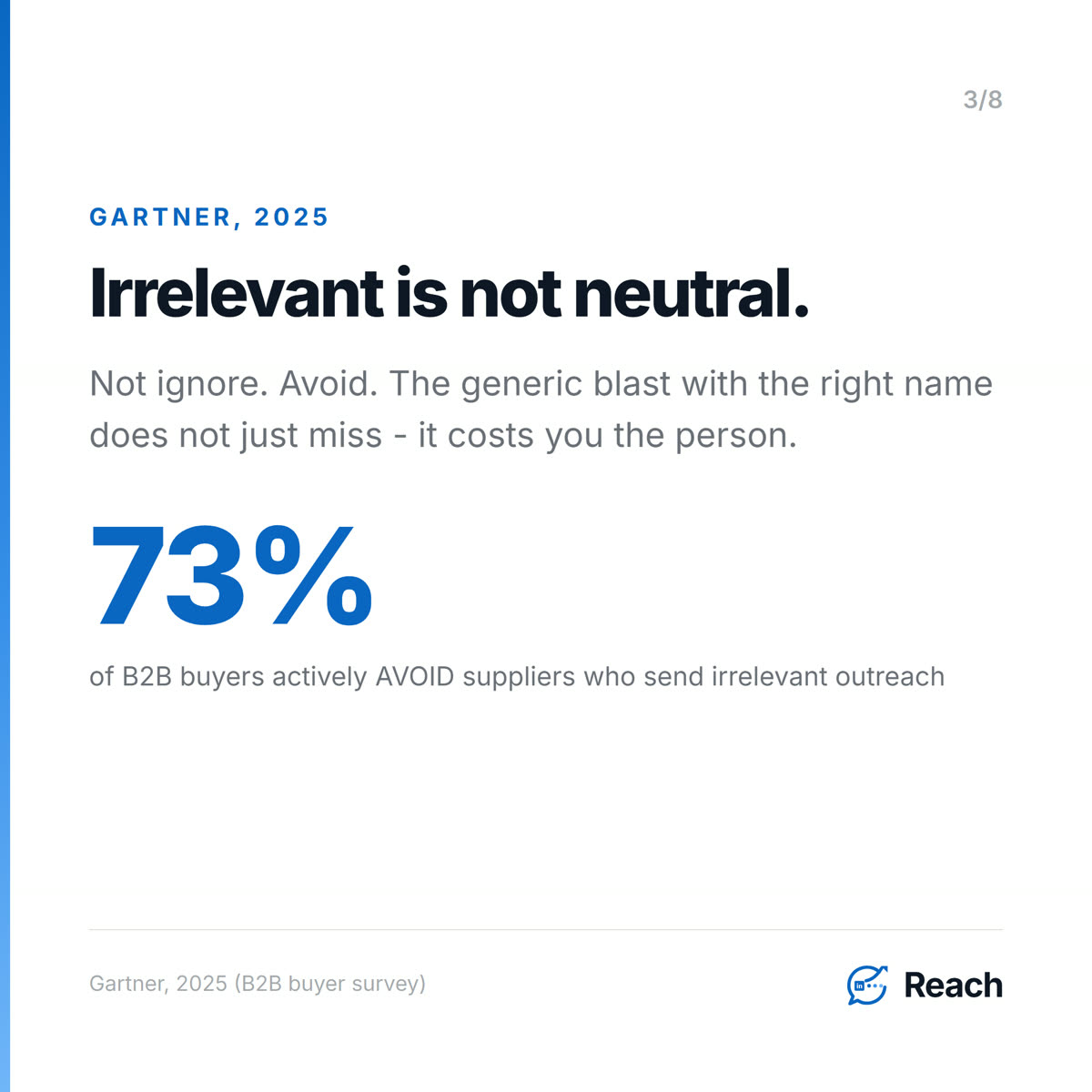
Gartner looked at this in 2025 and the number is worth sitting with. 73% of B2B buyers actively avoid suppliers that send them irrelevant outreach. Not ignore. Avoid. So the generic blast with the correct first name is not neutral, it is not a message that simply didn't land. It is a message that cost you the person. You spent a connection to send it, and you got back a little less trust than you had before.
And it gets worse if you try to fix it with more merge fields. The same Gartner work in June 2025, across 1,464 buyers, found that personalized marketing produced a negative experience for 53% of people who got it - more likely to regret the purchase, less likely to come back. So the answer was never "add more fields". A message that knows your name and your company and your job title and still has nothing to say about your actual problem is not more personal. It is just creepier. Relevance is not the number of things you know about someone. It is whether the thing you send is about their day.
What we actually did today
I will show the log instead of arguing it, because we ran this today, not in theory.
We took 50 people out of the dormant network - connections already made, months or years ago, never messaged since. The lazy move is one message to all 50 with the name swapped in. We didn't send one message. We sent five.
We sorted the 50 into the worlds they actually live in. Finance people. Staffing and recruiting. Deep-industrial founders. B2B salespeople. And then each group got the one thing that was about their world - a short paper on how their kind of team gets more out of the network they already have, written for them and almost nothing about us. Near-zero branding. A brief mention of the product at most.
That is the whole trick, and it is not a clever trick. It is just more work. One blast is one decision. Five papers for five worlds is five decisions plus the sorting, and the sorting is the part nobody wants to do. But the sorting is the only part the reader can feel.
The numbers from our own account
I don't have to reach for a study to know this works, because our own outreach already told us, on the same network, in the same weeks.
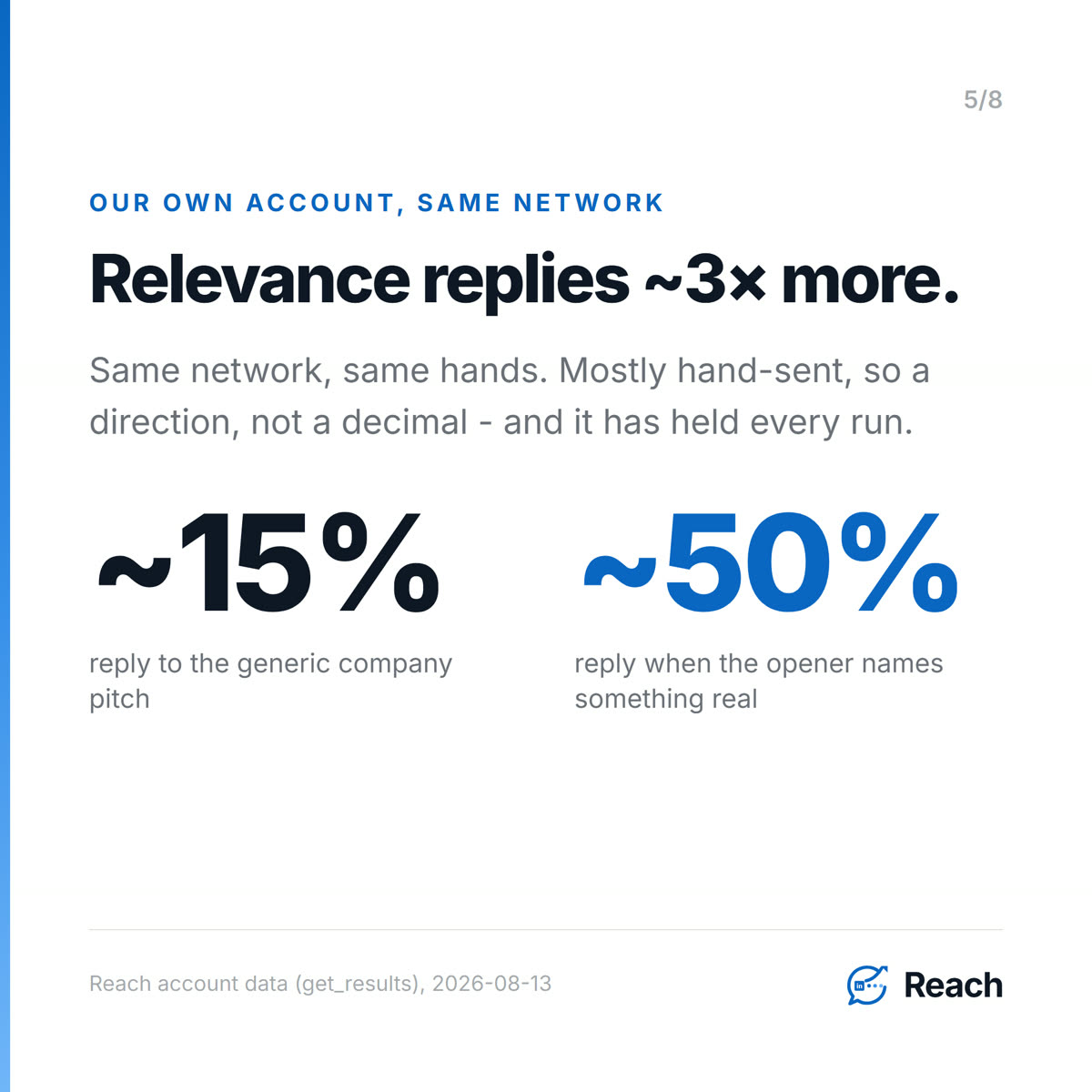
Our most-sent generic opener - the one that starts "We at Linkenite specialize in custom AI solutions..." - replies about 15% of the time. That is across 839 sends of one version and 221 of another, so it is not a small sample. 16.3% and 14.0%. It is a real, stable, unimpressive number.
Now the openers that name something true about the person. A founder-to-founder note about my own path replies 47% and 52%, on 286 and 222 sends. "Congrats on the new role" - which is just noticing a real thing that happened to them - replies 60%, on 108 sends. A line that names the specific thing someone is working on replies even higher on the smaller cohorts. Same account, same network, same hands. The relevant opener replies roughly three times as often as the generic one.
I want to be honest about what that number is. Most of those were sent by hand, not by a machine, so treat it as a direction and not a decimal. But the direction has held across every run we have looked at. The generic version is not a worse version of the same thing. It is a different thing, and it performs like a different thing.
What would have worked, said plainly
If I go back to my own inbox from this morning, none of those senders needed a better subject line or a smarter tool. They needed to send me the thing that was about my job, and they sent me the thing that was about theirs. That is the whole gap. It is not clever and it is not fast.
The reason most outreach doesn't do it is that it is genuinely more work. To send the relevant thing you have to know which world the person lives in, and you have to have the relevant thing ready, and you have to match one to the other. Fifty people, five piles. It is slower than a blast on purpose. The slowness is where the relevance comes from.
For a small team this is the good news, actually. You are not competing on volume - you would lose that, the whole inbox is volume. You are competing on whether the one message you send is about the person reading it. That is a thing a four-person company can win, and a fifty-person spray-and-pray outfit usually can't, because they have already committed to the blast.
So that is what today was. Fifty people we already know, sorted into five worlds, each sent the one thing that was about them. The first name was the easy part and we skipped past it. But yeah, nothing extraordinary otherwise. You already have the network. You just have to send people the thing that is actually about them.
Sources
Every figure below traces to a document that was opened this run. Where the primary was unreachable, the exact figure was verified verbatim in two or more independently opened sources, noted as such.
1. Gartner, 2025 — 73% of B2B buyers avoid irrelevant outreach
- Claim used: "73% of B2B buyers actively avoid suppliers that send irrelevant outreach."
- Origin: Gartner, 2025 — the survey behind the press release "Gartner Sales Survey Finds 61% of B2B Buyers Prefer a Rep-Free Buying Experience" (press release dated 2025-06-25).
- Primary status: Title and date confirmed live on gartner.com via the in-app browser (https://www.gartner.com/en/newsroom/press-releases/2025-06-25-gartner-sales-survey-finds-61-percent-of-b2b-buyers-prefer-a-rep-free-buying-experience). The article body sits behind a consent wall and could not be read; WebFetch on the same URL returned HTTP 403.
- Verification: The 73% figure appears verbatim in two independently opened sources, both attributing it to Gartner 2025:
- Corporate Visions — https://corporatevisions.com/blog/b2b-buying-behavior-statistics-trends/ — "73% actively avoid suppliers that send irrelevant outreach" (attributed: Gartner, 2025).
- Landbase — https://www.landbase.com/blog/go-to-market-statistics — "B2B buyers actively avoid suppliers sending irrelevant outreach (73%)".
- How it is cited in the story: "Gartner, 2025." Presented as a direction-setting benchmark, not the load-bearing number.
2. Gartner, June 2025 — personalization can backfire
- Claim used (case only, supporting nuance): personalized marketing produced a negative experience for 53% of customers; those customers were ~3x more likely to regret a purchase and 44% less likely to buy again.
- Sample: 1,464 B2B buyers and consumers; North America, UK, Australia, New Zealand; June 2025.
- Opened and verified at: Demand Gen Report — https://www.demandgenreport.com/industry-news/news-brief/gartner-survey-reveals-the-pitfalls-of-personalization-to-avoid/49907/
- Use: supports the point that more merge fields is not the fix — relevance is. Kept to the case, not put on a slide, to avoid conflating consumer-marketing personalization with B2B relevance.
3. Reach account data (get_results), 2026-08-13 — first-party, load-bearing
- Generic company opener "We at Linkenite specialize in custom AI solutions..." — reply rate 16.3% (n=839) and 14.0% (n=221).
- Openers naming something real about the person:
- Founder-to-founder note — 46.9% (n=286) and 51.8% (n=222).
- "Congrats on the new role!" — 60.2% (n=108).
- Honest caveat (stated in the story): the account's history shows Reach sent only ~23 of ~18,429 outbound messages; the rest were hand-sent. These describe the account's outreach, not a controlled A/B. Directional, not exact. The direction (~3x) has held across runs.
4. Linkenite team meeting, 2026-08-13 (transcript) — the operator log
- Drive doc
1ExaC0BQATNNAajLt0nag3aVZcpw1_3hSwjPKma15aRE, Transcript section, ~00:18:29. - Pravin: a "hyper-customized" nurture over a curated list of 50 dormant connections, matching five white papers to five worlds — finance, staffing/recruiting, deep-industrial founders, B2B salespeople — "very generic... basically zero branding... very brief mentions of the product." Value first.
- This is the real thing the story reports as "what we did today."
Not used (rejected on sourcing grounds)
- "86–90% of sales emails lack personalization" (Landbase, attributed to "Insta Page") — weak/uncertain attribution, dropped.
- "56% of buyers purchased from personalized, problem-focused cold outreach" and "only 5% of sellers personalize every email / 51% use segment templates" — appeared only in a search summary, not found on the pages actually opened. Dropped.


.png)
.png)
.png)
.png)
.png)
.png)
.png)
.png)
.png)
.png)
.png)
.png)

.png)
.png)
.png)
.png)


.png)
.png)

.png)


.jpg)

.jpg)
.jpg)


.png)


.png)

.png)
.png)
.png)


.png)
%20(2).png)
.png)
.png)




.png)

.png)


.png)


.png)


.png)


%20BLOG%20BANNER.png)


.png)