
For months I thought the message was the job.
I would sit and rewrite the first line. Then rewrite it again. Swap "I noticed" for "I saw", move the ask up, move it down, cut a sentence, add one back. I have a whole results screen that tells me which opener replies best, and I have read it more times than I would like to admit. My founder-story opener replies about three times as often as the corporate one, so I kept polishing the founder story. That felt like the work. Find the sentence that unlocks the reply.
Then this week a stranger replied, and he did something that stopped me.
He was a manager in the US ERP world, someone we had reached in a campaign to the American market. His note back was warm and specific. And the specific part is what got me - he wrote that "the intelligence layer you're developing sounds interesting, particularly the opportunity to reduce ERP and CRM costs." Those are not my words to him. Those are my words to everyone. That phrasing came almost straight off a carousel we had posted. He had read the post before I ever wrote to him, and when he replied, he replied in the language of the post, not the language of my message.
That is a small thing and it reframed the whole month for me.
Because the message is not what changed his mind. He had already made most of it up before my message arrived. The content did that. My carefully tuned opener just gave him a door to walk through, on a decision he was already leaning toward.
The number I had been ignoring
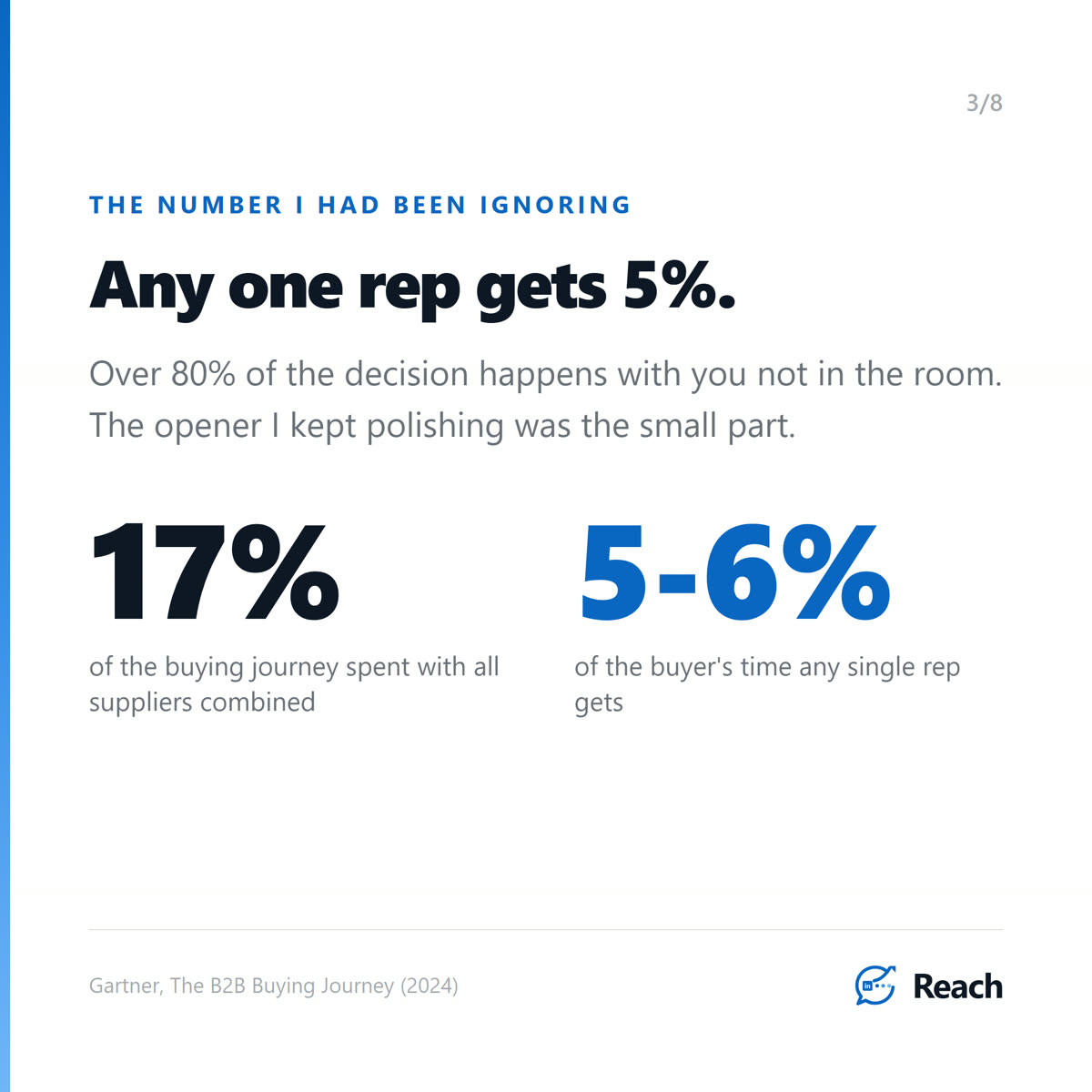
Gartner has been counting how B2B buyers actually spend a purchase. Buyers spend only 17% of the whole buying journey meeting with suppliers at all - and that 17% is split across every supplier they are considering. When you put multiple vendors side by side, any one sales rep gets about 5 to 6% of the buyer's time. The rest, north of 80%, happens with you not in the room. Independent research, talking to their own team, reading.
So sit with that. The opener I had been rewriting for months is 5% of the sale. Five percent. I was spending most of my effort on the smallest part of the thing.
And the other 95% - the part that actually decides it - is whatever they run into when I am not there. Which, for a small company, is mostly the content. It is the carousel that shows up in their feed. The blog they open on a Sunday. The video that plays while they scroll. That is the room the decision gets made in, and for a long time I was showing up to that room empty-handed and then obsessing over the doorbell.
What the content is actually doing
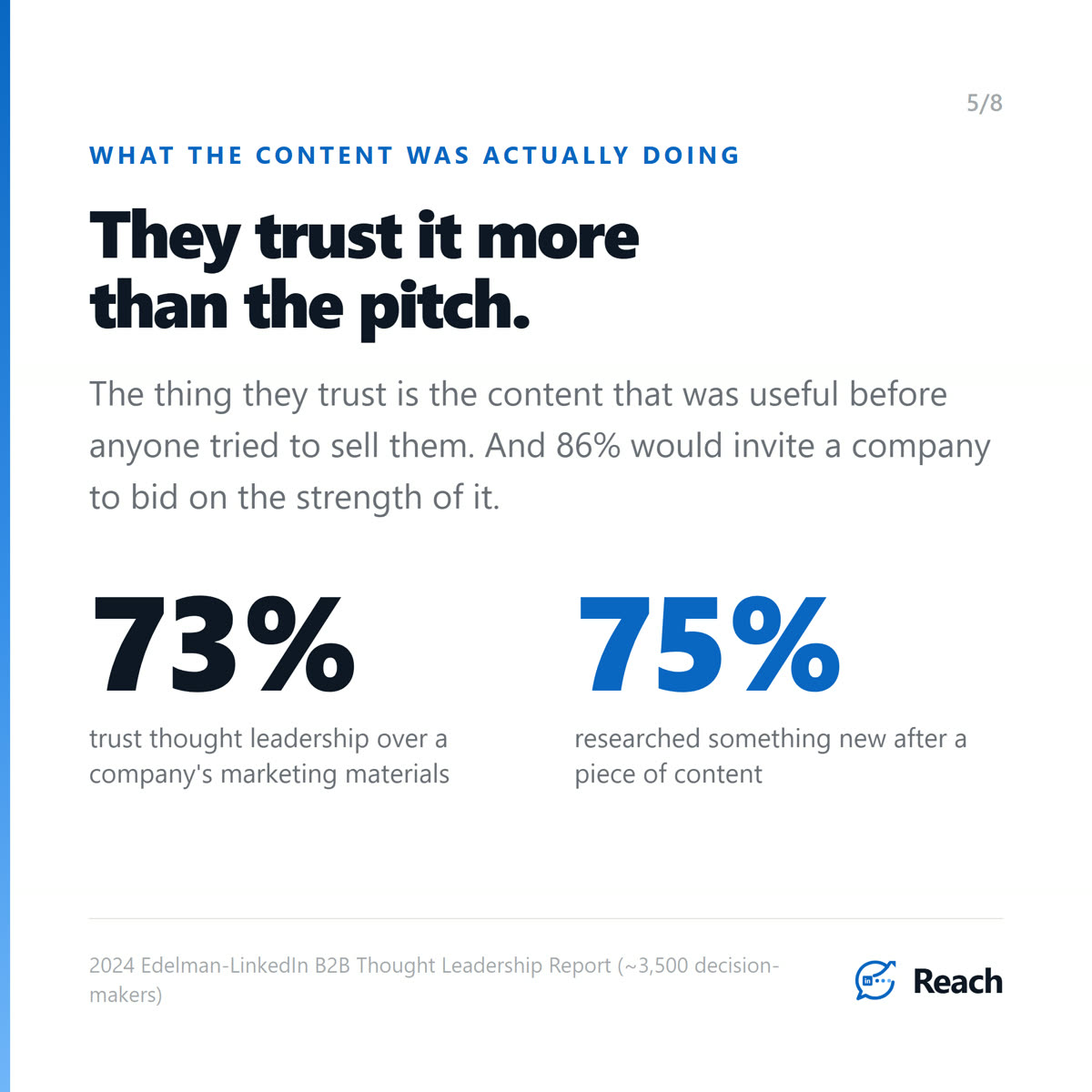
There is a big study Edelman and LinkedIn run every year on this, about 3,500 decision-makers. A few of the numbers land hard when you read them next to that 5%.
73% of decision-makers say a company's thought leadership is a more trustworthy way to judge what it can do than its own marketing materials and product sheets. So the thing they trust is not the pitch. It is the content that was useful to them before anyone tried to sell them.
75% say a piece of content prompted them to research a product or service they were not even considering before. That is the whole game for a small brand nobody has heard of. You do not get evaluated if you are not on the list, and the content is how you get on the list.
86% say they would be likely to invite a company to bid, or into an RFP, on the strength of its thought leadership. And of the people who went and researched a company because of its content, just under a quarter ended up doing business with it. That is not a soft brand metric. That is pipeline, arriving through the 95% instead of the 5%.
Read those the way I had to. The message was never carrying the weight I thought it was. The content was.
The order was backwards
I had it upside down. I was writing better and better cold messages into an empty room. Sharper opener, into a person who had never seen us, deciding in that moment whether we were worth a reply.
The order that actually works is the other way around. Post first. Pitch second. Publish the useful thing every day, so that by the time your message lands, you are not a stranger - you are the person whose carousel they half-remember. The message stops being a cold open. It becomes a reply to something they already read.
We changed almost nothing about the openers this month. What changed is that there was finally a trail of content sitting behind them - carousels, a blog, a video, going out steadily. And the campaign to the US pulled the best response we have seen in months. Same kind of message. Different because of what was already there when it arrived.
I want to be honest about the size of this. It is one campaign. The numbers are small and it is our own data, not a controlled test - I cannot prove the content is the single reason, and I would not. But the pattern lines up with the aggregate too cleanly to ignore, and there was one moment that was hard to argue with. A stranger quoted my own post back to me before I had said anything worth quoting.
That is the tell. When someone replies to your outreach using the words from your content, that is not your message landing. That is the content having already done the work, quietly, in the 95% of the time you were not in the room.
What I would tell the version of me from three months ago
Stop rewriting the first line. It is 5% of the sale.
Go make the thing they read when you are not there. Do it every day, keep it useful, keep it plain. Then send the message - the same message you were going to send anyway - into a room you have already been standing in for weeks.
The opener gets the credit because it is the part you can see. But the sale was mostly decided before you ever typed it. But yeah, nothing extraordinary otherwise. You just show up early, before anyone is ready to buy, and you keep showing up.
Sources
Every figure below was read from a page that was actually opened this run. The two primary sources (gartner.com and the edelman.com PDF) both returned HTTP 403 to the fetcher, so each figure was verified against two independent openable secondary sources that attribute it to the primary. No figure rests on a search summary.
Gartner — The B2B Buying Journey (2024)
- 17% of the total buying journey is spent meeting with potential suppliers at all, and that time is split across every supplier under consideration.
- 5-6% is what any single sales rep gets when the buyer is comparing multiple suppliers.
- Therefore ~80%+ of the decision happens without direct vendor involvement.
Verified via:
- https://brixongroup.com/en/the-modern-b2b-buying-journey-why-buyers-complete-80-of-their-journey-alone-and-how-you-can-still-remain-visible — "B2B buyers spend only 17% of their total buying time in direct contact with potential vendors - and this time is distributed among all considered providers"; attributed to a "recent Gartner study from 2024" (notes the self-directed share rose 57% in 2015 → 70% in 2019 → ~80% now).
- https://growthmethod.com/gartner-b2b-buying-journey/ — "When comparing multiple suppliers, they spend just 5-6% of their time with any one sales rep"; "B2B buyers spend only 17% of their total purchase journey meeting with potential suppliers."
- Primary (not openable, HTTP 403): https://www.gartner.com/en/sales/insights/b2b-buying-journey
2024 Edelman-LinkedIn B2B Thought Leadership Impact Report (~3,500 decision-makers)
- 73% say an organisation's thought leadership is a more trustworthy basis for assessing its capabilities than its marketing materials and product sheets.
- 75% say a piece of thought leadership prompted them to research a product or service they had not previously considered.
- 86% would be likely to invite a company to bid / into an RFP on the strength of its thought leadership.
- ~23% (just under a quarter) of those who researched a company because of its content then started doing business with it.
Verified via:
- https://columncontent.com/thought-leadership-statistics/ — 73% trust vs marketing materials; "75% of decision-makers said a compelling thought leadership piece prompted them to research a product or service they weren't originally considering"; 86% invite-to-bid; "~23% ultimately started doing business with that company."
- https://www.cremarc.com/thought-leadership/edelman-report-thought-leadership-content/ — "Just under a quarter of decision-makers attribute thought leadership to the reason why they began buying or partnering"; 86% would invite to an RFP.
- Primary (not openable, HTTP 403): https://www.edelman.com/sites/g/files/aatuss191/files/2024-02/2024%20Edelman-LinkedIn%20B2B%20Thought%20Leadership%20Impact%20Report%20Final.pdf
Dropped for lack of a verifiable source: a "90% more receptive to outreach" figure appeared in a search summary. cremarc.com, opened, does not contain it (only the 73% trust figure). Not used.
First-party (Linkenite)
- Team meeting transcript, 2026-08-12 (Google Drive, doc
1I7J2oBTQdkgiioLQ6zhVJmCtIxs3M2gqLH87admRXOc, Transcript tab). Faizan reports the US ERP-market campaign drew a very good response; his analysis is that prospects had read the posted content first ("that shows that they must have gone through whatever we are trying to advertise"), with prospects echoing content wording back. Pravin: "relatively speaking, a very good response for any campaign I have seen in recent months," and "I cannot say that only just one thing... combining all these things." - Reach
get_inbox, 2026-08-12: an inbound reply this week quoted the carousel's own phrasing nearly verbatim ("the intelligence layer you're developing sounds interesting, particularly the opportunity to reduce ERP and CRM costs"). The person and their company are deliberately not named in the story. - Reach
get_results, 2026-08-12: founder-story openers reply ~3x the corporate opener (46.9% n=286 and 51.8% n=222 vs 16.3% n=839 and 14.0% n=221). Directional, mostly hand-sent, reply counts include inbound-first threads.


.png)
.png)
.png)
.png)
.png)
.png)
.png)
.png)
.png)
.png)
.png)
.png)

.png)
.png)
.png)
.png)


.png)
.png)

.png)


.jpg)

.jpg)
.jpg)


.png)


.png)

.png)
.png)
.png)


.png)
%20(2).png)
.png)
.png)




.png)

.png)


.png)


.png)


.png)


%20BLOG%20BANNER.png)


.png)