
This morning my own team nearly went and bought phone numbers to cold-call strangers. I want to write that down before I talk myself out of how silly it was.
Here is how it happened, and it happens to everyone. Sales feels a bit thin. So you reach for the lever marked "more". A new region to campaign into. A phone-number subscription so someone can dial the US at a Boston number. Maybe a bigger list. It feels like progress because it is motion, and motion is the thing you can point at in a meeting.
We got as far as comparing calling services and which US area code sounds local before I stopped and actually looked at what was already sitting in front of us.
The number on the lever we were about to pull
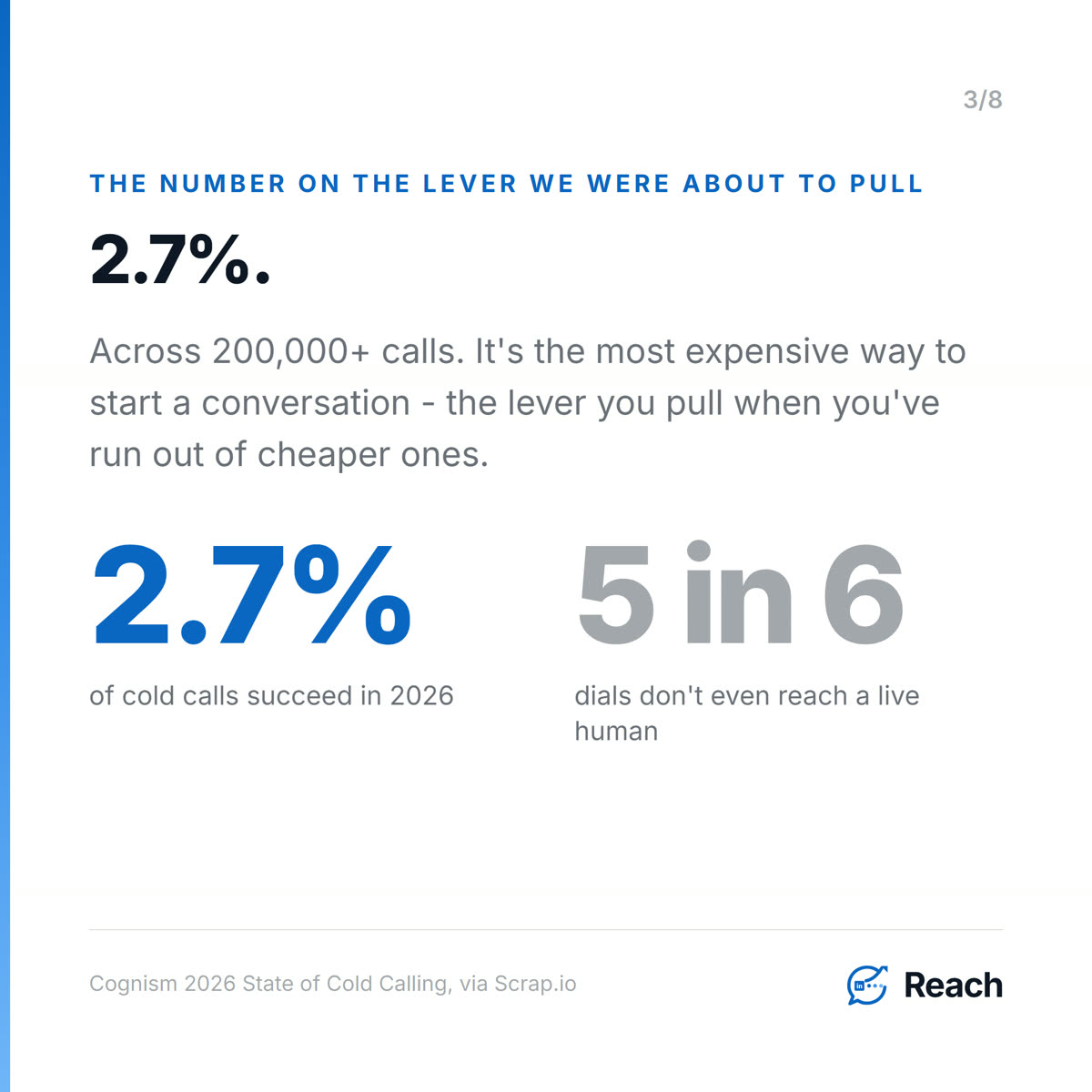
Cold calling is the hardest medium there is, and the data is not kind to it. Cognism looked at more than 200,000 cold calls and put the 2026 success rate at 2.7%. Their connect rate - the share of dials where a live human even picks up - was 16.6%. Five out of six calls are dead air, a voicemail, or someone hanging up before you finish your own name. One widely cited estimate from Baylor University research puts it at around 209 dials to land a single appointment.
I am not saying cold calling is dead. Plenty of good sellers make it work. I am saying it is the most expensive way to start a conversation, and you do it when you have run out of cheaper ways. We had not run out. We had not even started.
What was actually in the room
While we were pricing phone plans, there was a stack of people who had already replied to us. Some of them days ago. A few of them a week ago. People who had written back, asked a question, said "happy to connect", and then heard nothing from our side because we were busy going to find new ones.
That is the part that stung. You spend the effort to earn a reply, which is the whole hard part, and then you let it go cold so you can go earn a colder one from scratch. I said it out loud in the meeting and it sounded even worse out loud - if you get leads and then don't engage with them, you're just throwing away good discussions, so why bring more new ones in.
The LinkedIn campaigns were not broken. They were bringing people in. We were just not answering them. The follow-ups were dropping. The bottleneck was never the top of the funnel. It was us.
The math nobody runs before buying the phone plan
Put the two channels next to each other and it is not close.
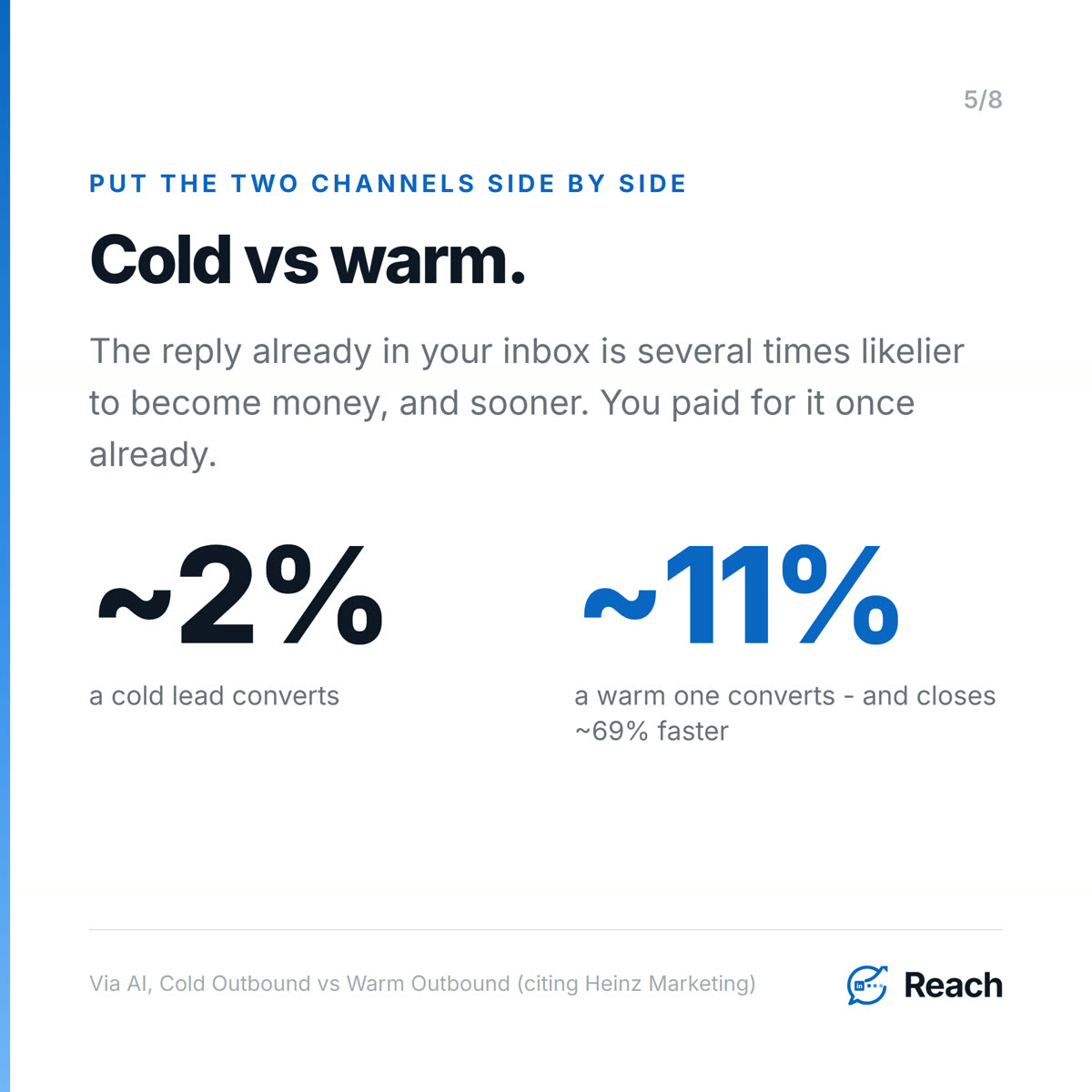
A cold lead converts somewhere around 0.2% to 2%, depending on whose benchmark you trust. A warm one - someone who already raised a hand - converts about 11%. That is the highest lead-to-customer rate of any channel anyone measures. And it closes faster. B2B teams working referrals and warm intros report close times roughly 69% shorter than cold.
So the reply already sitting in your inbox is not just easier to reach than the stranger you were about to dial. It is several times more likely to become money, and it becomes money sooner. It is the cheapest lead you will ever get, and it is already yours. You paid for it once. Ignoring it means paying again, at a worse rate, for a worse lead.
Why we still reach for "more" anyway
Because generating feels like building and answering feels like admin. A new campaign is a fresh start with no awkward history. A four-day-old reply you never answered is a small guilt you would rather not open. So the guilt pile grows and the new-lead machine keeps running, and you end up with two failures at once - the strangers you can't reach, and the warm people you had and lost.
There is also a measurement trick playing on you. New leads are a number that goes up, and it is satisfying to watch it go up. Whether any of them convert is a number almost nobody records, so the funnel looks healthy right up until the month ends and nothing closed. We had exactly this - a growing pile of replies and, until very recently, no honest count of what any of them turned into.
What would have worked, and what we are doing instead
The order was backwards. Engage before you generate. Work every warm reply you already have to a yes or a clean no, and only then go looking for new ones. Cold calling is a real lever, but it is the last one you pull, not the first, and you only pull it once the warm pipeline is genuinely empty. It is rarely as empty as it feels on a slow morning.
So we cancelled the phone-number errand. Instead, every warm conversation gets answered before anyone starts a new campaign. New leads still come - the campaigns keep running - but they go to the back of the line behind the people who already replied. And we finally started writing down what each conversation actually turns into, because a pipeline you can't measure is a pipeline you will keep mis-spending on.
This is not a clever growth hack. It is just doing the boring thing first. The network you already have - the people connected to you, and especially the ones who already wrote back - is almost always bigger and warmer than the pipeline you are about to go build from strangers. That is the entire idea behind the tool we make. Reach reads the network and the replies you already have and works them one by one, so the warm ones never sit for four days while you go price phone plans.
But you do not need our tool to do the first part. Open your own inbox. Count the replies you have not answered. That is your pipeline. It was there the whole time.
Sources
Every figure below was traced to a page I opened, not to a search summary.
External (opened and verified)
- Cognism, 2026 State of Cold Calling — reported via Scrap.io, "Cold Calling Success Rate" (analysis of 200,000+ cold calls). https://scrap.io/cold-calling-success-rate - Cold-call success rate 2026: 2.7% (up from 2.3% in 2025; top performers 11.3%). - Connect rate 16.6% — "Five out of six calls" reach no live human (dead air, voicemail, or a hang-up). Used in the deck as "5 in 6 dials don't reach a live human". - ~1.55 dials to reach someone on average. - "About 209 cold calls per appointment" attributed to Baylor University research — used in the case only as "one widely cited estimate", hedged.
- Via AI (connectvia.ai), "Cold Outbound vs. Warm Outbound" — opened. https://www.connectvia.ai/resources/answers/cold-outbound-vs-warm-outbound/ - Cold outbound reply rate "3.43% average, down from 5.1% the prior year". - "Only 2% of cold calls result in an appointment." - "Referral leads convert at 11%" vs "0.2-2% for cold lead sources" — described as the highest lead-to-customer rate of any channel. Used as "~2% cold vs ~11% warm". - "B2B companies with referrals report a 71% higher conversion rate and 69% faster close time" (attributed on the page to Heinz Marketing). Used as "closes ~69% faster".
First-party (my own account and team)
- Linkenite team meeting, 2026-08-11 (transcript). The team compared cold-calling services and US area codes (a "Hushed" phone-number subscription) to dial US leads, while multiple warm LinkedIn threads sat unanswered for days. The decision reached was to engage existing leads before generating new ones - cold calling described by Pravin as "a difficult medium" and a last resort, with the LinkedIn campaigns "bringing in leads and we are just not engaging with them" and "the follow-ups... dropping". Not a controlled test; used as the narrative spine and labelled as my own admission.
- Reach account data (2026-08-11). Account state shows a large backlog of replied threads awaiting a response, and the inbox lists warm inbound conversations days old. Used qualitatively ("a stack of people had already replied", "some days ago, a few a week ago"); no exact internal count is published in the post or slides.
Not used / guarded against
- No real company is named as struggling. The only company admitted to reaching for the wrong lever is Linkenite itself (first-party, permitted).
- HubSpot was mentioned in the meeting as a pricing-strategy example; not referenced here.
- No price appears anywhere in the deck, captions, or post.


.png)
.png)
.png)
.png)
.png)
.png)
.png)
.png)
.png)
.png)
.png)
.png)

.png)
.png)
.png)
.png)


.png)
.png)

.png)


.jpg)

.jpg)
.jpg)


.png)


.png)

.png)
.png)
.png)


.png)
%20(2).png)
.png)
.png)




.png)

.png)


.png)


.png)


.png)


%20BLOG%20BANNER.png)


.png)