
I sell a tool that sends LinkedIn messages. So this is a bit awkward to write.
This week I opened my own LinkedIn inbox and actually read it, top to bottom. Of the last thirty conversations sitting there, more than a dozen were from people I have never spoken to, and every one of them was selling me something. A productivity suite offering me a free trial and telling me to invite a hundred colleagues. A headhunter. An offshore-staffing service following up on a message I never answered. And my favourite - someone inviting me to join a small pilot of an AI system that would write and send my LinkedIn outreach for me.
I run a company that does exactly that. I got cold-pitched my own category, by a machine, in my own inbox. So I am not throwing stones here. I am one of the people filling everyone else's inbox too.
But it made something click. For about two years the whole industry told the same story - put an AI on your outreach, send ten times more, let it run. Everybody bought it, me included. And now every inbox on LinkedIn looks like mine. The question worth asking is not whether the AI works. It is what happens to a channel when everyone points the same machine at it in the same eighteen months.
What the machines did to the numbers
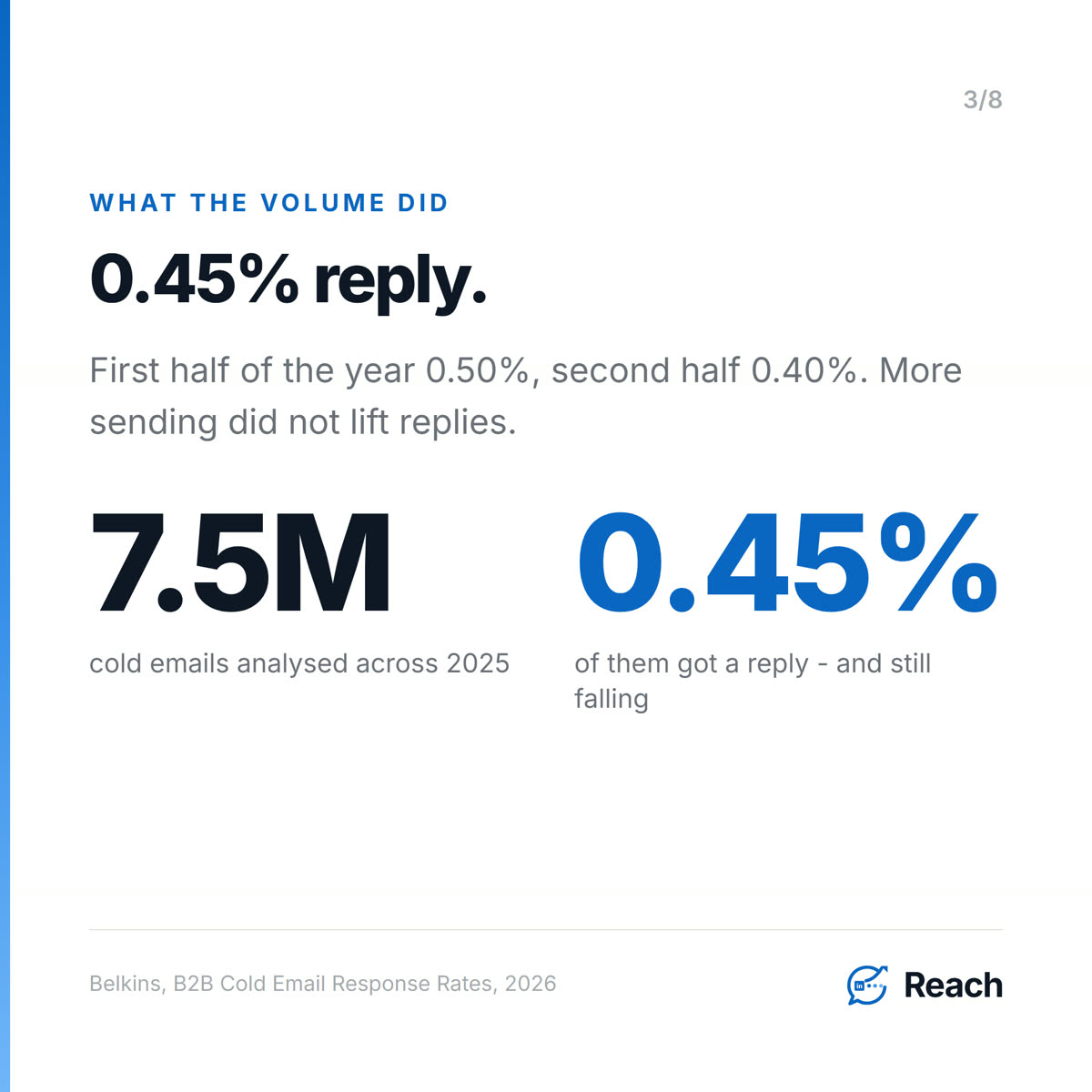
Belkins looked at 7.5 million cold emails sent across 2025 and counted 34,393 replies. That is a reply rate of 0.45%. Not four and a half percent. Zero point four five. And it was still falling inside the year - the first half of 2025 averaged 0.50%, the second half 0.40%. They changed how they measure it too, replies divided by everything sent, because open rates stopped being trustworthy.
Email is not LinkedIn, and I want to be honest about that. But the direction is the same everywhere, and the reason is the same. Apollo, who sell the sending tools, put it plainly in their own 2026 write-up - generic outreach is increasingly punished by buyers. Their own realistic target for a well-run campaign is 3 to 5% reply. When the people selling the sending admit the sending mostly gets ignored, that is the tell.
Here is the part that surprised me. The machines did not just fail to help. They taught buyers a shape. People now recognise the automated message on sight - the fake first-name warmth, the "I noticed you're doing great work at," the single call to action, the follow-up that says "just bumping this to the top of your inbox." Once a buyer can pattern-match the shape, they stop reading before they finish the first line. The volume did not lift the reply rate. The volume trained the market to filter.
My own account says the same thing, louder
I do not have to guess at this. I have my own numbers, from my own LinkedIn, and they are blunt.
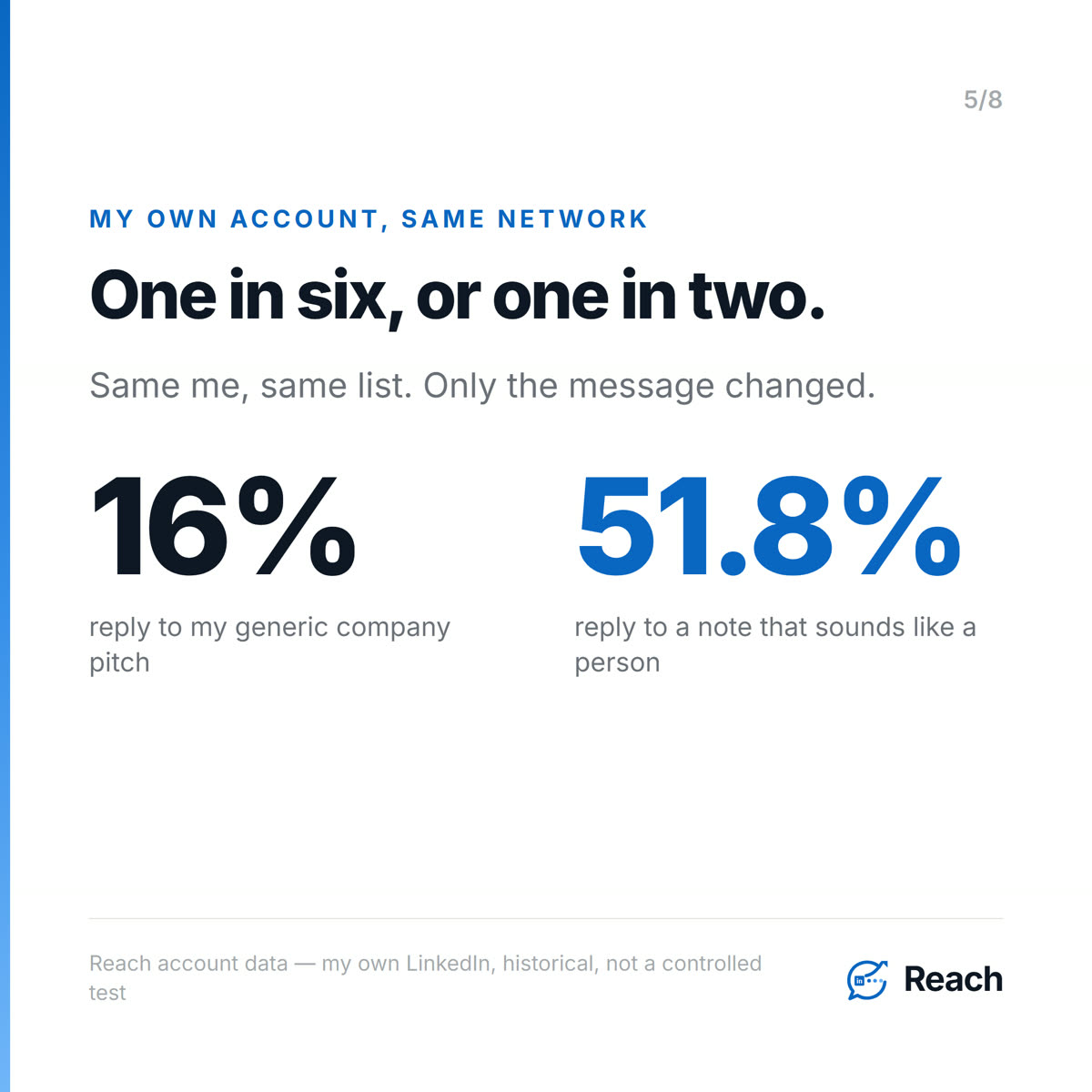
The generic company opener - the "We at Linkenite specialize in custom AI solutions to enhance business efficiency" one - has gone out to more than a thousand people across two versions of it. It replies about 14 to 16% of the time. That is actually better than the cold-email benchmarks above, because these are people I am already connected to. But look what happens when the message stops sounding like a machine.
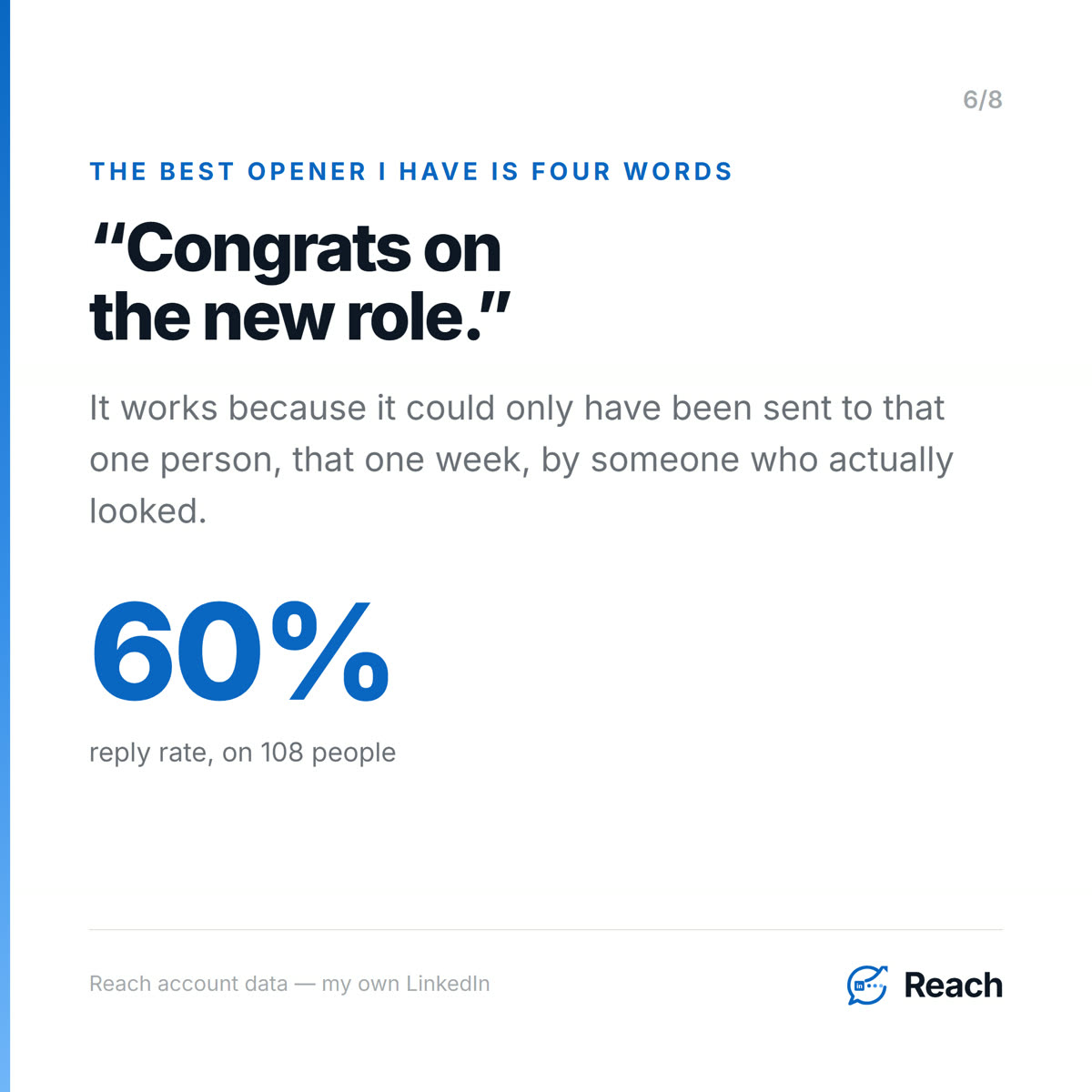
A short note that just says who I am - "I'm Pravin, a scientist turned entrepreneur" - replies 51.8% of the time, on 222 people. And the single best-performing opener in my whole account is four words. "Congrats on the new role." Sixty percent reply. It works because it could only have been sent to that one person, on that one week, by someone who actually looked.
Same network. Same me. The only thing that changed is whether the message reads like it was written for one human. The generic pitch gets one reply in six. The human note gets one in two. That gap is the entire story, and no amount of send volume closes it. It makes it worse.
So what actually broke
It is tempting to say AI broke outreach. That is too easy, and I do not believe it. The AI is fine. What broke is undifferentiated volume to strangers - the same templated shape, pointed at people who never asked and were never known, all at once, until the shape itself became a spam signal.
Two things did not break, and they are the two things worth keeping.
One - a message that could only have been written to that one person still works. Not because it is clever. Because it proves a human spent thirty seconds. That is the whole trick, and a machine can help you do it as long as a human is still the one deciding it is true before it sends.
Two - the people who already know you are a different channel entirely. My generic pitch to strangers replies at one in six. My warm connections, written to like humans, reply at one in two. Most people with a few thousand connections have never once gone back through that list. They spend their weekly limit inviting new strangers and leave the warm network sitting there, which is the one asset the machines cannot flood, because it is yours.
Where this leaves a tool like mine
I am not going to pretend the answer is to stop using software. I use mine every day, and I like it. But the backlash taught me what the software is allowed to do and what it is not.
It is allowed to remember who you know, sort your inbox by who is actually waiting on you, and draft the next line from what the person actually said. It is not allowed to decide, on its own, that the line is good enough to send to a stranger a thousand times. The moment it does that at volume, it is just adding to the pile I read this week.
So the rule we build on is small and a bit boring. A human approves every message before it goes. It runs in your own browser, on your own network, nobody hands their password to a server. And it points at the people who already know you first, not at the coldest list you can buy.
Nothing extraordinary. It is mostly just refusing to do the thing that filled my inbox this week.
The honest test is the one I ran on myself. Open your own inbox and read it like a stranger sent it. Count how many you would answer. Then ask whether the outreach going out under your name would survive the same read.
Sources
Every figure below was traced to a document that was opened and read, not to a search summary. Two summary claims were checked and discarded as fabricated - see the note at the bottom. This is the exact failure mode CONTENT-TREE §7 warns about.
External, verified
- Belkins — B2B Cold Email Response Rates (2026 study of 2025 data) https://belkins.io/blog/cold-email-response-rates - Sample: 7.5 million cold emails sent across 2025, 34,393 tracked replies. - Average reply rate 0.45%. First half of 2025 averaged 0.50%, second half 0.40% (a ~20% drop inside the year). - Methodology: replies divided by total emails sent (they moved off open-rate-based math, citing unreliable open tracking). - Used on: slide 3, the case, script, post. This is email, not LinkedIn - stated plainly as such everywhere it appears.
- Apollo — What's the Expected Reply Rate for a Well-Run Outbound Cold Email Campaign (2026) https://www.apollo.io/insights/whats-the-expected-reply-rate-for-a-well-run-outbound-cold-email-campaign - Well-run campaign realistic baseline: 3-5% reply; top quartile 8-12%. - Direct quote used: "generic outreach is increasingly punished by buyers." - Apollo sells sending tools, so this is a vendor conceding the point - noted as such in the case. - Used on: the case ("when the people selling the sending admit the sending mostly gets ignored").
First-party — my own Reach / LinkedIn account (read this run)
get_resultsbyOpeningLine, 2026-08-10. Same LinkedIn identity, historical, mostly hand-sent, not a controlled test. Said so wherever cited. - Generic "We at Linkenite specialize in custom AI solutions to enhance business efficiency" opener: 14.0% reply on 221 people and 16.3% on 839 (≈1,060 total, "one in six"). - "I'm Pravin, a scientist turned entrepreneur leading Linkenite in automation": 46.9% on 286; the closely-related "I'm Pravin, CEO of Linkenite (SalesLink). Starting as a space scientist": 51.8% on 222. Cited the 51.8% / n=222 figure ("one in two"). - "Congrats on the new role!": 60.2% reply on 108 people. Cited as "60%, four words."
get_inbox, 2026-08-10 (30 most-recent threads). The lived observation behind the hook: of the last thirty conversations, more than a dozen were inbound-first cold pitches from people never previously spoken to - a productivity-suite free-trial blast, a headhunter, an offshore-staffing follow-up, and an invitation to pilot an AI LinkedIn-outreach system. No sender or company is named in any asset (company-example rule). Described only as an aggregate pattern of what landed in my own inbox.
Discarded — search summaries that fabricated figures (checked, not used)
- A summary claimed Belkins "analysed 16.5 million cold emails" and reply rates "fell 15% in a single year." The opened page says 7.5 million and a 0.50%→0.40% intra-year move. The 16.5M / 15% figures do not appear on the page. Not used.
- A summary attributed to a "Bain Capital Ventures, April 2026" statement that autonomous AI SDRs "have not replaced human sales teams," plus a "79% adopted / 5% highly effective" adoption stat. Opening the contrarian source that supposedly carried them showed neither appears there - it cites unrelated deliverability and cohort data. Both claims dropped.


.png)
.png)
.png)
.png)
.png)
.png)
.png)
.png)
.png)
.png)
.png)
.png)

.png)
.png)
.png)
.png)


.png)
.png)

.png)


.jpg)

.jpg)
.jpg)


.png)


.png)

.png)
.png)
.png)


.png)
%20(2).png)
.png)
.png)




.png)

.png)


.png)


.png)


.png)


%20BLOG%20BANNER.png)


.png)