
I went through my LinkedIn inbox this morning and counted. There are messages in there from people who already said yes - happy to connect, nice to meet you, let's talk - that I have not answered in more than two weeks.
Not strangers. People who wrote back. Some of them warm, a few of them the exact kind of person the whole outreach effort was for. And they are sitting there, waiting on me, going cold one day at a time.
The part everybody optimises is not the part that hurts
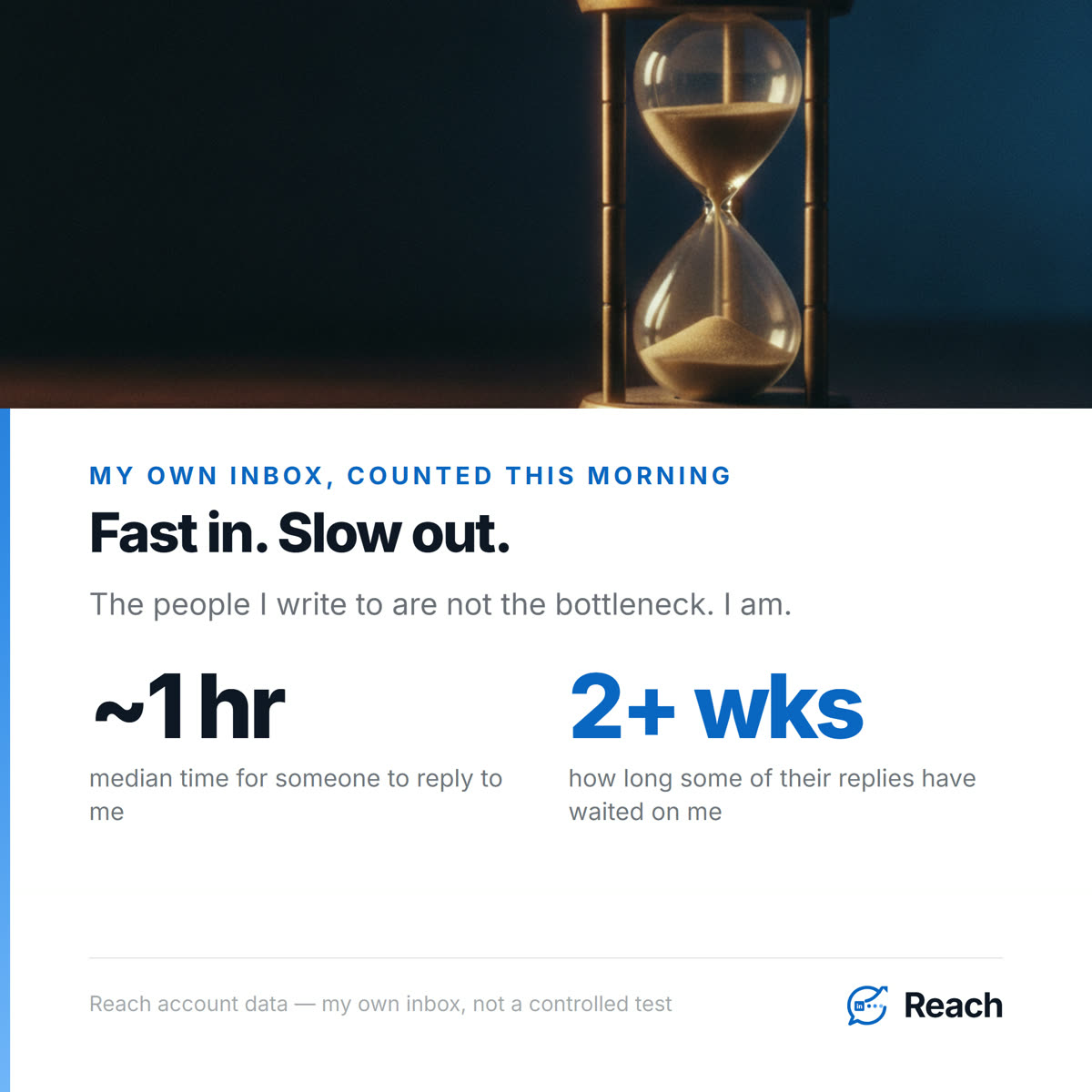
Every guide about LinkedIn outreach is about the top of the funnel. The opener. The connection note. How to get a reply. And that part, honestly, works fine. The people I reach out to write back, and they write back fast. The median time for someone to reply to me is about an hour.
An hour. And then the message lands in a pile with forty others, and it waits on the one part of the system that does not scale - me.
So here is the asymmetry that actually costs money. They answer in an hour. I answer in a week, when I answer at all. The reply was never the hard part. What happens after the reply is where the deal quietly dies.
Someone measured what slow does
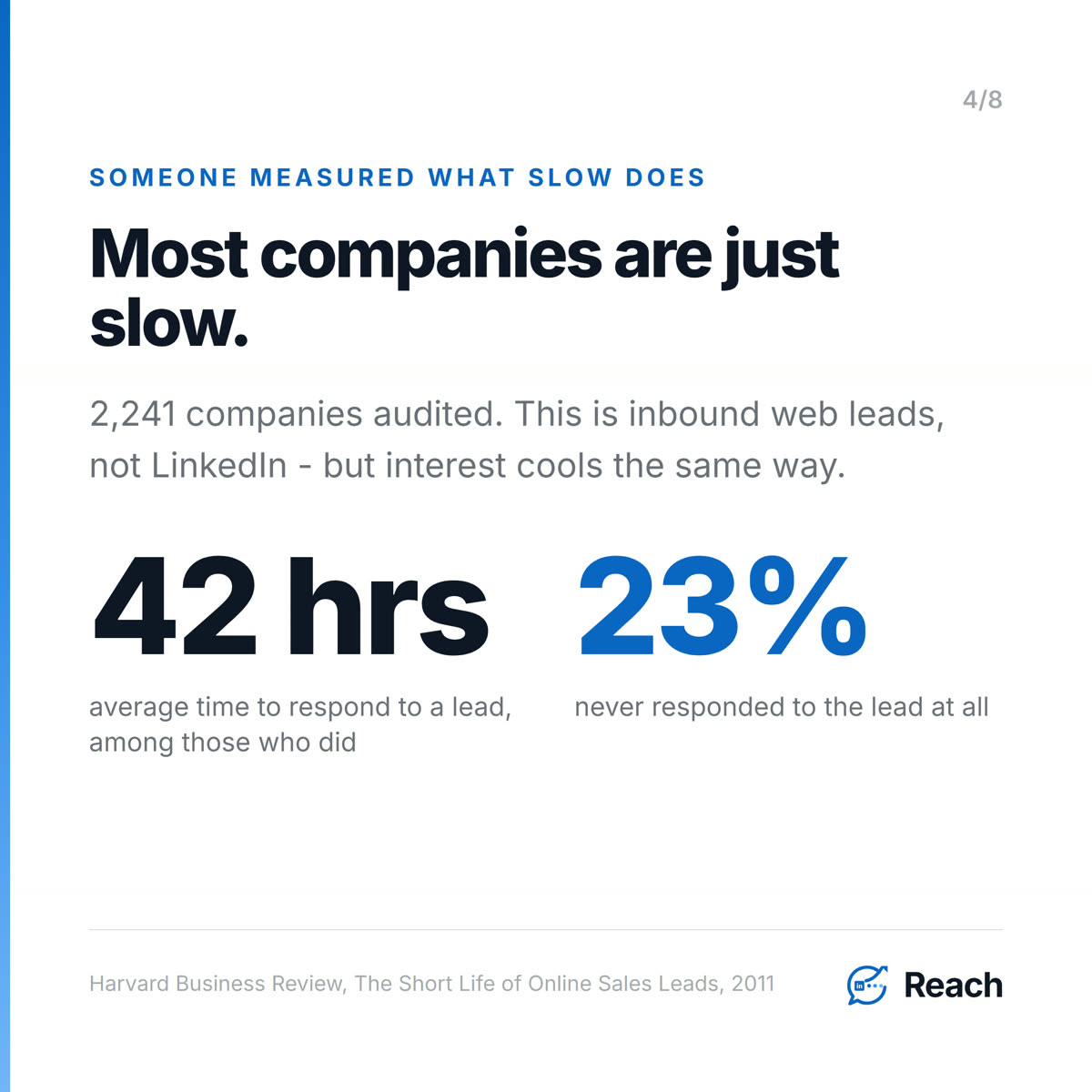
This is not just my bad week. There is a study I keep coming back to, from Harvard Business Review, called "The Short Life of Online Sales Leads." They audited 2,241 companies to see how long each took to respond to a lead. 23% of them never responded at all. The average time to respond, among the ones that did, was 42 hours.
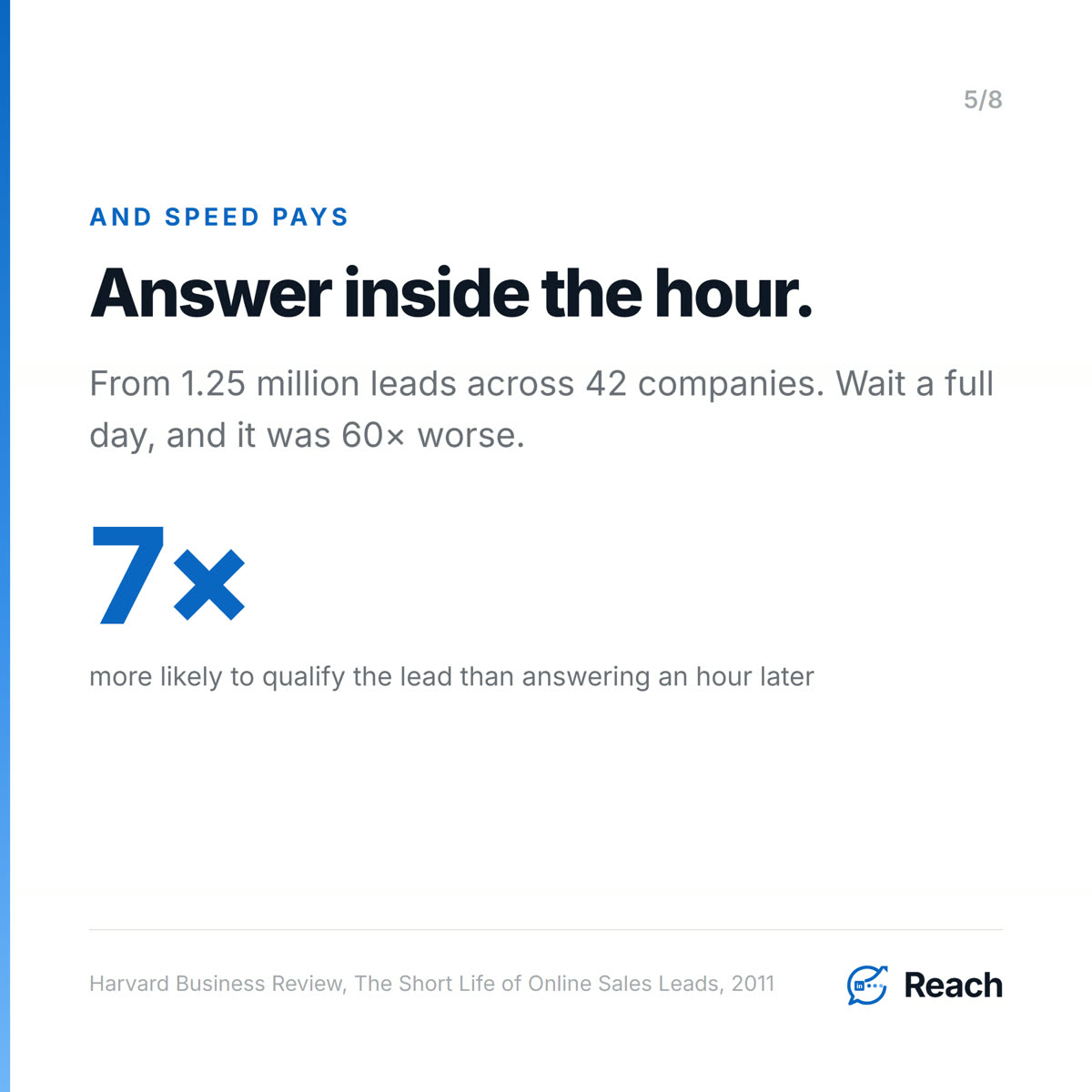
Then a second study, 1.25 million leads across 42 companies. Firms that made contact inside the first hour were nearly seven times more likely to have a real conversation with a decision maker than the ones that waited even an hour longer. Wait a full day and it was more than sixty times worse.
I want to be honest about what that data is. It is inbound web leads, people filling in a form, not someone replying to a LinkedIn message. It is from 2011. So I am not going to pretend it is a controlled study of my exact situation. But the thing underneath it is the same thing I am looking at in my inbox. Interest has a short shelf life. A yes that waits turns into a no, and nobody sends you a notification when it happens. It just goes quiet.
The wrong lesson to take from this
The easy read is "reply faster." Reply in five minutes. Reply in thirty seconds. Set up an auto-responder.
That is the wrong lesson, and I have watched it backfire. A reply that comes back in nine seconds is its own tell. Nobody believes a real person read your message, thought about it, and answered that fast. The moment someone smells an auto-reply, the whole thing is dead in a different way. You did not lose them by being slow. You lost them by being obviously a machine.
So the target is not zero. The target is a human window. Same day, a few hours, a reply that reads like a person actually wrote it - because a person did. The enemy is not the missing thirty seconds. The enemy is the two-week silence.
Why the silence happens
It is not laziness, and it is not that anyone stopped caring. It is arithmetic. One person, a fixed number of hours in a day, and a pile of replies that all look the same in the inbox. A "thanks" and a "let's book a call for next week" sit next to each other with the same little unread dot. There is no order to it.
So what happens is you answer the loudest thread, the one from this morning, the one from the person who followed up twice. And the quiet, warm, genuinely-worth-it reply from eleven days ago slides down the list and out of your head. Being a bit honest with ourselves, that is how it goes for most of us. The system rewards whoever shouted last, not whoever mattered most.
What would have actually helped
Not more replies coming in. I have plenty of those. What I needed was something sitting on top of the inbox doing three unglamorous things.
Telling me who actually replied and how long they have been waiting, so the warmest thread is not buried under a "thanks." Reading what they said and drafting the next line in my voice, so I am editing a sentence instead of staring at a blank box at eleven at night. And then holding it until I approve it, so nothing goes out that I would not have sent myself.
That is what we built Reach to do. It runs in your own browser, so nobody takes your LinkedIn password and nothing is driven from some server pretending to be you. It sorts your inbox by who is actually waiting on you. It drafts the follow up from what the person said, one at a time, in your voice. And you approve every message before it sends, at a human hour, not a robot one.
The point is not speed for its own sake. The point is that the follow-through stops depending on whether I had a good week. The yes does not get to rot on the vine just because Tuesday got busy.
I still think the opener matters. But I have stopped believing it is the hard part. The hard part is the eleven-day-old reply from someone who said yes, that I never got back to. Fix that and you are not working any harder. You are just not throwing away the people who already put their hand up.
But yeah - nothing extraordinary otherwise. It just means when someone answers in an hour, they do not have to wait a week to hear back.
Sources
Primary — aggregate anchor (opened and verified verbatim)
Harvard Business Review — "The Short Life of Online Sales Leads" James B. Oldroyd, Kristina McElheran, David Elkington. March 2011. https://hbr.org/2011/03/the-short-life-of-online-sales-leads
Opened via the archived full-text PDF and extracted with pdftotext, not read from a search summary. Verbatim figures used in the deck and post:
- "We audited 2,241 U.S. companies, measuring how long each took to respond to a web-generated test lead. Although 37% responded to their lead within an hour, and 16% responded within one to 24 hours, 24% took more than 24 hours - and 23% of the companies never responded at all. The average response time, among companies that responded within 30 days, was 42 hours."
- "...a separate study, which involved 1.25 million sales leads received by 29 B2C and 13 B2B companies in the U.S. Firms that tried to contact potential customers within an hour of receiving a query were nearly seven times as likely to qualify the lead (which we defined as having a meaningful conversation with a key decision maker) as those that tried to contact the customer even an hour later - and more than 60 times as likely as companies that waited 24 hours or longer."
29 + 13 = 42 companies. Every number on the stat slides (42 hrs, 23%, 7×, 60×, 2,241, 1.25m) traces to those two sentences.
Stated limit, on the slide and in the case: this is inbound web-form leads, not replies to LinkedIn outreach, and it is from 2011. Used by analogy for the half-life of expressed interest, not as a controlled measurement of the LinkedIn case. If challenged, concede the analogy immediately - the argument stands on the first-party inbox data without it.
Primary — first-party (my own account)
Reach account data, read live this run:
get_results→ overallmedianHoursToReply= 1.1 (rounded to "about an hour" in public copy). This is how fast prospects reply to the account.get_inbox→ a live pile of threads withneedsReply: trueandhoursWaitingrunning from under an hour up to 403 hours (≈17 days). Multiple threads over 336h (14 days). This is the "2+ weeks" figure - it is literally sitting in the inbox, read this morning.
Presented as an asymmetry (fast in, slow out), not as a rate. The outreach volume (contacted / reply-rate denominators) is deliberately kept out of public copy - it is not the point, and publishing it advertises scale for no reason. Caveated in copy as "my own inbox, not a controlled test."
Product claims (Reach)
Grounded in the account offering and prior vetted story copy: runs in the user's own browser, no password shared, nothing driven from a server, a human approves every message, sorts the inbox by who replied, drafts the follow-up in the user's voice. No guaranteed-volume or ban-proof claim is made.
No company named as struggling
None. My own inbox is described as a pattern, nobody named. HBR is a cited source. Reach / Linkenite is our own product.


.png)
.png)
.png)
.png)
.png)
.png)
.png)
.png)
.png)
.png)
.png)
.png)

.png)
.png)
.png)
.png)


.png)
.png)

.png)


.jpg)

.jpg)
.jpg)


.png)


.png)

.png)
.png)
.png)


.png)
%20(2).png)
.png)
.png)




.png)

.png)


.png)


.png)


.png)


%20BLOG%20BANNER.png)


.png)